Théâtre national de Chaillot is one of the six French national theaters. It is located in the Palais de Chaillot at 1, place du Trocadéro in Paris and has the legal status of a public industrial and commercial establishment. Built in 1937 by the frères Niermans, it became a symbolic place of popular theater associated with Jean Vilar and Antoine Vitez. Affiliated with the TNP until 1972, it underwent a complete interior renovation between 1973 and 1975 by architects Valentin Fabre and Jean Perrottet. Declared a national theater in 1975, it later housed a theater school that closed in 2006. The building contains three rooms: the salle Jean-Vilar, the salle Gémier, and the studio Maurice-Béjart, intended for smaller-scale performances. In the 1990s and 2000s, it also became associated with contemporary dance, including the creation of the bal moderne and the direction of a choreographic center.
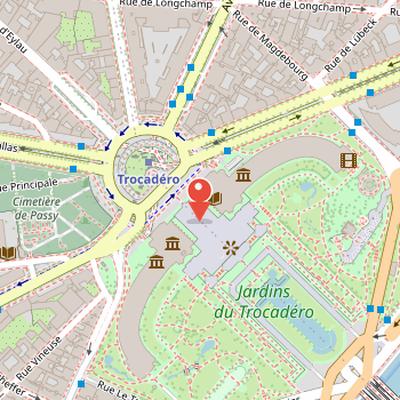
Nearby Objects
-
 Chaillot Palace 10 m away
 -
 Musée de l’Homme 60 m away
 -
 Cité de l'architecture et du patrimoine 60 m away
 -
 Place du Trocadéro 110 m away
 -
 Jardins du Trocadéro 150 m away
Location and Status
Theatre national de Chaillot is one of the six French national theaters. It is located in the Palais de Chaillot at 1, place du Trocadero in Paris. The institution has the legal status of a public industrial and commercial establishment.
History and Performance Spaces
The Theatre de Chaillot was built in 1937 by the brothers Niermans and became a symbolic place for popular theater, associated with Jean Vilar and Antoine Vitez. It remained affiliated with the TNP until 1972. Its interior was then completely renovated between 1973 and 1975 by the architects Valentin Fabre and Jean Perrottet, who had also worked on the renovations of the Theatre de la Ville in 1967 and 1968. In 1975, the Theatre de Chaillot was declared a national theater.
The building includes three rooms: the salle Jean-Vilar with 1250 seats, the salle Gemier with 420 seats, and the studio Maurice-Bejart with 80 seats. The studio Maurice-Bejart is intended for smaller scale performances and is described as the experiences room. The theatre also housed a theater school, which closed in 2006.
The venue later developed a strong link with contemporary dance. Michel Reilhac created the bal moderne there in 1993 during the Festival Paris quartier d'ete, inviting novices to learn mini-choreographies by renowned dance figures. Dominique Hervieu and Jose Montalvo later took over direction of the new choreographic center, whose mission prioritizes the promotion of contemporary dance over the history of the theatre. Under this framework, Chaillot specializes in contemporary French choreographers from the Nouvelle danse francaise of the 1980s, while Theatre de la Ville is focused on an international contemporary dance program. In this context, Christine Albanel decided to create competition or synergy between the two institutions, and Frédéric Mitterrand later announced Didier Deschamps as head of Theatre national de Chaillot from 2010. Dominique Hervieu left to direct the Biennale de la danse de Lyon and Maison de la danse de Lyon, while Jose Montalvo remained part of the management team.
The Journey of L'ame et la Danse
The history of L'ame et la Danse is marked by several relocations before its installation at the Theatre national de Chaillot. The statue was moved to the molding workshops in 1964 during the creation of Bar Bleu. In 1981, Duchamp requested it for salle Pleyel, and Hubert Martigny removed it during renovations in 2004. When palais de Chaillot refused to reclaim the statue and invited salle Pleyel to keep it, it was stored in the reserves of the Centre national des arts plastiques in Saint-Ouen-l'Aumone. In summer 2017, it was installed on the landing facing the cloakroom at theatre de Chaillot.