The Jardins du Trocadéro are an urban park in Paris, facing the Seine and bordered by the palais de Chaillot. They were created for the 1937 Exposition spécialisée on the site of the former garden of the palais du Trocadéro, which had been designed by Adolphe Alphand for the 1878 Exposition universelle. The site also has a longer historical background, as it lies on the former domain of the Visitandines convent of Chaillot and on a small part of the Minimes convent domain to the southwest. In the late 18th century, the area was shaped by the wall of the Fermiers généraux and later by the closure of the convents in 1790. Over time, the site became associated with plans and commemorations linked to the Trocadéro battle, even though several proposed projects for the hill were never realized. The gardens therefore combine a modern exhibition setting with a location marked by earlier urban and historical layers.
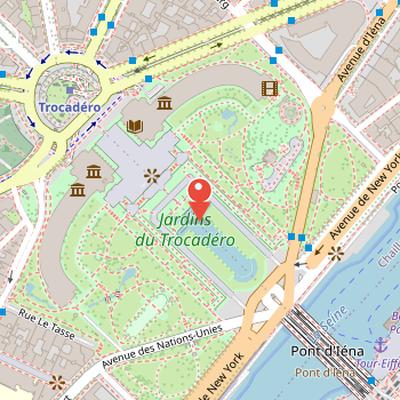
Nearby Objects
-
Théâtre national de Chaillot 150 m away
-
 Chaillot Palace 160 m away
 -
 Cité de l'architecture et du patrimoine 200 m away
 -
 Musée de l’Homme 200 m away
 -
 Place du Trocadéro 250 m away
Location and Origins
Les jardins du Trocadero are located in Paris, facing the Seine and bordered by the palais de Chaillot. They were created for the 1937 Exposition specialisee on the site of the former garden of the palais du Trocadero. That earlier garden had been designed by Adolphe Alphand for the 1878 Exposition universelle.
History of the Trocadero Gardens Site
The gardens of Trocadero stand on the former domain of the Visitandines convent of Chaillot, and also cover a small part of the domain of the Minimes convent of Chaillot to the southwest. In 1787, the wall of the Fermiers generaux bordered the dividing wall between the two convents near the site. From 1790, the Minimes convent was outside the City of Paris, on the territory of the former village, then commune, of Passy. Both the Visitandines and Minimes convents were closed in 1790. The Visitandines convent buildings were destroyed by an explosion in 1794, and its lands were sold as national assets to private owners. Between 1811 and 1813, the State acquired the former Visitandines lands for the abandoned King of Rome palace project. The King of Rome palace project and the Iena bridge, built between 1804 and 1813, define the site as a solemn location. The site also lies on an axis beginning at the Ecole militaire on the left bank.
Early Commemorative Projects at Chaillot
In 1824, the Restoration monarchy commissioned architect Antoine-Marie Peyre to design an ensemble of Roman-influenced houses around a large fountain topped by an obelisk commemorating the Trocadero battle. The project referred to the battle in which French expeditionary forces took the fort and restored King Ferdinand VII, but the ensemble was not realized. The memory of the event continued to be associated with the site: in 1826, a spectacle reenacting the battle was held, with the Chaillot hill representing the fort. By metonymy, the Chaillot site, including the square arranged in 1869 and the gardens below, came to refer to the Trocadero battle. Over the following decades, several unrealized proposals sought to crown the hill, including a mausoleum on Napoleon's tomb by Antoine Ettex in 1841, a monumental statue of Napoleon by Hector Moreau in 1841, a people's palace in 1848, and a triumphal arch designed by Gabriel Davioud in 1856.
Formation of the Trocadero Site
The Historique site remained a wasteland crossed by several roads, including rue des Batailles, which ran parallel to the Seine between barriere Franklin and the Chaillot neighborhood. An avenue from the Iena bridge formed a T with rue des Batailles at the site, while the avenue de la rampe, with two symmetrical lanes, ascended the hill and joined an avenue in the middle of the present place du Trocadero. In the early 1860s, a wide avenue linking rue Delessert to avenue d'Iena was built closer to the Seine than rue des Batailles and was bordered by lawns. These changes were part of a broader reorganization of the area after the octroi wall was moved to the Thiers enclosure in 1860, and after the wall of the fermiers generaux and the old octroi barriers, including barriere Franklin and barriere des Batailles, were destroyed. Barriere Sainte-Marie had already been closed in 1845 at the location of the square de Yorktown, and the new barriere de Sainte-Marie was later placed at the outlet of avenue d'Eylau on place du Trocadero. Land acquisitions by the State in 1811-1813 and earthworks in the 1860s enabled the construction of the palais du Trocadero on the Chaillot hill. The top of the hill was cut down by 3 meters in 1867 to create the circular place du Roi de Rome, later renamed place du Trocadero in 1877, and a staircase was added to the southeast of the square, aligned with pont d'Iena.
Design and Transformation of the Trocadero Gardens
The gardens below the palais du Trocadero were developed in 1878 under the design direction of engineer Adolphe Alphand. They were organized around a cascade, a feature linked to the site by the later Trocadero fountain, whose location had already held a cascade during the 1867 exposition. The gardens formed part of a larger ensemble that included outdoor spaces, planted areas, and exhibition-related structures, giving the site both a landscaped and monumental character.
During the Universal Exposition of 1878, the gardens contained several notable elements. A large freshwater aquarium was created under the gardens, partly inside old stone quarries. The same period also saw references to La ferme japonaise in the gardens. The gardens were decorated with statues including Bœuf by Auguste Cain and Cheval a la herse by Pierre Louis Rouillard, placed so that they faced the Seine and the palais du Champ-de-Mars, the latter built by Leopold Hardy for the 1878 exposition. The site was also represented in a painting by Jules Ernest Renoux.
The gardens continued to serve as an exhibition setting in 1900, when the Russian pavilion was placed on the right side of the garden and became known as the Kremlin of Trocadero. It housed the sketch of Henri Gervex's Le couronnement de Nicolas II, now in the Musee d'Orsay. Other exhibition installations included French colonies and protectorates pavilions in the palace gardens during the same Universal Exposition. The west part of the gardens also includes a window from the Tuileries Palace and a dormer from the former City Hall, adding reused architectural elements to the landscape.
In the mid-1930s, the Trocadero gardens were restructured at the time of the construction of the Chaillot Palace. The present layout retains a fountain, plantation, and aquarium triptych. The vegetal zones are described in Second Empire style, while the stone zones reflect interwar monumental architecture. The Trocadero fountain is a central feature, designed by Roger-Henri Expert with assistance from Adolphe Tiers and Paul Maitre. It consists of a series of cascading pools with fifty-six water jets ending in eight water staircases.
The gardens also contain many sculptures, mostly dating from the 1930s. According to the available facts, these works were commissioned from many artists because of the crisis. Among them are gilded bronze animal heads by Georges Lucien Guyot and Paul Jouve atop fountains, as well as four allegories in stone installed on the garden staircases. Several earlier bronzes from the fountain group have since been relocated, with three now in Paris in front of the Musee d'Orsay and one in Nimes.
Sculptures and Memorials in the Trocadero Gardens
The historical composition of the jardins du Trocadero includes a wide range of sculptural works placed across the site. Near the Seine are La Joie de vivre by Leon Drivier and La Jeunesse by Pierre-Marie Poisson. The gardens also feature Flore and Pomone, reclining stone sculptures by Louis-Aime Lejeune and Robert Wlerick, as well as L'Homme and La Femme, standing stone sculptures by Pierre Traverse and Daniel Bacque. On the upper terrace near the palace are two colossal bronze statues. Other works are positioned on the surrounding architectural elements: Hercule domptant le taureau de Crete by Albert Pommier is on the Passy wing, while Apollon musagete by Henri Bouchard is on the Paris wing. Above the head pavilions on the plaza side are two allegorical trilogies, and the ensemble also includes La Connaissance humaine by Raymond Delamarre and Les Elements by Carlo Sarrabezolles. Later additions to the site include the monument Aux combattants polonais by Andre Greck from 1977 and the monument A l'amiral de Grasse by Paul Landowski from 1931.
Layout and Uses of the Jardins du Trocadero
The Jardins du Trocadero are organized around a set of named spaces and circulation routes. The area is intersected twice by the avenue des Nations-Unies, and two underground passages for crossing this avenue remain from the 1937 exposition. The fountain is surrounded by the avenues Albert-de-Monaco, Hussein-de-Jordanie, and Gustave-V-de-Suede. Other parts of the site include the esplanade Joseph-Wresinski, which is located below the parvis des droits de l'homme, and the esplanade Bernard-Dupeier, where the Aquarium de Paris - Cineaqua is located. The Historique section also features sloping alleys along the basins, which are used for roller sports such as longboarding and roller skating. In hot weather, the basins are often used by tourists and Parisians for cooling.
Olympic Uses of the Gardens
The gardens were temporarily redesigned in summer 2021 to create a fanzone for following the Tokyo Olympic Games. During the 2021 Olympic setup, the fountain was emptied and converted into a stadium. The garden has also been planned to host part of the opening ceremony, the Parc des Champions, a fanzone, and race arrivals for the Paris 2024 Olympic Games.