The Cité de l'architecture et du patrimoine is located in the Paris wing of the Palais de Chaillot, at Place du Trocadéro-et-du-11-novembre in Paris, near the Trocadéro and Iéna metro stations. Inaugurated on 19 September 2007, it is a public establishment of industrial and commercial nature under the supervision of the Ministry of Culture. It covers what is described as the largest architecture center in the world by floor area.
Its missions include promoting French architecture and built heritage in France and abroad, and exhibiting emblematic works of French architectural heritage alongside international contemporary creation. The institution brings together several components: the Museum of French Monuments, the École de Chaillot, the Jean-Louis Cohen Contemporary Architecture Library, and the Contemporary Architecture Archives Center.
Its history is linked to the Musée des Monuments Français, founded in 1795, and to the later museum of Comparative Sculpture developed by Eugène Viollet-le-Duc in 1879 and installed in the Palais du Trocadéro. The current institution emerged from a project developed after a 1995 competition and launched in 1999, following a reflection by the Ministry of Culture on bringing several missions together.
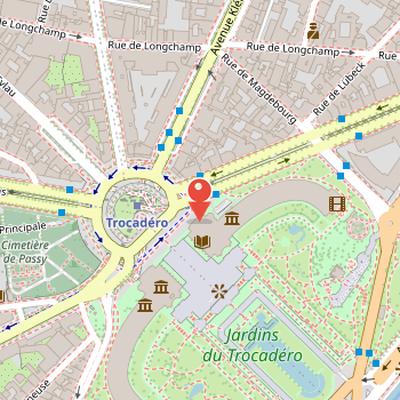
Nearby Objects
-
 Chaillot Palace 60 m away
 -
Théâtre national de Chaillot 60 m away
-
 Place du Trocadéro 90 m away
 -
 Musée de l’Homme 100 m away
 -
 Jardins du Trocadéro 200 m away
Location and Institutional Role
The Cite de l'architecture et du patrimoine is a public establishment of industrial and commercial nature under the supervision of the Ministry of Culture. Its mission is to promote French architecture and built heritage in France and abroad, and to exhibit emblematic works of French architectural heritage as well as international contemporary creation. It is located in the aile Paris of the Palais de Chaillot at Place du Trocadero-et-du-11-novembre in Paris, near the Trocadero and Iena metro stations. Inaugurated on September 19, 2007, it covers the largest architecture center in the world by floor area. The institution includes the Museum of French Monuments, the Ecole de Chaillot, the Jean-Louis Cohen Contemporary Architecture Library, and the Contemporary Architecture Archives Center.
From the Musee des Monuments Francais to the Palais de Chaillot
The history of the Cite de l'architecture et du patrimoine begins with the Musee des Monuments Francais, founded in 1795 as the second national museum after the Louvre, established in 1793. It was located in the convent of Petits Augustins, now occupied by the Ecole Nationale Superieure des Beaux-Arts de Paris. The museum was created to preserve works from vandalism after the Revolution, and it presented a monumental narrative of French history through rooms devoted to different centuries, with sculpted ensembles and memorials to illustrious personalities. In 1816, under the Restoration, the museum was suppressed.
A new stage came in 1879, when architect Eugene Viollet-le-Duc defined the project for the museum of Comparative Sculpture. Installed in the Palais du Trocadero, built for the 1878 universal exhibition, it presented molds intended to give architects, painters, and sculptors identical reproductions of medieval sculptures.
The site later continued to evolve in the Palais de Chaillot. Rather than destroying the museum, the building preserved its wing's original metal fittings, but replaced the Seine side promenade with a closed gallery that doubled the ground floor and extended the Art Deco facade upstairs. In 1963, the Cinematheque Francaise was installed there under the impulse of Henri Langlois. An accidental fire on July 22, 1997 destroyed part of the roof of the Paris wing of the Palais de Chaillot. The museum and cinema museum collections were spared the flames, though they were damaged by water used to extinguish the fire, and the event forced the Cinematheque Francaise to leave the Palais de Chaillot.
Creation and Opening of the Citede l'architecture et du patrimoine
The project developed after a 1995 competition, when Jean-Francois Bodin's agency was selected to lead the work, with the official launch following in 1999. Earlier, on the proposal of Jean-Marie Perouse de Montclos and Jean-Marie Vincent, the Ministry of Culture's Heritage Directorate began reflecting on an establishment intended to bring together several missions. A prefiguration mission was then installed, but it was criticised and discontinued. The Citede l'architecture et du patrimoine was later created as an EPIC, with Francois de Mazieres as president.
The institution was then reoriented to focus solely on architecture, and offices were delivered in February and later in 2005. It had a first opening during the European Heritage Days on September 15 and another day, followed by an official inauguration by President Nicolas Sarkozy and a later opening to the public. The institution also proposed reflection on a Grand Paris development project and the launch of an international architectural consultation for 2008. Its museum collections were distributed in three galleries.
Exhibition and Event Programming
The Cité de l'architecture et du patrimoine includes a wide range of programmed activities in dedicated premises. These include exhibitions, colloquiums, conferences, debates, and professional study days, with events held in an auditorium that was formerly the French Cinematheque hall. Its exhibition spaces are organized in two permanent galleries, including the Viollet-le-Duc room, and five temporary spaces on the lower floors. Among these, the large upper gallery hosts one or two major annual exhibitions, alongside the lower gallery. The institution also hosts the Albums of Young Architects and Landscape Architects every two years, recognizing professionals under 37 for project quality and social engagement. From 2007 to 2023, it awarded the Global Award for Sustainable Architecture in partnership with Jana Revedin under UNESCO patronage.
Jean-Louis Cohen Architecture Library
The Bibliotheque d'architecture contemporaine Jean-Louis Cohen includes a large architecture library with 55,000 books and 500 journals. It also holds documentary films and electronic documents, making it a significant research resource. The space is marked by a vaulted ceiling that reproduces the frescoes of the nave of Saint-Savin-sur-Gartempe Abbey, giving the library a distinctive interior feature tied to historic architectural imagery.