Musée de l’Homme is a French national museum and part of the Muséum national d'histoire naturelle. Since 1937, it has been installed in the floors of the Palais de Chaillot in Paris, occupying much of the Passy wing. The museum is intended to present the human species in its anthropological, historical, and cultural diversity, and it operates under the joint supervision of the Ministry of Higher Education and Research and the Ministry of Ecology.
The museum is the heir to the Musée d’ethnographie du Trocadéro, founded in 1882 by Ernest Hamy and formerly installed in the Palais du Trocadéro. Its collections grew through donations, deposits, expeditions, and scientific missions, and its early displays approached humanity from evolutionary, anthropological, and ethnographic perspectives, including cultural, ethnobotanical, and ethnozoological aspects. In 1937, Paul Rivet created the museum for the Exposition universelle. In 2009, its ethnographic collections were transferred in part to the Musée du Quai Branly - Jacques-Chirac, while another part joined the Musée des Civilisations de l'Europe et de la Méditerranée in Marseille. Renovation work on the museum was financed mainly by the Ministry of Higher Education and Research, with additional support from the Ministry of Culture.
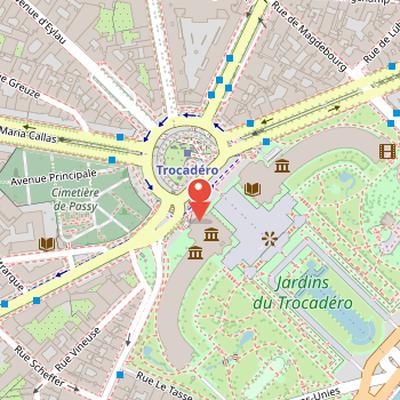
Nearby Objects
-
 Chaillot Palace 50 m away
 -
Théâtre national de Chaillot 60 m away
-
 Place du Trocadéro 100 m away
 -
 Cité de l'architecture et du patrimoine 100 m away
 -
 Passy Cemetery 150 m away
The Musée de l Homme at the Palais de Chaillot
The Musee de l Homme is a French national museum that forms part of the Museum national d histoire naturelle. Since 1937, it has been installed in the floors of the Palais de Chaillot in Paris. The museum aims to present the human species in its anthropological, historical, and cultural diversity, and it operates under the joint supervision of the Ministry of Higher Education and Research and the Ministry of Ecology.
In its early form, the museum presented the human species from evolutionary, anthropological, and ethnographic perspectives, with displays that also covered cultural, ethnobotanical, and ethnozoological aspects. In 2009, President Jacques Chirac emptied the ethnographic collections of the museum. These collections were used to create the Musee du Quai Branly - Jacques-Chirac, while another part of the holdings joined the Musee des Civilisations de l Europe et de la Mediterranee, or MUCEM, in Marseille.
Renovation work on the museum involved investments financed 95 percent by the Ministry of Higher Education and Research and 5 percent by the Ministry of Culture.
From the Trocadero to the Palais de Chaillot
The Musee de l'Homme is heir to the Museum of Ethnography of Trocadero, founded in 1882 by Ernest Hamy and installed in the former Palais du Trocadero, which had been built for the 1878 Exposition universelle. Its first collection was formed from a donation by the explorer Alphonse Pinart of approximately objects from the Americas, mostly bought from Eugene Boban, and also included objects from Oceania. The museum further inherited exceptional historical collections originating in curiosity cabinets, the Cabinet royal, and the scientific mission service of the Ministry of Public Instruction. Over time, its ethnographic collections expanded through expeditions and scientific missions worldwide, as well as through donations or deposits from travelers and private collectors.
In the early period, the museum competed with other institutions such as the Musee national des Arts asiatiques - Guimet for interest in exotic collections, while the expansion of exploration books and films contributed to a negative image around the early period. The palace of Trocadero's leaders also launched the 1931 Dakar-Djibouti mission, which removed thousands of objects from African heritage, and the mission's ethnological team collected African cultural symbols through purchases and rackets.
The former Palais du Trocadero was demolished in 1935. The Musee de l'Homme was then created by Paul Rivet for the 1937 Exposition universelle and occupies the majority of the Passy wing of the new Palais de Chaillot in Paris. Rivet brought together major French collections on the definition, life, history, and civilizations of humans by installing collections from the Trocadero ethnography museum and from the physical anthropology and Prehistory collections of the Muséum national d'histoire naturelle, which had previously been kept at the Jardin des plantes. The result was a novel structure combining collections on all human species with a university teaching center, a major research laboratory, and an important library. It also includes the Institute of Ethnology, founded in 1925 by Marcel Mauss and Lucien Levy-Bruhl. Among its students was Georges Condominas. The library was adapted to American standards using the Library of Congress classification system by Yvonne Oddon.
History and Scientific Identity
The Musee de l'Homme was intended to bring together the elements needed to situate and define the human being, and its triple function made it a unique place in France and a world reference. During the Second World War, Paul Rivet was an important actor in the fight against fascism and had been president of the Comite de vigilance des intellectuels antifascistes since its creation. On June 22, 1940, he posted Rudyard Kipling's poem If... on the door of the museum. In spring 1940, several staff members formed the reseau du musee de l'Homme around Boris Vilde, Anatole Lewitsky, and Yvonne Oddon, making it one of the first Resistance networks. This network facilitated passages to the free zone and to England and also published the clandestine magazine Resistance.
In the early 2000s, the museum became the subject of major institutional change. Jacques Chirac announced a project for a new museum dedicated to arts premiers on quai Branly in the 7th arrondissement, with the transfer of collections from the Musee de l'Homme and the Musee des Arts d'Afrique et d'Oceanie. The project was officially announced in 2002, and the collections were transferred in 2003 to the Musee du Quai Branly, which opened in 2006. European ethnology collections were deposited in 2005 at the Musee des Civilisations de l'Europe et de la Mediterranee in Marseille. The removal of more than half of the Musee de l'Homme's collection and the Chirac project drew strong criticism, including the view that the Musee du Quai Branly uses aesthetic criteria that obscure scientific data. Critics also noted that the Palais de la Porte-Doree lost its intended link between cultural diversity and natural diversity, while the Musee de l'Histoire de l'immigration remained historical, social, and limited to immigration in France. As a result, the Musee de l'Homme's themes of prehistory, anthropology, and future geonomic studies were partly deprived of ethnological illustration. In response, a commission chaired by archaeologist Jean-Pierre Mohen proposed a renovation program in 2003, and its conclusions were published by Jean-Pierre Mohen in Le Nouveau musee de l'Homme in 2004. Museographic and scientific definition studies were then carried out with a scientific commissariat and orientation committee.
Architectural Renewal and Interior Reorganization
An architecture competition led to the selection of Brochet-Lajus-Pueyo and partners for the project. Their design brought together the architectures of the Trocadero and Chaillot palaces, originally built for the 1878 and 1937 universal exhibitions. During work in 2010, structural weaknesses were discovered in the floors and pillars because of heterogeneous concrete found during asbestos removal and cleaning. In response, the central building's supporting structures and floors were consolidated or replaced, and the interior layout was reorganized.
The project aimed to introduce natural light and create a fluid, continuous visitor route. To achieve this, the first floor slab was pierced to form a 16-meter-high light well illuminated by Davioud's original glass roof. The atrium was transformed into a large public distribution and meeting space, while mezzanines and entresols were added between the permanent exhibition floors. Laboratories and offices for scientists were also incorporated into the architectural plan. Most reserves were moved to the garden level and teaching rooms to the first floor, a change that caused delays and additional costs. Reinstallation of staff, laboratories, and museography later began.
The Renovated Musee de l'Homme
The renovated Musee de l'Homme is located in the Passy wing of the Palais de Chaillot building and was inaugurated after a preview by Cecile Aufaure, Evelyne Heyer, and Bruno David in the presence of Francois Hollande. It brings together a research and teaching center and a museum in the same building, and it develops a scientific program focused on understanding humans and their place in life. Since its creation in 1937, it has been a reference site for human history.
The permanent exhibit is organized around three main axes on two levels of the Galerie de l'Homme arc wing. It uses large thematic display cases with anatomical and evolutionary exhibits, together with interactive multimedia devices including 80 screens and 14 digital label desks. The museum also offers audiovisual, tactile, and sensory experiences, such as language walls and time displays. These elements support an approach that presents human history through both scientific interpretation and direct public engagement.
The institution relies on international researchers in anthropology, genetics, prehistory, and ethnology, and it houses new laboratories of the Center for the Research on Human Evolution and Societies on its last two levels. These laboratories are equipped with specific equipment for research purposes. The museum reaffirms its founding concept as a museum-laboratory combining natural and human sciences, and it aims to present ongoing research results to the public-citizens within the institution.
The Musee de l'Homme classifies as both a science and society museum. It positions itself differently and complementarily to major French museums of civilization, art, or archaeology, and retraces a natural and cultural history of humans by emphasizing the ongoing interaction of these dimensions. Its collections are described as among the richest worldwide in their field, with a unique national collection of anthropology and prehistory worldwide. They document the emergence and development of human sciences in the 20th century and include significant specimens related to human origins and early symbolic behaviors, while also supporting current research.
The museum's reserves are divided by discipline: cultural anthropology reserves are located at an unspecified upper floor in fixed shelving, while biological anthropology and prehistory reserves are on six ground floor rooms with metal compact storage units. These reserves include skeletons, skulls, and flints, and they are accompanied by study rooms for collection examination and a treatment room for the reception, quarantine, and preparation of new pieces and loan requests.
Collections and Display at the Renovated Museum
The renovated Musee de l'Homme combines conservation spaces, research collections, and public displays focused on prehistoric, anthropological, and artistic material. It includes a conservation and restoration room for mummies and preserves mummified remains, phrenological skulls, and more than one thousand skeletons, among them those of Descartes and Saint-Simon. The museum also holds original fossils of Cro-Magnon Man, the Pataud shelter woman, the Lady of Cavillon with a shell-covered head, Neandertal Man from Chapelle-aux-Saints, Ferrassie Man, and the child of Pech-de-l'Azé. On the mezzanine, it displays prehistoric artworks such as the Venus of Lespugue, the mammoth plaque of Madeleine, the pierced stick of Montgaudier, and the reindeer antler thrower of Enlène.
The museum conserves a wide range of material from scientific and artistic traditions. Its holdings include the collection of prehistoric objects of Paul de Vibraye, the records of rock paintings of Tassili du Hoggar by Henri Lhote, paintings and sculptures, and mostly works performed during scientific expeditions. It also preserves bronze or marble sculptures by Charles Cordier, presenting 91 of his sculptures on a large support 2 meters high. Additional collections include anthropological plaster models painted to describe the diversity of peoples worldwide.
The museum further conserves anatomical waxes dating back to the 18th century, including the Tete de vieillard by Gaetano Giulio Zumbo from 1701, an earlier head kept at the Specola Museum of Florence, anatomical waxes by Andre-Pierre Pinson from the late 18th century, waxes from the cabinet of the Duke of Orleans, and the wax La femme a la larme. It also keeps many sets of objects showing social relations of contemporary societies with their environments. In the vestibule of the auditorium, it exhibits an original plaster copy of the White Bear by Francois Pompon from 1922, reworked in 1927-1928.
Exhibitions, Research, and Public Spaces
The renovated Musee de l'Homme combines exhibition, research, and mediation functions within a single public setting. Its spaces include permanent exhibition paths, additional areas for activities and content exploration, and temporary exhibition rooms of 300 square meters located on the second floor in the head pavilion. The building also contains the Paul Rivet atrium and the science balcony on the second floor, as well as the Jean Rouch auditorium on the first floor. The auditorium is used for symposiums, conferences, and screenings, and it also hosts the International Jean Rouch Festival, formerly known as Bilan du film ethnographique, which was created in 1982.
The museum also includes the Germaine-Tillion resource center, which is dedicated to pedagogical consultation and mediation, with a focus on image and multimedia. Research and conservation of collections are integrated with public spaces, reinforcing the museum's role as a museum-laboratory closely linked to research. This arrangement reflects the museum's broader function as a place for thinking about humanity, society, ethnography, anthropology, and civilization.
The renovated museum presents contemporary works, including sculptures by Pascale Marthine Tayou, and has also hosted artists Theo Mercier and Emeric Chantier with foam sculptures. Its thematic programming includes the first exhibition, Les collections du musee de l'Homme demain ?, and a new version of Balcon des sciences launched in 2019 with the temporary exhibition Piercing. Other seasons have included En droits!, which featured thirty photographs by Sebastiao Salgado and thirty photographs by Clarisse Rebotier, as well as street artist performances.
The museum's public programming also includes sections such as Actualites, which presents the research laboratories of the musee de l'Homme on multimedia supports, scientific research news, and an object from the collection or a recent collection. The section Expositions thematiques presents the results of research teams' work, links to temporary exhibitions and cultural programming such as colloquiums and scientific days, and features exhibitions of photographs and contemporary artists. Temporary exhibitions scheduled for 2023 included Neandertal, from April 14 to December 3, and Je mange donc je suis, from February 14 to December 17. The museum also marked its anniversary with the international colloquium Des lieux pour penser - Musees, bibliotheques, theatres, in collaboration with Sorbonne-Nouvelle Paris III and Toulouse-Jean-Jaures universities.
Portraits de France at the Musee de l'Homme
In 2021, the renovated Musee de l'Homme presented the exhibition Portraits de France in partnership with the Achac research group. The exhibition traced the life paths of 58 personalities from immigration and overseas territories, presenting them as decisive actors in the grand national narrative. It was organized following the homonymous report commissioned by Emmanuel Macron and referenced the scientific council chaired by Pascal Blanchard for that report. The museum also acknowledged the report's submission to the minister delegate of the city, Nadia Hai, in 2021. According to the facts provided, the report aimed to support the integration of these figures into school programs and to encourage their names to be used for streets, squares, and public buildings.
Research Activities at the Musee de l'Homme
The Musee de l'Homme is a site for research conducted by Structures de recherche, an organization co-supervised by the Ministry of National Education and Youth, the Ministry of Higher Education and Research, and the Ministry of Ecological Transition and Territorial Cohesion. The research unit is supported by the Department of Man and Environment of the National Museum of Natural History and carries out its work in three main fields at the Museum of Man.
Before the 2001 reform, Structures de recherche housed three laboratories of the National Museum of Natural History: Biological Anthropology, Prehistory, and Ethnology. It now includes two CNRS mixed units: Eco-anthropology and Natural History of Prehistoric Man. The organization brings together ethnologists, ethnobiologists, ethnomusicologists, primatologists, geneticists, paleoanthropologists, and prehistorians who share offices and technical platforms.
Its research themes include human species adaptation to environments, global Prehistory, parietal art, population history, and cultural adaptation to environments. The unit also reflects the four vocations of the National Museum of Natural History: collection conservation, fundamental research, higher education, and knowledge dissemination. In addition, it provides training within the framework of the museum's Master's and Doctoral School programs.
Library, Photo Library, and Sound Archive
During the construction of the Musee de l'Homme, Yvonne Oddon intervened in the library plans and imposed American standards in library architecture. She supervised the progress by residing on site and insisted that the library occupy the upper floor with a terrace overlooking the Seine. The library opened partially before functioning normally in its new premises one year later. Its development was supported by a new librarian position financed by David David-Weill.
Alongside the library, a phototheque was established to gather photographic documentation from the Laboratoire d'anthropologie du Museum. It later expanded with images brought back from various missions. Yvonne Oddon and Therese Riviere worked on a dual indexing of photographs based on a thematic classification system developed in 1938.
A phonotheque was created in 1932 by Andre Schaeffner and included published and unpublished sound recordings. Its first collection consisted of 78 rpm records from the 1931 Exposition coloniale in Paris, and Schaeffner also recorded unpublished cylinder recordings during the 1932 Dakar-Djibouti mission. The collection was then supplemented by many acquisitions from various missions and commercial records.
The museum also integrated a cinema room dedicated to ethnographic purposes in 1938, with contributions from ethnologist Marcel Griaule and his student Jean Rouch. A cinematography department was founded in 1945, and an ethnographic film committee was established in 1952 under Andre Leroi-Gourhan. The cinematography production resulting from this committee was significant.
After World War II, the documentation center received major collections such as the Paul Broca and Paul Topinard funds. Later additions included the Roger Bastide library in 1975 and ethnographic documents on the Inuits from Paul-Emile Victor's Greenland expeditions between 1934 and 1937. The ethnographic collections and photo library later joined the media library of the Musee du Quai Branly, while prehistory and paleography collections were retained. In 2006, the center received the CADIST for prehistory and human paleoecology from the Muséum national d'histoire naturelle, and it combined the Societe prehistorique de France collection into a recognized reference center. Its archives joined those of the Muséum national d'histoire naturelle, while phonographic documents are managed by the Centre de recherche en ethnomusicologie (CNRS) under the name Archives sonores du CNRS - Musee de l'Homme.