The Guimet Museum, the musée national des Arts asiatiques, is located at 6, place d’Iéna in Paris. Founded by Émile Guimet for the permanent presentation of his collection, it was inaugurated in 1889 under the name musée des Religions. The museum occupies a building constructed from 1888 to 1889 by architect Charles Terrier, using the same plans as the earlier museum in Lyon. Émile Guimet had previously conserved his collection at the ancien musée Guimet of Lyon in 1879, after gathering important art collections from Egypt, Greece, Japan, China, and India in 1876. The Paris museum was completely restructured and renovated from 1994 to 2001 by architects Henri and Bruno Gaudin. It presents one of the most complete collections of Asian arts worldwide and is said to hold the largest Asian art collection outside Asia. Its façade, roofs, and library are listed as historical monuments.
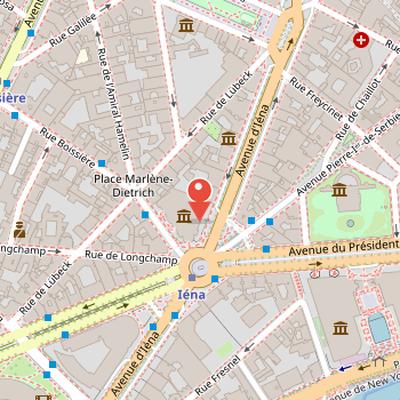
Nearby Objects
-
 Palais Galliera 200 m away
 -
 Musée d’Art Moderne 250 m away
 -
 Musée Baccarat 300 m away
 -
 Musée d'art moderne de Paris 300 m away
 -
 Avenue d'Iéna 350 m away
History and building
The Guimet Museum, officially the Musee national des Arts asiatiques, is located at 6, place d'Iena in Paris. It was founded by Emile Guimet for the permanent presentation of his collection, which had previously been conserved at the ancien musee Guimet of Lyon in 1879. The museum was inaugurated in 1889 under the name musee des Religions.
The institution occupies a building constructed between 1888 and 1889 by architect Charles Terrier. It later underwent a complete restructuring and renovation from 1994 to 2001, carried out by architects Henri and Bruno Gaudin. The facade, roofs, and library of the building are listed as historical monuments.
Since December 26, 2003, the museum has been a public administrative establishment. It presents one of the most complete collections of Asian arts worldwide, giving the site a major cultural role in Paris.
From Lyon to Paris: the formation of the museum
The Guimet Museum was constituted on the initiative of Emile Guimet, an industrialist and scholar from Lyon. Its museographic model was inspired by the Boulaq Museum in Egypt. In 1876, Emile Guimet assembled important art collections from Egypt, Greece, Japan, China, and India, and from 1879 these collections were presented in Lyon. The institution later specialized in Asian art objects and transferred its collections to a new museum in Paris. This Paris museum was built by Charles Terrier and inaugurated in 1889, using the same plans as the museum in Lyon.
Over time, the museum expanded its institutional role. In 1927, it was attached to the direction of Museums of France and grouped together other collections and private legacies. It is now recognized as holding the largest Asian art collection outside Asia. Its collections are arranged geographically and stylistically in order to support the study of Asian art history, and this organization reflects an emphasis on knowledge rather than display alone. The Buddhist Pantheon, the Hotel Heidelbach near the main museum, is managed by the institution, as is the Ennery Museum, which is dedicated to Asian art.
The museum also had earlier links with the Trocadero palace, where it housed an Indochinese museum in the Passy wing between 1878 and 1925. It transferred Indochinese objects from the Trocadero palace to its own museum and kept 624 plaster casts from the Angkor temple there until donating them to the Museum of French Monuments in 1936. Its activities extend beyond collections, including a textile department created from the legacy of Krishna Riboud, contemporary art acquisitions and temporary exhibitions, and cultural events such as retrospectives, recitals, concerts, dance, and theater.
Controversy over the Museum Labels
In 2024, the Guimet Museum renamed its rooms from "Nepal - Tibet" to "Monde himalayen" and designated Tibet under the Chinese appellation. The change drew criticism and became a public controversy. In March 2025, deputy Charles de Courson questioned the decision, while Culture Minister Rachida Dati defended it. The use of "Monde himalayen" was justified by reference to the categorization used by the Metropolitan Museum and the Smithsonian. The issue escalated in July 2025 when four associations brought a legal challenge, and the administrative court ordered the museum to rewrite labels concerning Tibet. The association France-Tibet presented the controversy as evidence of political and cultural influence from China on the Guimet Museum.
Collections and Conservation Departments
The Guimet Museum's conservation departments present a collection mainly dedicated to Khmer Empire statuary and architectural decor, while also including testimonies of Champa art and art from Thailand, Siam, Indonesia, Burma, Laos, Cambodia, and Vietnam. Among the architectural elements on display is the pink sandstone porch of the Khmer temple of Banteay Srei. The collections note that this sandstone porch resists time well and was dismantled and reassembled on site, although some parts still remain on the ground because the original bases are missing. A fragment in the collection shows the apsara Tilottama picking fragrant flowers under a tree and surprising the demons Sunda and Upasunda; Tilottama is described as commissioned for a Shaivite foundation.
The collections also extend to ancient India, where excavation objects include rare items from the Indus Valley civilization and many from South India. They demonstrate ancient India's commercial relations with the western world, especially Rome, and feature sculptures related to Buddhism, Brahmanism, and Jainism in ancient India and the Indo-Greek kingdom. The collections indicate that Buddhism and Brahmanism influenced new aesthetics in the arts of China, Japan, and Southeast Asia. Most of the Indian material consists of sculptures in local stone, including red sandstone, marble, and schist, from major archaeological sites. An important set of Gandhara art representing Afghanistan and Pakistan is shown on the first floor, and the collections also include art from the Gupta Empire.
Temples and monasteries excavated or constructed by Buddhists, Hindus, and Jains are preserved in the collections, along with sculptures and decorations from sites such as Mathura, Nasik, Sanchi, Ajanta, Badami, Aihole, Ellora, Elephanta, Aurangabad, Mamallapuram, Pattadakal, Kailasanatha de Kanchipuram, and the Temple de Brihadesvara de Tanjore. The Riboud collection gallery presents Indian and Asian textiles, while 150 art objects, including exceptional Mughal jewelry, are exhibited from the Riboud collection. The museum also holds mostly miniatures and some movable paintings from the Mughal era linked to the Indian literary tradition, which are rotated in the rotunda of the old library on the first floor.
Chinese Art Collections
The Guimet Museum's conservation departments preserve collections that cover seven millennia of Chinese art and represent the history of Chinese art from its earliest periods up to modern times. The holdings include Neolithic Chinese ceramics, Chinese bronzes, antique sculptures and models, mostly mingqi, as well as jade and lacquer objects in excellent condition. They also feature celadon stoneware from the Three Kingdoms period, Tang tri-colored stoneware, and well-known types of porcelain such as xing porcelain, blue and white porcelain, famille verte, and famille rose.
The collections also include Chinese paintings on vertical hanging scrolls, horizontal portable scrolls, and painted fans. In addition, they contain numerous testimonies of traditional Chinese cults and Buddhism, including splendid sculptures. Traditional Chinese furniture is also represented through highly valuable aesthetic collection pieces.
The Guimet Museum Collections
The Guimet Museum collections continue the project initiated by Emile Guimet for a museum of comparative history of religions. They were shaped as scientific collections that moved away from the fashion for chinoiseries at the end of the 19th century, and they were built through the scholarly work of Edouard Chavannes and Victor Segalen. Over time, they were considerably enriched in 1945 by Asian art objects from the Louvre museum, while ceramics gathered by Ernest Grandidier also became part of the holdings.
For 125 years, the collections have developed through a coherent acquisition policy and the support of many donors. They present the history of art and archaeology of China with an effective educational system, and much of their core derives from the Paul Pelliot mission of 1906 to 1909. The collections also preserve wood and unfired clay sculptures from dry Silk Road regions, made possible by the dry climate, and illustrate the artistic hybridization that accompanied Buddhist expansion and Chinese art from the early centuries to the 10th century.
Another important focus is Greco-Buddhist art from kingdoms in present Afghanistan and Pakistan, based on Alfred Foucher acquisitions and DAFA archaeological excavations. The museum also has a core collection of bronze statuettes from Emile Guimet. In 1912, the holdings were enriched by bronzes and paintings brought by Jacques Bacot, together with other donations in memory of Gustave-Charles Toussaint.
The collections are especially notable for Tibetan and Nepalese religious art, with roughly 550 pieces including statuettes, cult objects, and thangka. They were the first to reveal Tibetan art in France, and since the Lionel Fournier donation of 1989, the museum has stated that it holds the richest collection of Tibetan art worldwide. The National Museum of Asian Arts - Guimet also owns a Dzogchen secret visions book from the Dalai Lama. Most of these artworks were not shown in permanent collections, but were exhibited in 1926 in Calcutta within the Tagore family.
The museum's textile holdings developed through links formed after a large textile exhibition in Paris in 1962, which was organized to raise funds for victims of the Sino-Indian conflict. This led to ties with the Guimet museum and its curator Jeannine Auboyer, who in 1964 entrusted a textile collection study mission at the museum, focusing on textiles collected by the Paul Pelliot mission in Central Asia. In the 1970s, the collections were linked to the International Committee for the Study of Ancient Textiles, where vice-presidency was held, and a research program was launched with studies published in collaboration with Gabriel Vial from the Lyon textile school. These studies examined textiles technically in order to address questions of cultural and artistic exchange in Asia. In 1979, Jean Riboud founded the Association for the Study and Documentation of Asian Textiles, which became a model and the largest private collection dedicated to Asian textiles. A donation of 150 pieces from the AEDTA collection was made to the Guimet Museum in 1990, and further items plus watercolors showing weaving techniques were added in 2003.
Collections and Research Resources
The Guimet Museum's conservation departments hold a wide range of collections that support research and display. On the ground floor, the collection Riboud is included among the museum holdings. The collections also contain specialized publications for contemporary research, periodicals from Asia and France, and reference works on Asia by researchers and scholars. Older materials include 18th-century Chinese maps, Muslim books in Chinese, precious Manchu books, and hundreds of Tibetan books.
The museum also preserves decorative ensembles, including painted or lacquered folding screens displayed in the rotunda. Among these is a twelve-panel lacquered wood screen from the Qing dynasty Kangxi period, dated 1662 to 1722. In addition, the collections include a large photographic archive estimated at nearly 400,000 items. This archive covers most Asian countries from the 1850s to contemporary times and preserves reproductions of museum works according to their display chronology.
A significant part of the photographic holdings consists of traveler photographs and images by Samuel Bourne, Felice Beato, and Emile Gsell. The photographs document landscapes, sites, architecture, portraits, and scenes of daily life, and they have ethnographic, social, and historical value. The archive also includes photographs from French archaeological missions in China by Edouard Chavannes, Paul Pelliot, and Victor Segalen, as well as missions in Afghanistan by Alfred Foucher and Joseph Hackin. These images provide detailed views of archaeological working conditions and of masterpieces at the moment of discovery, sometimes emerging from the sands of Xinjiang.
Le prix Emile-Guimet de litterature asiatique
The first edition of Le prix Emile-Guimet de litterature asiatique was held at Hotel Heidelbach on June 28, 2017. The prize was awarded to Indian writer Rana Dasgupta for the novel Delhi Capitale. It was presented by the president, Jean-Claude Carriere, marking the debut of the literary award at this location.
Asian Galleries and Their Collections
The Guimet Museum gallery holds a wide range of works spanning many periods and regions of Asia, with pieces in stone, bronze, terracotta, wood, porcelain, jade, paper, ivory, and glass. Its holdings include a Gladiateur in enamelled glass from Roman art in the treasure of Begram in the region of Kappisa, Afghanistan, as well as a Bodhisattva from Gandhara under the Kushan Empire and a Buddha in uttarasanga robe from the early Gupta Empire in Mathura, India. The gallery also includes a Bhairava from the Hoysala period in Karnataka, a Mughal wine cup in jade, gold, ruby, and emeralds, and Khmer works such as a Harihara from Phnom Da style in Takeo province, a Bodhisattva Lokesvara, and a presumed head of Jayavarman VII in Bayon style.
The collection extends to East Asia with a mural painting of a Buddha from Kucha in Xinjiang, an ivory taotie mask from the Shang Dynasty, a Tang Dynasty polo player in terracotta, a celadon glazed stoneware set from Longquan in Zhejiang, a late 17th century painting by Wang Hui, and a vase with mille fleurs decoration from Jingdezhen in the late Qianlong period. It also includes a meditating Bodhisattva from the Three Kingdoms period in Paekche, a Goryeo double-gourd shaped ewer with inlaid decoration under celadon glaze, a Dogu figurine from the late Jomon period, an early Edo portrait in painted and lacquered wood with rock crystal inlay, a Noh theater mask from the Edo period, and Hokusai's color woodblock print Choshi from the series One Thousand Images of the Ocean.