The Musée d'art moderne de Paris is a French art museum located at 11, avenue du Président-Wilson in Paris. It occupies the east wing of the Palais de Tokyo, while the west wing belongs to the State and is dedicated to contemporary creation. Opened in 1961, the museum presents the municipal collection of modern and contemporary art since Fauvism. Its collection includes more than artworks and focuses on artistic movements related to Paris and the European art scene. The museum is one of fourteen museums in Paris managed by Paris Musées.
The Palais de Tokyo itself was designed by architects André Aubert, Marcel Dastugue, J.-C. Dondel, and P. Viard for the Exposition internationale des arts et des techniques of 1937, in the Art déco style. The site’s history includes the decision in 1934 to construct two modern art museums, one for the State and one for Paris. The museum reopened with an exhibition dedicated to Pierre Bonnard.
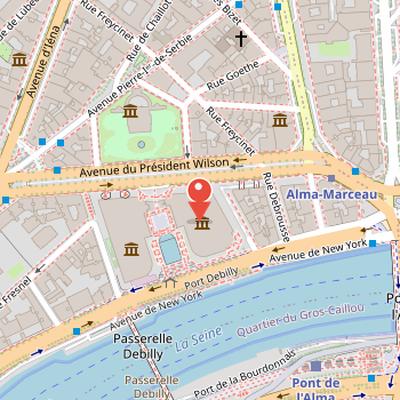
Nearby Objects
-
 Musée d’Art Moderne 60 m away
 -
 Palais Galliera 150 m away
 -
 Place Diana 200 m away
 -
 Flame of Liberty 250 m away
 -
 St. Stephen's Greek Orthodox Cathedral 250 m away
Location and Collection
The Musee d'art moderne de Paris is a French art museum located at 11, avenue du President-Wilson in Paris. It presents the municipal collection of modern and contemporary art since Fauvism, with a collection that includes more than artworks. The museum focuses on artistic movements related to Paris and the European art scene. It occupies the east wing of the Palais de Tokyo, while the west wing belongs to the State and is dedicated to contemporary creation. The museum opened in 1961 and later reopened with an exhibition dedicated to Pierre Bonnard. It is one of fourteen museums in Paris managed by Paris Musees.
Palais de Tokyo and the Museum's Early Development
The Musee d'art moderne de Paris was established through decisions made by the State in 1934, when it agreed to build two modern art museums, one of them for Paris to relieve the Petit Palais museum. The museum is located in the Palais de Tokyo, a building designed by Andre Aubert, Marcel Dastugue, J.-C. Dondel, and P. Viard for the Exposition internationale des arts et des techniques of 1937. The Palais de Tokyo was designed in the Art deco architectural style.
The museum history is closely tied to the division of the building between east and west. The State museum was located to the west and functioned as the Musee national d'Art moderne from 1947 to 1977, while the city museum was located to the east. In 1940, the prefect of the Seine made the Palais de Tokyo available to Entraide des artistes for art salons in order to avoid German requisition. In 1953, the Maurice Girardin legacy influenced further development, prompting Paris authorities to open a new location inside the Palais de Tokyo.
The site became an active venue for artistic events and exhibitions. It hosted the Salon de la jeune peinture from 1954 to 1969 and again from 1972 to 1975, while the Salon de mai and the Salon des realites nouvelles were held there from 1946 to 1969. The first Biennale de Paris was inaugurated by Andre Malraux in 1959 and featured Jean Tinguely's Une sculpture qui fait de la peinture; Biennale de Paris events continued at the MAMVP until 1982, except in 1971. The Palais de Tokyo also installed Henri Matisse's La Danse in the former dark room, and the department of Animation, Research, Confrontation, or ARC, was set up on the first floor. Renovation work began in 1976 and ended the hosting of various salons. The municipal museum opened after six years of work with a core collection drawn from the Petit Palais modern art collections.
Collection Growth and the 1937 Exhibition
The museum collection expanded through acquisitions from the fine arts purchasing committee, which added works to the municipal museum collection. It was also enriched by private collectors, including Ambroise Vollard, Emanuele Sarmiento, Mathilde Amos, and Dr. Girardin. A major moment in this history was the 1937 exhibition, during which the museum acquired several significant works and objects. These included La Danse de Paris by Henri Matisse, L art et la technique by Gaston Suisse, Nu dans le bain and Le Jardin by Pierre Bonnard, L'Equipe de Cardiff by Robert Delaunay, La Riviere by Andre Derain, Les Disques by Fernand Leger, L'Escale by Andre Lhote, L'Oiseau bleu by Jean Metzinger, and four Portraits d'artistes by Edouard Vuillard. The exhibition also led to the acquisition of furniture by Pierre Chareau, Andre Arbus, and Jacques-Emile Ruhlmann, as well as monumental decorations by Robert and Sonia Delaunay, Albert Gleizes, and Jacques Villon. Together, these additions show how the museum's holdings were shaped by both institutional purchases and exhibition-based acquisitions.
Post-opening transformations and renovations
The Musee d'art moderne de Paris underwent several major internal changes after its opening. The first post-opening project, carried out in the early 1960s under Pierre Faucheux and Michel Jausserand and completed by the mid-1960s, reworked the building's interior organization. Internal partitions were removed to arrange the high ground floor rooms, and the initial plan was altered to create a floor cutting through the old entrance hall. The project also added a mezzanine for offices and a documentation center, an auditorium connected by a two-level walkway, and an elevator serving all museum levels. In certain sections, mobile museography was introduced, using spatial arrangements typical of the period and showing the rapid constraints of the time. La Fée Electricite by Raoul Dufy was installed in the great hall in 1964, and ARC was later placed in the first floor rooms after this first project.
Further adaptations followed in later decades. About twenty years after previous work, credits were engaged to remake the air conditioning system in the temporary exhibition rooms on the upper ground floor, and these rooms were made accessible to disabled visitors. Rehabilitation of the building, initiated in 1989 during the installation of Histoires de musee, continued between 1991 and 1994 with architect Jean-Francois Bodin. This operation cleared numerous original volumes of the building. During the same renovation period, the museum acquired the recovered version of La Danse inachevee by Henri Matisse in 1993, created a specific room with the required dimensions to confront it with La Danse de Paris from 1937, and rearranged the dark room renamed Salle Matisse so that both Matisse triptychs could be permanently exhibited together.
In 2000, a consultation led Paris city hall to commission the architecture studio Canal for a safety work study and project management, with project ownership assigned to the Directorate of Cultural Affairs and operation management to the Directorate of Heritage and Architecture, agency of major projects. As part of the resulting work, asbestos removal was carried out in the Dufy room in 2002, after which the museum reopened with a new hanging of artworks. Jean-Francois Bodin was then entrusted with reorganizing the permanent collections route. He restored closed basement spaces to provide a dark room for video projection from the collection and restored the reconfigured Boltanski room in the basement. Salle Albert Amon was also renamed in the year specified in the records, in honor of Maurice A. Amon's father, and Maurice A. Amon committed to restore and maintain it for 10 years. Later renovation works, carried out to improve public reception conditions, partially closed the museum for accessibility improvements and restored the parvis and its basin on the Seine side.
The 2010 Painting Theft
In the night of the 19th, five paintings were stolen from the museum in an event known as the Vol de tableaux de 2010. The works taken were Le Pigeon aux petits pois by Pablo Picasso, Pastorale by Henri Matisse, L'Olivier pres de l'Estaque by Georges Braque, a painting by Fernand Leger, and La Femme a l'eventail by Amedeo Modigliani. The stolen paintings had an estimated total value in euros, although the exact amount is not provided here.
The theft was carried out by Vjeran Tomic, a Croato-Bosniaque thief, who entered through a window with a security defect. The museum's alarm system had been out of service for weeks, and the missing works were discovered before the museum opened in the morning. The case triggered controversy about museum security.
Two other suspects were later arrested: Jean-Michel Corvez, described as an antiquarian from Paris, and Yonathan Birn, an acquaintance of Corvez and a watchmaker. Birn concealed the five paintings and claimed to have thrown them into a green incineration bin. The case involved a non-disclosed Emirati commissioner. A trial followed in 2017, resulting in prison sentences of eight years for Tomic, seven years for Corvez, and six years for Birn. The theft also inspired the 2025 film Les Regles de l'art.
ARC and the Friends of the Museum
ARC, short for animation, recherche, confrontation, is the contemporary department of the Musee d'Art Moderne de la Ville de Paris. It was created in 1967 by Pierre Gaudibert with the aim of being international and multidisciplinary. Suzanne Page served as curator from its creation and took the direction of ARC in 1973, when it gained autonomy from the Musee d'Art Moderne de la Ville de Paris. In 1988, Page became director of the museum itself, and ARC returned under the museum's authority while she remained in charge. Angeline Scherf later succeeded Laurence Bosse and directed ARC until 2015. During the museum renovation in 2004 and 2005, ARC presented exhibitions at the Couvent des Cordeliers.
The Societe des Amis du Musee d'Art Moderne de Paris was founded in 1975 by Henriette Joel, encouraged by Gottfried Honegger, Francois Morellet, and Otto Hahn. The society supports the realization of exhibitions and the acquisition of artworks. It also offers members conferences and visits devoted to Parisian, French, and foreign art scenes, as well as meetings with artists and exhibition curators. In addition, it organizes trips in France and abroad and publishes limited edition products created by artists for its members. Since 2008, funds raised at the annual dinner have contributed to the purchase of artworks for the museum, including works by Christopher Wool, Albert Oehlen, Anita Molinero, Francois Morellet, Peter Doig, Francoise Vergier, Philippe Parreno, Jimmie Durham, Gilles Barbier, Tacita Dean, Jan Dibbets, and Loris Graud.
Exhibition Attendance Records
The exhibition history of the Musee d'art moderne de Paris includes record-setting visitor numbers. In 2024, the Nicolas de Stael exhibition reached 409,162 visitors, according to Historique des expositions announced on X. This attendance surpassed the museum's previous record of approximately 352,000 visitors, set by the Jean-Michel Basquiat retrospective at MAM in 2010. These figures show the strong public interest generated by major exhibitions at the museum.