Avenue d'Iéna is a street in the Quartier de Chaillot, in the 16th Arrondissement of Paris. It measures 1,140 metres in length and is described as 36 metres wide. The street was opened by decree on 6 March 1858 and runs between the Trocadéro at Avenue Albert-de-Mun and Rue de Presbourg. Its creation also led to the dissolution of the Rue des Batailles, which had run from Avenue Albert-de-Mun to Place d’Iéna. The avenue follows the route of a village street in the former location of Chaillot and is associated in the historical record with the pavilion of Heinrich IV and Gabrielle d’Estrées in Chaillot. The avenue received its name in memory of Napoleon’s victorious battle of 14 October 1806.
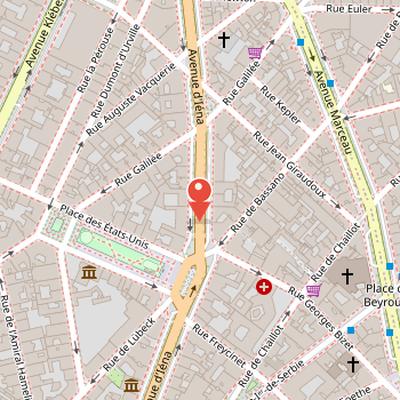
Nearby Objects
-
 Musée Baccarat 150 m away
 -
 Avenue Marceau 250 m away
 -
 St. Stephen's Greek Orthodox Cathedral 300 m away
 -
 Palais Galliera 300 m away
 -
 Guimet Museum 350 m away
Location and Dimensions
Avenue d'Iena is a 1,140 meter long street that is 36 meters wide. It is located in the Quartier de Chaillot, in the 16th Arrondissement of Paris. These details place it within a clearly defined part of the city and describe its scale as an urban thoroughfare.
Name and Historical Origin
Avenue d'Iena received its name in memory of Napoleon's victorious battle on October 14, 1806. The naming gives the avenue a direct historical reference, linking the site to a specific military event commemorated through its title. This origin is the main documented feature of the avenue's identity provided here, and it situates the name within a broader remembrance of that victory.
Formation of Avenue d'Iena
Avenue d'Iena follows the route of a former village street in the old location of Chaillot, near the pavilion of Heinrich IV and Gabrielle d'Estrees in Chaillot. It was opened by decree on March 6, 1858, and has a width of 40 meters. The avenue runs between the Trocadero at Avenue Albert-de-Mun and Rue de Presbourg. As part of this action, the Rue des Batailles was dissolved; that street had run from Avenue Albert-de-Mun to Place d'Iena.