Musée Baccarat is housed in an ancient Parisian mansion on Place des Etats Unis that once belonged to Countess Marie-Laur de Noailles. The modern design of the palace was created by Philippe Starck. The former owner was a muse of the surrealists and a close friend of Jean Cocteau, whose film Beauty and the Beast inspired motifs at the main entrance. Inside, high vaulted ceilings, wide marble stairs with a red carpet, tiny embedded lamps, and a crystal throne create a striking central sequence. A rotating chandelier in the stairwell is one of the largest ever made by Baccarat. To the left of the central stairs are a ballroom and a museum, while a restaurant is located to the right. The museum area includes three exhibition halls: Madness of Size, Beyond Transparency, and the Hall of Alchemy, with ascetic interiors and notable exhibits such as the first electric crystal chandelier commissioned by Russian Emperor Nicholas II and furniture from the Ferrier collection purchased by maharajas.
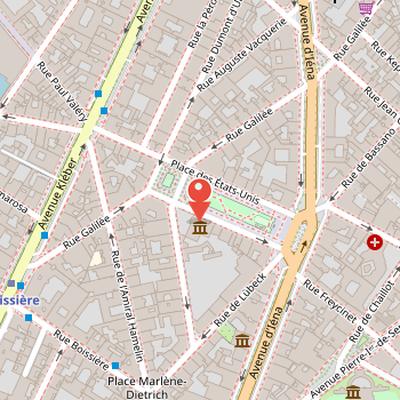
Nearby Objects
-
 Avenue d'Iéna 150 m away
 -
 Guimet Museum 300 m away
 -
 Palais Galliera 350 m away
 -
 St. Stephen's Greek Orthodox Cathedral 400 m away
 -
 Avenue Marceau 400 m away
Musée Baccarat at Place des Etats Unis
Musée Baccarat is located in an ancient Parisian mansion on Place des Etats Unis. The mansion once belonged to Countess Marie-Laur de Noailles, who was a muse of the surrealists and a close friend of Jean Cocteau. The modern design of the palace was created by Philippe Starck. Its main entrance is decorated with motifs from Jean Cocteau's film Beauty and the Beast.
Interior Layout and Decorative Program
The interior of the Musee Baccarat is arranged around central stairs and a sequence of distinct spaces that combine museum display, dining, and decorative spectacle. High vaulted ceilings frame wide marble stairs covered by a red carpet with tiny embedded lamps that glitter along the edges. A crystal throne stands beside the stairs, while a rotating chandelier hangs in the stairwell; it is described as one of the largest ever made by Baccarat.
To the left of the central stairs are a ballroom and the museum. The ballroom is decorated with gilded carvings, mirrors, and paintings. The museum area contains three exhibition halls: Madness of Size, Beyond Transparency, and the Hall of Alchemy, which has a conical ceiling. These halls have ascetic interiors and display objects including the first electric crystal chandelier commissioned by Russian Emperor Nicholas II, as well as furniture from the Ferrier collection purchased by maharajas.
To the right of the central stairs is the Baccarat restaurant. Its decoration is described as luxurious. The restaurant hall covers about 200 square meters and contains several covered tables and four sofas grouped in the center. Cameos with bas-reliefs are fixed on opposite walls, and the same motif is repeated on the pillows placed on the sofas. Fantastical paintings on the theme of the seasonal menu appear between the windows. A small separate room is set aside for private dining, with a pink satin ceiling and pink tulle draped on the walls. In that room, a black massive chair, a black chandelier designed by Starck, and a table with five chairs are depicted as if outlined on the walls. The terrace serving aperitifs includes a large mirror in a silver frame with a crystal candle holder fixed at the bottom. Philippe Starck expressed the crystal theme of Baccarat through an eclectic mix of Baroque, Rococo, Empire, and Avant-garde styles.
Baccarat and the Art of Crystal
The history of Baccarat presents the French firm as a long-established maker of crystal, operating for almost 250 years and associated with creative masters throughout its history. It is described as the Crystal Stradivari, and its products are regarded as standards of highest quality and refined taste. Baccarat was the first to produce colored crystal, beginning in 1827, and its reputation was built in part on its ornamented guest sets of decanters, glasses, and goblets, which were used to decorate elegant tables.
From 1909, the company also began producing perfume bottles in addition to wine crystal. According to the provided history, perfume had previously been sold in common pharmacy bottles, but Baccarat was the first worldwide to create special perfume bottles that reflected the quality of their contents. Several perfume makers used Baccarat bottles, including Coty, Patou, Schiaparelli, Elizabeth Arden, Guerlain, Dior, Versace, and Lancome. The history also notes a separate connection with the Russian imperial family in Baccarat.
Imperial Connections and Baccarat Crystal
In 1896, after ascending the throne, Nicholas II and Alexandra Feodorovna traveled through Europe. During a formal reception in Paris, Nicholas II was presented with Baccarat crystal, and he later placed several orders with the Baccarat manufactory. Among these were glasses, replicas of which Baccarat still produces under the name Tsar. Nicholas II also personally designed sketches for candelabra made by Baccarat craftsmen, and the imperial candelabra associated with his designs are now held in the Hermitage collection.
The relationship between Baccarat and Russia was also reflected in the companys production in the town of Baccarat near Nancy, where three furnaces operated for Russia. Baccarat fulfilled large orders for the Russian imperial family, including chandeliers and candelabra for Emperors Alexander II and Nicholas II. The records also note that Alexander II ordered four-meter-high candelabra for his wifes anniversary, showing the scale of these commissions and the importance of Baccarat crystal in imperial settings.
Design Objects and Decorative Creations
Baccarat's production includes a range of decorative and collectible objects that highlight the brand's use of crystal and collaboration with designers. Among its notable historical creations are a nearly entirely crystal fountain, seven meters high, made for the Paris Universal Industrial Exhibition, and a transparent classical-style gazebo designed for the Portuguese king's residence. The gazebo was displayed in the royal pond and later added to a private collection.
The brand also created an anniversary chandelier with 230 sparkling pendants for Baccarat's 230th anniversary, which is now stored in the brand's museum. In its boutiques, Baccarat sells crystal chandeliers, dishes, vases, photo frames, ashtrays, candlesticks, and animal figurines. The company also produces collectible interior items designed by famous designers and artists, including large black-and-white candlesticks designed by Kenzo and black glasses and cups designed by Philippe Starck, made of two layers of crystal.
Original crystal jewelry is considered a special pride of Baccarat. The company began making crystal jewelry in 1993, using 750 gold and 925 silver for the settings. It also introduced its own watches featuring crystal at the 2001 Basel international watch and jewelry exhibition.