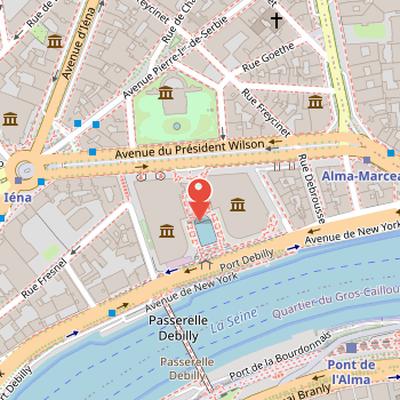
Musée d’Art Moderne is a museum building dedicated to modern and contemporary art at 13, avenue du Président-Wilson in Paris, along the Seine quays near the Palais de Chaillot. Built on the site of the former manufacture de la Savonnerie, its exterior envelope is fully covered with marble. It is one of the three permanent buildings from the 1937 Exposition internationale, alongside the Palais de Chaillot and the Palais d’Iéna. Planned in 1934 to replace the Musée du Luxembourg, it was originally intended to house two modern art museums, one for the City of Paris and one for the State. The building was officially inaugurated in 1947, when collections returned after World War II. The Musée d’Art moderne de la Ville de Paris occupies the east wing, while the west wing formerly housed the Musée national d’Art moderne and now contains the Palais de Tokyo contemporary art center. On July 3, 2001, the building and the municipal museum were listed as historic monuments.
Nearby Objects
-
 Musée d'art moderne de Paris 60 m away
 -
 Palais Galliera 150 m away
 -
 Place Diana 250 m away
 -
 Guimet Museum 250 m away
 -
 Flame of Liberty 300 m away
The Palais de Tokyo Site and History
The building dedicated to modern and contemporary art at 13, avenue du President-Wilson in Paris stands along the Seine quays near the Palais de Chaillot. It occupies the site of the former manufacture de la Savonnerie and has an external envelope fully covered with marble. Planned in 1934 to replace the Musee du Luxembourg, it was one of the three permanent buildings of the 1937 Exposition internationale, together with the Palais de Chaillot and the Palais d'Iena. The building was named Palais de Tokio before the war, Palais de New-York immediately after, and then Palais de Tokyo after the Quai de Tokio. It first served to present a retrospective of French art since the Middle Ages, and it was officially inaugurated in 1947 during the return of collections moved during World War II.
Museum Wings and Later Uses
The building was initially intended to house two modern art museums: one belonging to the city of Paris and one national museum. The Musee d Art moderne de la ville de Paris occupies the east wing. The Musee national d Art moderne was located in the west wing before most of its collections moved to the Centre Pompidou in the 1970s, and its remaining collections were transferred to the Musee d Orsay in the 1980s. The west wing now hosts a contemporary art center called Palais de Tokyo.
The site also has a significant urban setting. A municipal decree gave the name Place de Tokyo to a parking area in front of the building entrance on Avenue du President-Wilson. Place de Tokyo is located opposite Palais Galliera, between Rue Maria-Brignole and Rue de Galliera. The building is served by the Alma-Marceau and Iena metro stations.
The structure is described as having one of the largest exhibition surfaces for contemporary art internationally. On July 3, 2001, the building and the Musee d Art moderne de la Ville de Paris were listed as historic monuments by the prefect of Ile-de-France.
Planning a Museum for Modern Art
In 1932, the small size of the Luxembourg Museum led to the proposal of Un batiment pour deux musees, which promoted the idea of building a Modern Art Museum for the city of Paris. The proposal was associated with Louis Hautecoeur, who was the conservator of the Museum of Living Artists housed in the Luxembourg orangery. In 1934, the State decided to build a National Museum of Modern Art. The city of Paris owned the land and guaranteed the loan used to finance the 1937 International Exhibition. The State then agreed to construct two modern art museums and to give one of them to the city of Paris, in order to relieve the Petit Palais Museum. Under this plan, the State's museum was to occupy the west wing, while the city's museum was planned for the east wing.
Site History
The land chosen for the Musee d'Art Moderne included part of the former Savonnerie Carpet Factory site. The Savonnerie Carpet Factory had been installed in 1627 in an orphanage whose wards made soap, and it was transferred in 1826 to the Gobelins factory enclosure. The site later served as the Military Supplies or military food depot, in buildings rebuilt in 1836. These buildings were burned down in 1855 and rebuilt twice during the Great War.
Polish Embassy Plot and Site Changes
The southeast part of the land was initially spared by the project because it was occupied by the Polish embassy plot. The embassy was later expropriated for the project, although no date is specified. The Polish embassy itself had been installed in 1936 in the Monaco Hotel on rue Saint-Dominique, and the Monaco Hotel was purchased by the State for the embassy's transfer.
The Architecture of the Musee d'Art Moderne
The project titled Un batiment pour deux musees, by Jean-Claude Dondel, Andre Aubert, Paul Viard, and Marcel Dastugue, was selected from 128 architectural proposals, among them designs by Le Corbusier and Mallet-Stevens. The resulting building was conceived with two symmetrical wings joined by a large peristyle, and it is set along an axis perpendicular to the Seine, where the water mirror is located. This water feature lies on a terrace overlooking the river below a monumental staircase. The staircase is decorated with bas-reliefs titled Allegorie a la gloire des Arts by Alfred Janniot and is surmounted by the statue La France by Antoine Bourdelle. The building has tall windows facing south toward the Seine and the Eiffel Tower, and glass ceilings that provide natural zenithal light to most rooms.
Its exterior decoration is notably Art Deco in style. On the west side are the metopes Centaure and Eros by Marcel Gaumont, while the east side features Sirenes and Hercule by Leon Baudry. On the avenue du President-Wilson side, bronze doors by ironsmith Adalbert Szabo include reliefs by Andre Bizette-Lindet and eight gilded bronze allegories by Gabriel Forestier. On the avenue de New-York side, a fronton in bas relief titled La Ville de Paris crowning the arts was made by Raymond Subes with reliefs by Louis Dideron. The terraces of the water mirror also held many isolated statues by Felix Fevola, including Nymphes couchees by Louis Dejean, Leon-Ernest Drivier, and Auguste Guenot.
From Exhibition Palace to Cultural Hub
The building known as Un batiment pour deux musees was one of three permanent buildings constructed for the 1937 International Exhibition. It was inaugurated by President Lebrun as the Palais des Musees dart moderne, replacing the Luxembourg Museum. During the Exhibition, it hosted a retrospective of French art since the Middle Ages, with more than 1300 works drawn from provincial and foreign museums. A conference room planned beneath the shared forecourt for the two museums was never completed or opened.
The building later took on several museum functions. From 1940, the east wing provisionally displayed the City of Paris collections, while the west wing hosted the National Museum of Modern Art for a few months from January 9, 1940. That museum included one-third of the collection brought back from deposits in the occupied zone, and its official inauguration took place on December 7, 1947. The building was later named Palais de Tokyo after the quay of the same name.
During World War II, the basements were used to store Jewish property under sequestration. In 1961, after renovation of the east wing, the Paris Museum of Modern Art opened there using works from the Petit Palais. The National Museum of Modern Art left the west wing in 1977 after the inauguration of the Georges-Pompidou Center, although post-impressionist works by artists born before 1870 remained on site until they joined the Orsay Museum in 1986. The building also temporarily hosted the Art and Experimentation museum between 1977 and 1986.
Later uses reflected its role as a shared cultural site. The National Photography Center was housed there from 1984 to 1993, and the film school Femis occupied the building from 1988 to 1995. The Institute of Advanced Studies in Plastic Arts, created by Pontus Hulten, was installed from 1988 to 1990 in former sculpture rooms. The National Contemporary Art Fund reserves were stored at the Seine level until their transfer to La Defense in 1991. A 1995 project called Palais Jean-Renoir sought to group cinema and photography institutions there, but it was abandoned in 1998 after ministerial changes and institutional departures, and the Cinematheque and Bifi were transferred to the former American Cultural Center at 51 rue de Bercy, designed by Frank Gehry, where they were merged.
Musée d'Art Moderne de Paris
Opened in 1961 in the eastern wing of the palace, the Musee d'Art moderne de Paris presents the municipal collection of modern and contemporary art since Fauvism. Its collection includes more than a certain number of works. The museum collection has mainly focused on artistic movements related to the capital, and more recently it has concentrated on the European artistic scene.
Palais de Tokyo and the Centre d'art contemporain
The Centre d'art contemporain was established in the west wing of the building in 1999 by Catherine Trautmann at the Palais de Tokyo. As a site de creation contemporaine, the Palais de Tokyo was inaugurated by Lionel Jospin and opened in redesigned spaces by the architects Anne Lacaton and Jean-Philippe Vassal. In 2012, the building was expanded to 22,000 square meters. The Centre d'art contemporain focuses on emerging French and European art scenes and serves as an interdisciplinary space for contemporary creation in painting, sculpture, design, fashion, video, cinema, literature, and dance.
Monument de la France libre at the Palais de Tokyo
The Monument de la France libre was inaugurated by General Edgard de Larminat on 1 July 1950 on the forecourt of the Palais de Tokyo. It consists of a bronze statue by Antoine Bourdelle representing 'la France'. At the foot of the statue, a verse by Charles Peguy is engraved. The monument also carries a dedication set against a background of the Cross of Lorraine. The inscription reads: 'Aux volontaires des Forces francaises libres morts pour l'honneur et la Liberte de la France 18 juin 1940 - 8 mai 1945.'
Le Palais de Tokyo in Visual Culture
Le Palais de Tokyo is described as a major skateboarding location in Paris and a mythical spot for skate attempts and practices. Beyond skateboarding use, it has appeared as a backdrop in several visual works. Skateboarding there is featured in the music video of You by DJ Etienne de Crecy, and Skate also appears in the music video of Monsieur Sable by the rappers Nekfeu and Alpha Wann from the rap group 1995. The site additionally serves as a backdrop in the 2014 film The Smell of Us directed by Larry Clark.