Located on Chaillot hill in the 16th arrondissement of Paris, Palais Galliera is a French neo-Renaissance style museum. It showcases collections of nearly 100,000 items and holds one of the most important fashion collections worldwide. Its displays present fashion history from the 18th century to the present, and its programming also includes temporary exhibitions, each lasting approximately four to six months. The museum is one of fourteen museums in Paris managed by Paris Musées, which has overseen it since 2013.
The museum is housed in the former museum palace of the Duchess of Galliera, built between 1878 and 1894 by architect Léon Ginain. The Duchess, Maria Brignole Sale De Ferrari, decided to build a museum to house her art collection and wished to bequeath it to the city of Paris. The site is accessible at 10 avenue Pierre-de-Serbie, between rue de Galliera and rue Maria-Brignole, and faces Palais de Tokyo across avenue du Président-Wilson. It is served by metro line 9 at Iéna station and RER C at Pont de l'Alma station.
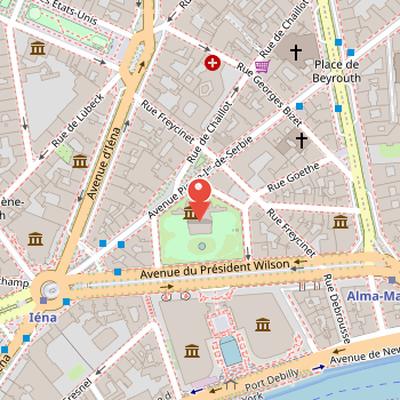
Nearby Objects
-
 Musée d'art moderne de Paris 150 m away
 -
 Musée d’Art Moderne 150 m away
 -
 St. Stephen's Greek Orthodox Cathedral 200 m away
 -
 Guimet Museum 200 m away
 -
 Avenue d'Iéna 300 m away
Palais Galliera and Its Fashion Museum
Palais Galliera is located on the Chaillot hill in the 16th arrondissement of Paris. It is a French neo-Renaissance style museum and is known for housing collections of nearly 100,000 items. The museum holds one of the most important fashion collections worldwide and presents fashion history from the 18th century to the present.
Its programming also includes temporary exhibitions, each lasting approximately four to six months. Since 2013, Palais Galliera has been one of fourteen museums in Paris managed by Paris Musees.
Access and Surroundings
Palais Galliera is accessible at 10 avenue Pierre-de-Serbie. It is served by metro line 9 at Iena station and by RER C at Pont de l'Alma station. The site is located between rue de Galliera and rue Maria-Brignole. It also faces Palais de Tokyo across avenue du President-Wilson, placing it within a prominent urban setting.
The Museum Palace of the Duchess of Galliera
Palais Galliera is the former museum palace of the Duchess of Galliera, built between 1878 and 1894 by the architect Leon Ginain. The Duchess of Galliera, Maria Brignole Sale De Ferrari, inherited a fortune after her husband's death in 1876 and intended to use it for charitable works. She owned many plots of land in Paris and decided to build a museum to house her art collection, with the wish that it would later be bequeathed to the city of Paris.
The donation was made by authentic deed before Maaitre Delapalme, a notary in Paris, and the Duchess undertook to build both the museum and the square at her own expense. A presidential decree accepted the donation, and two planned streets were named rue Maria-Brignole and rue de Galliera and classified as public roads. Construction began on February 12, 1878. In a holographic will dated October 4, 1879, the Duchess charged the city of Paris with completing the museum for a maximum sum of 1,500,000 francs, covering all completed and remaining work.
The Duchess died before the end of construction. Her heirs deposited a sum of francs with the receiver of the city of Paris in 1888 to finish the works, and the municipal council decided on September 27, 1889 to accept the donation and receive the museum and square after completion. The heirs then completed the works with Leon Ginain. The works were finished on May 24, 1894.
From Private Project to Exhibition Venue
The city of Paris received the Brignole-Galliera museum and square on 24 May 1894, after the Galliera collection left France for Italy. The initial project of the duchess of Galliera did not come to fruition, but the city adapted the building for public use by depositing works it owned there and turning it into a venue for temporary exhibitions. Its first exhibition, devoted to portraits of women and lace, was inaugurated by President Felix Faure on 29 April 1895.
In 1902, at the initiative of Maurice Quentin-Bauchart, the city decided to establish an industrial art museum. Over time, the Brignole-Galliera museum also hosted contemporary art exhibitions and was rented to Parisian auctioneers for prestigious sales. Among the notable events held there was the salon du Franc in 1926, an exhibition-sale supporting the franc.
The museum also remained a site of cultural activity in the mid-20th century. In 1948, Histoire visited the Galliera Museum during an exhibition on 800 years of English life and art and gave a speech in French there. Gastion Balande painted a picture about this reception involving Histoire, showing the museum's continuing role as a place for exhibitions and public events.
Design and Early Museum Function
Palais Galliera was designed under the project direction of Leon Ginain, at the request of the duchesse de Galliera. Ginain drew plans inspired by the duchesse's palace in Genes, and the building combines a Beaux-Arts design with a stone envelope that recalls the Italian Renaissance. Its metallic structure was made by the Compagnie des etablissements Eiffel. The building opened in 1895 as the musee d'Art industriel, giving the Parisian public the opportunity to discover textile art and fashion accessories in a museum setting. Formerly known as palais Galliera, it was conceived as a permanent institution with regular rotation of exhibited pieces.
Maurice Leloir and the Museum Exhibitions
Maurice Leloir organized two exhibitions at musee Galliera in 1937 and 1938. During the 1937 Exposition Universelle, he presented Cent ans de costume parisien, an exhibition that brought together costumes, accessories, paintings, drawings, and engravings. The display was successful and reflected Leloir's work as a collector of historical clothing. He also addressed practical questions linked to reconstructing ancient pieces and considered how mannequins should be presented.
In 1938, Palais Galliera organized Costumes d autrefois. XVI, XVII, XVIII siecles, an exhibition that introduced new display methods. These two exhibitions marked an important phase in the museum's history and in Leloir's efforts to shape the presentation of costume collections. His project for a Costume Museum was later paused by the outbreak of the Second World War. Leloir died in 1940 and did not live to see the museum inauguration in 1956 under Madeleine Delpierre.
Relocation and Expansion of Palais Galliera
The museum first occupied the ground floor of the Musee d Art moderne de la Ville de Paris. It closed in 1971 and then rejoined the musee Carnavalet after that closure. In 1977, the museum took place within the Palais Galliera, as desired by Maurice Leloir and his associates. During a later period of closure, the musee Galliera continued to present exhibitions outside its own walls, with shows held at the Docks, Cite de la mode et du design, and Paris city hall.
The museum's collection history is closely tied to the Societe de l histoire du costume, whose holdings make up 40 percent of the XVIIIe department of Musee Galliera. In summer 2021, a permanent collection was installed in the newly arranged basement. This collection presents fashion history from the eighteenth century to the present.
The museum was closed again for basement expansion and for the creation of a bookstore and cafe, under Dominique Brard. The extension was funded by Chanel, which supported the Galeries Gabrielle Chanel, doubling the exhibition area. The basement galleries, with red bricks and dressed stones, added 700 square meters to the museum. A workshop room for cultural and educational activities was also created on the garden-level floor. Altogether, 5000 square meters of the building were renovated, with balustrades consolidated and facades restored before the museum reopened after the expansion works.
Museum Direction Changes
The direction was led by historian Olivier Saillard until the beginning of 2018. The facts also note later leadership changes beyond that point, including Arzalluz taking direction of the Guggenheim Museum in Bilbao in 2025 and Emilie Hammen replacing direction at the Guggenheim Museum in Bilbao. These details indicate a sequence of administrative transitions linked to museum leadership.
Exhibitions and Collection Routes
Palais Galliera presents an average of three exhibitions each year on different aspects of fashion. The exhibitions cover historical periods, famous wardrobes, and designers including Margiela, Fortuny, Balenciaga, Lanvin, Alaia, Comme des Garcons, Gres, and Carven. Since 2021, the collections have been shown at garden level through renewed thematic routes designed for preventive conservation. The museum also inaugurated new galleries with the collection route titled "Une histoire de la mode. Collectionner, exposer au Palais Galliera". A second route, "La Mode en mouvement", traces the history of fashion from the 18th century to the present through three display arrangements.