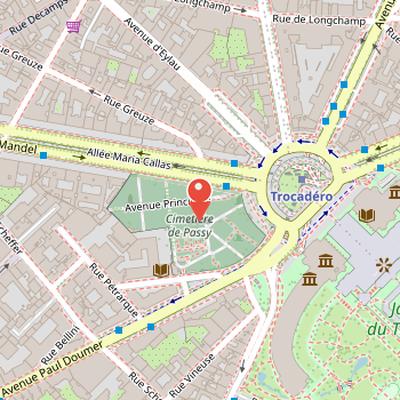
Passy Cemetery is a cemetery in Paris, located at 2, Rue du Commandant Schlœsing, behind the Trocadéro and in the shadow of the Eiffel Tower. It opened in 1820 near the Champs-Élysées in an expensive district of the Right Bank, replacing the old communal cemetery on Rue Lekain, which had been closed in 1802. The cemetery was part of Napoleon I’s wider plan to replace Paris cemeteries with several large new ones outside the capital, alongside Montmartre Cemetery in the north, Père Lachaise Cemetery in the east, and Montparnasse Cemetery in the south. By 1874, Passy Cemetery had become the aristocratic necropolis of Paris. Its current entrance, built in 1934, was designed by René Berger. The cemetery is also noted as the only cemetery in Paris with a heated waiting-room. Its retaining wall includes a bas relief by Louis Janthial commemorating World War I soldiers. The cemetery has also contained notable graves and monuments, including works associated with Dunikowski and various memorials shown in the gallery.
Nearby Objects
-
 Place du Trocadéro 160 m away
 -
 Musée de l’Homme 150 m away
 -
 Chaillot Palace 200 m away
 -
Théâtre national de Chaillot 200 m away
-
 Cité de l'architecture et du patrimoine 250 m away
History and memorial features
Passy Cemetery replaced the old communal cemetery of Passy on Rue Lekain, which was closed in 1802. Its creation followed an order from Napoleon I to replace the cemeteries of Paris with several large new burial grounds outside the capital, alongside Montmartre Cemetery in the north, Pere Lachaise Cemetery in the east, and Montparnasse Cemetery in the south. Passy Cemetery opened in 1820 near the Champs-Elysees, in the expensive districts of the Right Bank, and by 1874 it had become the aristocratic necropolis of Paris.
The cemetery also has several notable architectural and commemorative features. It is the only cemetery in Paris with a heated waiting-room. Its current entrance was designed by Rene Berger and built in 1934. The retaining wall includes a bas relief by Louis Janthial commemorating World War I soldiers. The cemetery formerly housed a statue by Dunikowski titled The Soul Escaping the Body on the grave of Antoni Cierplikowski, but the statue was removed when the grave was cleared in 2004.
Location and Setting
Passy Cemetery has an entrance at 2 Rue du Commandant Schl oesing, on a street named for Squadron Leader Jacques-Henri Schl oesing, a Free French pilot who lived from 1919 to 1944. Schl oesing flew with the wartime RAF until he was killed in action on the day Paris was liberated. The cemetery is located behind the Trocadero and lies in the shadow of the Eiffel Tower. Its setting gives it a clearly defined place within this part of Paris, with the entrance tied to a street name that recalls a wartime figure associated with the liberation period.
Notable Graves and Memorials
The gallery at Passy Cemetery highlights a number of notable graves and memorials. It shows the grave of Bảo Dai, the last Emperor of Vietnam, as well as the graves of the artist Edouard Manet and the composer Claude Debussy. Other featured sites include the grave of Leila Pahlavi, the grave of Antonio Guzman Blanco in Cementerio de Passy, Paris, and the grave monument of Fernandel. The cemetery is also represented by the mausoleum of the Guerlain clan and the tomb of Marie Bashkirtseff, which is described as a recreation of her studio. Together, these examples indicate the cemetery's association with a range of public figures and commemorative forms.