Porte Saint-Denis is a triumphal arch in the current city of Paris, built in 1673 by the architect François Blondel to honor Louis XIV. It stands at the site of a Paris gate belonging to the former enclosure of Charles V, and the adjacent walls have since been destroyed. The monument is regarded as one of the most representative works of the official art of its period.
The name Porte Saint-Denis has been used for several successive gates on the rue Saint-Denis axis in Paris history. Earlier gates included a first gate near the crossroads of rue de la Ferronnerie and rue de la Reynie, a second known as porte aux Peintres, and a third or bastide Saint-Denis, described as a fortified structure with a drawbridge, a fixed bridge, and an outpost. As Paris expanded, medieval fortified gates were replaced by triumphal gates. The present monument was erected in 1672–1673 under Louis XIV. It has been classified as a historic monument since 1862, and restoration work was undertaken in 1988.
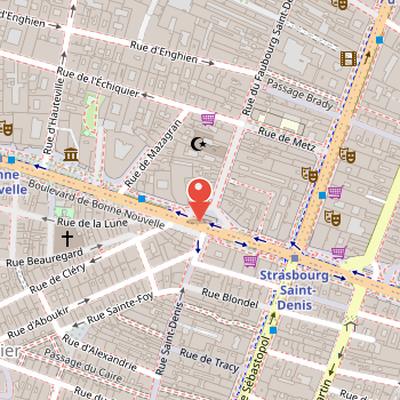
Nearby Objects
-
 Théâtre Antoine 250 m away
 -
 Porte Saint-Martin 250 m away
 -
 Théâtre du Gymnase Marie Bell 300 m away
 -
 Théâtre de la Renaissance 300 m away
 -
 Théâtre de la Porte Saint-Martin 300 m away
Architecture and Historical Setting
Porte Saint-Denis is an arch of triumph located in the current city of Paris and built in 1673. It was constructed by the architect Francois Blondel to honor Louis XIV. The monument stands at the site of a Paris gate from the former enclosure of Charles V, while the adjacent walls have since been destroyed. Porte Saint-Denis is considered one of the most representative monuments of the official art of its era.
Historical Successive Gates on the Rue Saint-Denis Axis
The name porte Saint-Denis refers to five successive constructions along the rue Saint-Denis axis in Paris history. The first was located before the crossroads of rue de la Ferronnerie and rue de la Reynie, at number 548 rue Saint-Denis. A second gate, called the porte aux Peintres, stood north of the crossroads of rue Saint-Denis and rue Etienne-Marcel. The impasse des Peintres marks the location of the outer chemin de ronde. The third porte Saint-Denis, also called bastide Saint-Denis, was situated south of the current arc de triomphe at numbers 210 and 212 rue Saint-Denis, beyond rue Blondel. It consisted of a building with a drawbridge, a fixed bridge, and an outpost.
As Paris expanded, the fortified wall of the 14th century was replaced by a fiscal barrier with a wall and boulevard, and medieval fortified gates gave way to triumphal gates. The fourth porte Saint-Denis was erected in 1672 by architect Francois Blondel and sculptor Michel Anguier by order of Louis XIV. It was funded by the city and commemorated victories on the Rhine, Maastricht, and Franche-Comte. This gate was built on a bastion from the previous century, at the site of a medieval gate in Charles V's enclosure. The old porte aux Peintres of the Philippe Auguste wall is now destroyed and is sometimes also called porte Saint-Denis, while the porte Saint-Denis of the Charles V wall was rebuilt under Louis XIV. The gate appears on the Truschet and Hoyau plan of Paris around 1550 and on the Vaugondy plan of Paris in 1760. The area around porte Saint-Denis was also a battleground between insurgents and troops during the Trois Glorieuses, and a combat at porte Saint-Denis is noted in 1830. The monument has been classified as a historic monument since 1862, and restoration work was carried out in 1988.
Historic Crossings around Porte Saint-Denis
The historic area around Porte Saint-Denis was shaped by several former crossing points. Rue du Faubourg-Saint-Denis crossed the mur des Fermiers generaux at the barriere Saint-Denis, which was renamed barriere Franciade during the Revolution, at the present intersection with boulevard de la Chapelle on the odd-numbered side. Farther on, rue Marx-Dormoy and rue de la Chapelle lead to the current porte de la Chapelle just past the crossing with boulevard Ney. The old porte de la Chapelle was formerly called the fifth porte Saint-Denis and was a crossing point of the Thiers fortifications between bastions.
Architecture and Decoration of Porte Saint-Denis
Porte Saint-Denis is a triumphal arch inspired by the Arch of Titus in Rome. Auguste Choisy described its composition in Histoire de l'architecture as based on the division of a square by two and three. The monument is pierced by a large arch and two small doors in the piedestaux attached to the piedroits; the small doors measure 1.70 meters in height. On the city side, obelisks charged with trophies rise to the height of the entablature, and two seated figures at their foot represent the United Provinces, sculpted after Lebrun's drawings. Above the arch, between the archivolt and the entablature, are bas-reliefs by Michel Anguier. The frieze of the entablature carries a bronze dedication to Louis the Great, and on both sides the Latin date of construction, 1673, is inscribed, indicating the prefect and ediles who ordered the work.