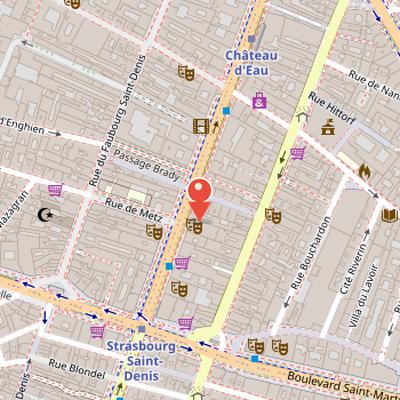
Théâtre Antoine-Simone-Berriau is a Parisian private theater located in the 10th arrondissement on Boulevard de Strasbourg. It has been listed as a Monument historique since 1989. The building is named after French actor and theater director André Antoine and also bears the name of actress and theater director Simone Berriau.
Opened in 1866 as the Théâtre des Menus-Plaisirs, the theater changed name several times during its history, including Théâtre des Arts, L’Opéra-Bouffe, Les Menus Plaisirs, Comédie-Parisienne, and Théâtre Antoine. André Antoine became permanently associated with the theater in 1881, and from 1889 to 1899 it presented a mixed program of operettas, comedies, and socially critical plays following Théâtre Libre principles. The theater also served as a venue for significant premieres, including Die Wildente by Henrik Ibsen in 1891 and the French premiere of Die Weber by Gerhart Hauptmann in 1892. Under Simone Berriau, who directed the theater from 1943, it premiered all of Jean-Paul Sartre’s dramas and hosted world or French premieres by several major playwrights.
Nearby Objects
-
 Porte Saint-Martin 150 m away
 -
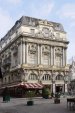 Théâtre de la Renaissance 200 m away
 -
 Théâtre de la Porte Saint-Martin 200 m away
 -
 Porte Saint-Denis 250 m away
 -
 Théâtre du Gymnase Marie Bell 500 m away
Theatre Antoine - Simone-Berriau
Theatre Antoine - Simone-Berriau is a Parisian private theater in the 10th arrondissement, located on Boulevard de Strasbourg. It has been listed as a Monument historique since 1989. The theater is named after French actor and theater director Andre Antoine, and it also bears the name of Simone Berriau, an actress and theater director. Under Simone Berriau, the theater premiered all of Jean-Paul Sartre's dramas starting in 1943, a fact that underlines its role in French theatrical history.
Name Changes and Early Programming
The theatre opened in 1866 as the Theatre des Menus-Plaisirs. Over time, it changed its name several times: it was called Theatre des Menus-Plaisirs from 1866 to 1874, from 1877 to 1879, and from 1882 to 1888; Theatre des Arts from 1874 to 1876 and from 1879 to 1881; L'Opera-Bouffe from 1876 to 1877; Les Menus Plaisirs in 1877; and Comedie-Parisienne in 1881. It was permanently directed by Antoine from 1881, when it took the name Theatre Antoine. Between 1889 and 1899, the theatre presented a mixed program of operettas, comedies, and socially critical plays, following Theatre Libre principles.
Major Premieres and Artistic Direction
The theatre built a significant reputation through a long series of premieres and notable artistic directions. It presented Die Wildente by Henrik Ibsen in 1891 and hosted the French premiere of Die Weber by Gerhart Hauptmann in 1892. From 1943, it was directed by Simone Berriau, under whom it premiered all plays by Jean-Paul Sartre. During this period, the theatre also hosted world premieres or French premieres of dramas by Albert Camus, Jean Cocteau, Arthur Miller, Luigi Pirandello, and Harold Pinter.
Under Simone Berriau, the theatre also attracted innovative directors such as Peter Brook. In 1956, Brook staged the first French production of Die Katze auf dem heißen Blechdach by Tennessee Williams there, with Jeanne Moreau, Henri Guisol, and Paul Guers in the cast. Two years later, it hosted the French premiere of A View from the Bridge by Arthur Miller, also staged by Brook. In 1959, the theatre presented an adaptation of Dostoevsky's novel Die Dämonen by Albert Camus, featuring Pierre Blanchar, Tania Balachova, Pierre Vaneck, Michel Bouquet, Alain Mottet, Charles Denner, and Roger Blin.
After Simone Berriau's death in 1984, Helena Bossis took over direction, followed by Daniel Dares after Bossis's death in 2008. The theatre is currently owned and directed by Jean-Marc Dumontet, born in 1966. In 2010, it joined the Association pour le soutien du theatre prive and the Syndicat with 50 Parisian private theaters.
Architecture and Interior of the Theatre
The theatre building was designed in the mid-1860s and conceived and constructed in cooperation with Andre Antoine and Henri Grandpierre. Its technical equipment was handled by Edouard Clemancon, who also installed innovative lighting technology in several Paris theaters and opera houses and equipped the Paris Opera with gas lighting after the fire in 1887. The interior decoration and color design were carried out by Marcel Deligniere.
The facade is three stories high and follows an Italianate historicist style. It is richly decorated with Corinthian pilasters, acanthus friezes, mascarons, and rosettes. A small triangular pediment crowns the facade, with a theater mask in the gable field. On the upper floor, a cartouche displays a lyre and the year 1881. Between the piano nobile and the upper floor, a colored tendril frieze includes three mosaic panels inscribed COMEDIE, MUSIQUE, and DRAME.
Inside, the rooms feature typical 19th-century French cast iron architecture. The hall has parquet flooring, three tiers, and a box stage, and its layout is oriented toward late 18th-century historic theater architecture. The auditorium has 799 seats.