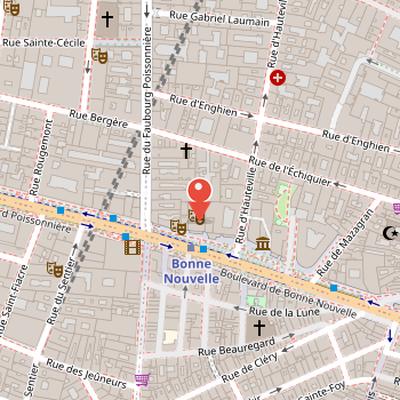
Théâtre du Gymnase Marie Bell is a theatre building in Paris, located at 38, boulevard de Bonne-Nouvelle and served by the Bonne-Nouvelle metro station. The venue has 800 seats, as well as two smaller rooms: the studio Marie-Bell, with 90 seats, and the Petit-Gymnase, with 160 seats. It is registered as a historical monument.
The theatre’s history began in 1820, when M. Lugan de La Rozerie sought to give Paris a theatre for beginner actors. The name Gymnase was chosen to evoke a place for physical and mental exercise. Opening conditions limited the repertoire to condensed versions of Comédie-Française and Opéra de Paris works, with multi-act plays reduced to one act and one-act plays to one scene. The theatre, intended as a training venue for conservatory students, was constructed by architects Auguste Rougevin and Louis-Régnier de Guerchy on former grounds that included the gardens of Baron Louis’ hotel and part of the Bonne-Nouvelle cemetery. It was later renamed Théâtre de Madame, then resumed the name Gymnase-Dramatique after the July Revolution. The building’s history also includes renovation, gas lighting installed in 1823, and periods of closure linked to changes in condition and upkeep.
Nearby Objects
-
 Le Grand Rex 90 m away
 -
 Porte Saint-Denis 300 m away
 -
 Église Saint-Eugène-Sainte-Cécile 300 m away
 -
 Folies Bergère 450 m away
 -
 Théâtre Antoine 500 m away
Location and Auditorium Capacity
The Theatre du Gymnase Marie Bell is a Parisian theater located at 38, boulevard de Bonne-Nouvelle. It has an 800-seat main auditorium, along with two smaller performance spaces: the studio Marie-Bell, which seats 90, and the Petit-Gymnase, which seats 160. The building is registered as a historical monument, reflecting its protected status within the urban heritage of Paris. It is also served by the Bonne-Nouvelle metro station, which provides access to the venue.
Origins and Early Repertoire
In 1820, M. Lugan de La Rozerie sought to give Paris a theater for beginner actors. The name Gymnase was chosen to indicate a place for physical and mental exercise, and the Gymnase-Dramatique was intended as a training venue for conservatory students. A privilege was granted for the theater's opening, but it came with strict conditions governing the repertoire. Young actors could perform works from the Comedie-Francaise and the Opera de Paris only when these plays were condensed: multi-act plays had to be reduced to one act, and one-act plays to one scene. M. Lugan de La Rozerie accepted these conditions.
The construction of the theater was entrusted to the architects Auguste Rougevin and Louis-Regnier de Guerchy. It was built on the former gardens of Baron Louis' hotel and on part of the Bonne-Nouvelle cemetery. The theater was inaugurated with plays including La Visite a la Campagne and Le Boulevard Bonne-Nouvelle. Later, M. Lugan de La Rozerie transferred his operating rights to Delestre-Poirson.
Under Delestre-Poirson, the theater underwent several changes. Gas lighting was installed in 1823, and in 1824 the venue was renamed Theatre de Madame after receiving the favor of the duchesse de Berry. Delestre-Poirson expanded the repertoire to include two-act and three-act plays and introduced comedies-bouffes, including La Fee Urgele by Charles-Simon Favart. He also contracted Eugene Scribe exclusively.
After the Trois Glorieuses revolution, the theater was closed for renovation and later resumed the name Gymnase-Dramatique after the July Revolution. It was closed again for about twelve days because of severe dilapidation, and some parts of the theater were sacrificed in order to improve others. In 1844, Adolphe Lemoine, called Montigny, became director. He gradually moved away from moral and edifying plays in favor of the sentimental genre, including works with compromising situations and calculated effronteries.
Notable Playwrights and Early Premieres
The theatre's history is linked with a number of major playwrights, including Balzac, Emile Augier, George Sand, Edmond About, Victorien Sardou, Octave Feuillet, Meilhac and Halevy, and Alexandre Dumas father and son. It was also the site of important first performances. Le Voyage de monsieur Perrichon by Eugene Labiche and Edouard Martin was created there in 1860. Henri Meilhac and Ludovic Halevy presented their first play, Fanny Lear, at the theatre in 1868, followed by Frou-Frou the next year.
Late 19th-Century Transformations
After Montigny died in 1880, Victor Koning took over as director of the Theatre du Gymnase and transformed the theatre with architect Charles de Lalande. The salle was entirely redecorated, with Alfred Rube and Philippe Chaperon painting the stage curtain decoration. The ceiling of the salle was also decorated by Compan and Plumet, who created allegories of the seasons. In 1894, Koning ceded the position to Albert Carre and Paul Porel. Carre later became director of the Opera-Comique in 1898 and retired from the direction of the Theatre du Gymnase.
Directors and Productions in the 20th Century
From autumn 1899 until 1919, Alphonse Franck directed the Theatre du Gymnase, soon joined by Gustave Quinson. In 1926, the dramatist Henry Bernstein became director and created most of his best known works there, including Samson, La Rafaie, La Galerie des Glaces, Melo, Le Bonheur, and Le Messager. In 1940, Bernstein was replaced by Mme Paule Rolle, who hosted Jean Cocteau's play Les Parents Terribles. From 1939 onward, the theatre also allowed the creation of works by Marcel Pagnol, Jean Cocteau, Marc-Gilbert Sauvajon, Sacha Guitry, Felicien Marceau, and Jean Genet. In 1956, Paule Rolle partnered with Marie-Rose Belin, former director of the Theatre Gramont. The theatre then continued to stage important productions, including Le Balcon by Jean Genet, directed by Peter Brook in 1960. In 1962, the tragedienne Marie Bell took over the direction and performed a notable Phdre at the theatre. She remained in charge until her death, after which Jacques Bertin, administrator since 1975, succeeded her. The Theatre du Gymnase also works in partnership with the Comedie des boulevards theatre. More recently, Antoine de Caunes filmed Coluche, l'histoire d'un mec there in 2007, and in 2010 the theatre joined 49 other private Parisian theatres under Les Theatres parisiens associes. It also hosted the Bobards d'Or event organized by Fondation Polemia.