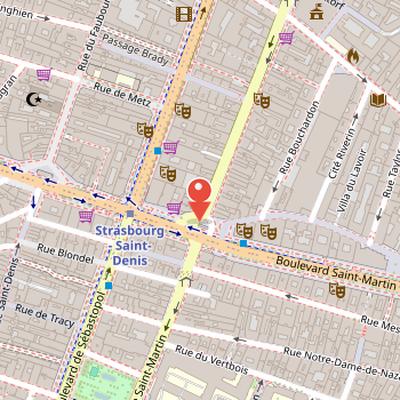
Porte Saint-Martin is a 17th-century triumphal arch on the Grands Boulevards in Paris, in the 10th Arrondissement. It stands at the intersection of Rue Saint-Martin, Rue du Faubourg Saint-Martin, Boulevard Saint-Martin, and Boulevard Saint-Denis, near Strasbourg – Saint-Denis metro station. The current monument was built about 60 meters north of the former city gate of the same name. Around 1670, the Grands Boulevards were laid out on the site of the 14th-century wall of Charles V. Built in the form of an ancient triumphal arch, the monument was dedicated by the city of Paris to Louis XIV in 1674 to commemorate his victories in Franche-Comté during the Dutch War. The architect was Pierre Bullet, a student of François Blondel, who built the nearby Porte Saint-Denis. The arch measures 18 meters in height and width and is made of large, regularly hewn limestone blocks with clearly marked joints. Its central opening is a large round arch, flanked by two smaller side passages. Reliefs decorate the north and south sides, depicting military victories and allegorical figures.
Nearby Objects
-
 Théâtre de la Renaissance 60 m away
 -
 Théâtre de la Porte Saint-Martin 80 m away
 -
 Théâtre Antoine 150 m away
 -
 Porte Saint-Denis 250 m away
 -
 Musée des Arts et Métiers 350 m away
Location and Heritage Status
Porte Saint-Martin is a 17th century triumphal arch on the Grands Boulevards in Paris, in the 10th Arrondissement. It stands at the intersection of Rue Saint-Martin, Rue du Faubourg Saint-Martin, Boulevard Saint-Martin, and Boulevard Saint-Denis. The nearest metro station is Strasbourg - Saint-Denis, served by lines 4, 8, and 9. In 1862, the monument was listed as a Monument historique in France.
Construction and Dedication
Around 1670, the Grands Boulevards were built at the site of the 14th-century city wall from the time of Charles V. The present Porte Saint-Martin was then constructed about 60 meters north of the former city gate of the same name. Designed by the architect Pierre Bullet, a student of Francois Blondel, it was built in the form of an ancient triumphal arch. In 1674, the city of Paris dedicated the monument to King Louis XIV to commemorate his victories in Franche-Comte during the Dutch War. The Porte Saint-Martin is also closely associated with the nearby Porte Saint-Denis, built by Francois Blondel in 1672 and located 200 meters away.
Architectural Form and Relief Program
Porte Saint-Martin is a triumphal arch measuring 18 meters in both height and width. It was built from large, regularly hewn limestone blocks with clearly marked joints, giving the structure a precise and monumental appearance. The composition includes a large round-arched arcade in the center and two side passages that are half the size of the central opening.
The arch is decorated on both the north and south sides with reliefs that present military victories and associated allegorical figures. On the north side, the left relief by Gaspard Marsy shows the defeat of the Habsburgs. In this scene, Ludwig XIV is shown as the war god Mars, driving away an eagle and holding a shield with three lilies. The right relief on the north side, attributed to Pierre Le Gros, depicts a sorrowful female figure beside a lying lion, symbolizing the conquest of Limburg. A Latin inscription on the north side of the marble-clad attic refers to Ludwig the Great's capture of Limburg and the repelling of enemy threats in 1675.
The south side reliefs represent the capture of Besancon and the breaking of the alliance against France. These sculptures are attributed to Martin Van den Bogaert, called Desjardins, on the right, and Etienne Lehongre on the left. Ludwig XIV appears as Hercules with a club and lion skin, while the goddess Victoria crowns him with a laurel wreath. A kneeling woman offers him the keys of the city of Besancon. A Latin inscription on the south side refers to Ludwig the Great's conquests and military victories in 1674.