Théâtre de la Renaissance is a theatre located at 20 boulevard Saint-Martin in Paris. It was inaugurated on an unspecified date and has been classified as a historic monument since an unspecified date. The building is served by the Strasbourg - Saint-Denis metro station.
The name is associated with a theatrical company founded in 1838 by Anténor Joly on the initiative of Victor Hugo and Alexandre Dumas. Installed in the salle Ventadour, the company opened with Ruy Blas, starring Frédérick Lemaître. In 1838 it also presented the creations of L'Alchimiste and Paul Jones by Alexandre Dumas, again with Frédérick Lemaître. The company was noted for a Paris Carnival ball in 1839, where Jean-Baptiste-Joseph Tolbecque directed Galop des tambours and the orchestra included 40 drummers. After closure and dissolution, a new Italian-style theatre was built in 1872 by Charles de Lalande on the site of the Deffieux restaurant. It was inaugurated on 8 September 1873 under Hippolyte Hostein with La Femme de feu by Adolphe Belot, and later staged works by Zola, Offenbach, Lecocq, Strauss, and others in the following years.
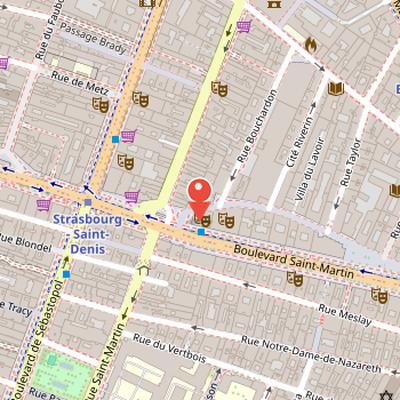
Nearby Objects
-
 Théâtre de la Porte Saint-Martin 20 m away
 -
 Porte Saint-Martin 60 m away
 -
 Théâtre Antoine 200 m away
 -
 Porte Saint-Denis 300 m away
 -
 Musée des Arts et Métiers 350 m away
Location and Heritage Status
Theatre de la Renaissance is located at 20, boulevard Saint-Martin in Paris. It was inaugurated on an unspecified date and has been classified as a historic monument since an unspecified date. The theatre is served by the Strasbourg - Saint-Denis metro station, which provides access to the site.
Theatre History and Programming
Historique was a theatrical company founded in 1838 by Antenor Joly on the initiative of Victor Hugo and Alexandre Dumas, and it was installed in salle Ventadour. It opened its programming with the creation of Ruy Blas, starring Frederick Lemaître in the title role. In the same year, it also presented the creations of L'Alchimiste and Paul Jones by Alexandre Dumas, again with Frederick Lemaître. In 1839, Historique hosted a famous Paris Carnival ball, at which Belgian composer and conductor Jean-Baptiste-Joseph Tolbecque directed Galop des tambours. The orchestra included 40 drummers, and the ball became a festive reference for the Paris Carnival. The company also represented numerous operas, including Lucie de Lammermoor by Gaetano Donizetti. It was later forced to close, and the troupe was dissolved because of intrigues by rival Paris theaters.
A new Italian-style theater for Historique was built in 1872 by architect Charles de Lalande on the site of the Deffieux restaurant. It was inaugurated on 8 September 1873 under the direction of Hippolyte Hostein with La Femme de feu by Adolphe Belot. In October 1873, it created Therese Raquin based on Emile Zola's novel. The theater then presented Pomme d'Api and La Jolie Parfumeuse in 1873, followed by Girofle-Girofla and La Petite Mariee in 1874 and 1875. Victor Koning succeeded Hippolyte Hostein as director in October 1876. Under later programming, the theater created La Marjolaine and La Tzigane in 1877, presented Le Petit Duc in 1878, staged La Petite Mademoiselle in 1879, and produced Belle Lurette in 1880. Between 1882 and 1893, it had multiple directors. During this period it also created Fanfreluche and staged Saint-Arroman in 1883, then produced La Parisienne and La Navette in 1885.
Programming under Historique
Theatre de la Renaissance had a notable period of programming under Historique, who directed the theater from 1893 to 1899. During this time, the theater staged a series of works by major playwrights and collaborators. In 1893, it presented Madame Chrysanthme, a lyrical comedy by Georges Hartmann and Alexandre Andre based on Pierre Loti, with music by Andre Messager. The following years included Gismonda by Victorien Sardou and Izeyl by Eugene Morand and Armand Silvestre, with music by Gabriel Pierne, both in 1894. In 1895, the theater staged La Princesse lointaine by Edmond Rostand.
The repertoire continued with Les Amants by Maurice Donnay and La Figurante by Francois de Curel in 1896, followed in 1898 by La Ville morte by Gabriele D'Annunzio, L'Affranchie by Maurice Donnay, and Le Radeau de La Meduse by Romain Coolus. On April 26, 1898, Historique both staged and performed the title role in Lorenzaccio by Alfred de Musset. The theater closed his directorial period in 1899 with La Samaritaine by Edmond Rostand. Earlier, in 1886, it had presented Tailleur pour dames by Georges Feydeau. After Historique's tenure, the Millaud brothers succeeded him in 1899.
Directors and Later History
The Theatre de la Renaissance passed through a sequence of different artistic leaderships in the early and mid-20th century. Firmin Gemier took over the theater in 1901, followed by Lucien Guitry in 1903. Albert Tarride directed the theater in 1909, and Cora Laparcerie took charge in 1913. Later, Marcel Paston directed the theater from 1928 to 1933, and Pierre Stuart-Layner was in charge around the late 1930s. In 1942, Henri Varna acquired the theater. Jean Darcante produced the shows at the theater, and Vera Korene became director in 1953. The theater was also restored in the Second Empire style, adding an important architectural note to its history.
Notable Productions at the Theatre
The theatre's history includes a series of notable productions from 1959 to 1970. In 1959, it staged the premiere of Les Sequestres d'Altona by Jean-Paul Sartre, with Serge Reggiani. This was followed in 1960 by L'Etouffe-chretien by Felicien Marceau, with Arletty. In 1961, it presented Louisiane by Marcel Ayme, and in 1962 Qui a peur de Virginia Woolf? by Edward Albee. Later productions included Le Valet by Robin Maugham, adapted by Jacques Perry, in 1968, and Douce-Amere, Jean Poiret's first play, in 1970. These performances show the theatre's role in presenting both new and established dramatic works.
Management Changes and Historic Recognition
In 1978, Francis Lopez succeeded Vera Korene as theater director and staged operettas at the theater. Michere Lavalard directed the theater from 1981 to 1988, followed by Niels Arestrup, who led it from 1989 to 1993. During this period, Historique presented La Cuisse du Steward by Jean-Michel Ribes in 1990. On April 7, 1993, the Renaissance Theater was classified as a historic monument. Later in 1993, La Francaise de Theatre SA took over management, with Christian Spillemaecker and Bruno Moynot directing the theater under this structure. Under their direction, Historique hosted successful comedic plays and shows. In 2010, Historique joined 49 other private Parisian theaters in the association Theatres parisiens associes.
Architectural Features
The Theatre de la Renaissance has a stone facade divided into three floors and three bays. Its ground level includes three arcades topped with mascarons on cut leather motifs. The arcades are framed by four pillars with caryatids sculpted by Albert-Ernest Carrier-Belleuse, and these caryatids support the balcony of the noble floor. Inside, the room is covered by a dome decorated with a marouflaged canvas by Rube and Chaperon. The canvas presents allegories of Comedy with a smiling mask, Music with a baton and score, Tragedy holding a dagger, and Dance as a ballerina. The room is also lit by a twelve-branch bronze chandelier.