The Théâtre de la Porte Saint-Martin is a theatre building in Paris, located at 16 Boulevard Saint-Martin in the 10th arrondissement. It was originally designed with 1,800 seats and was one of the largest boulevard theatres. The building has been listed as a historic monument since 1992.
The site’s earlier history includes a temporary opera house built in 1781 under Nicolas Lenoir to house the Paris Opera after the previous opera building burned down. Inaugurated on 27 October 1781, it later stood empty for several years, was used for political events, and was sold by the state in 1799. Under its current name, the theatre opened on 30 September 1802. Its repertory included spectacular plays, comedies, ballets, and melodramas by Pixérécourt, including Robinson Crusoë in 1805. After a closure in 1807 and a reopening in 1810 under the name Jeux Gymniques, the theatre later regained its original name and melodramas under new management in 1814.
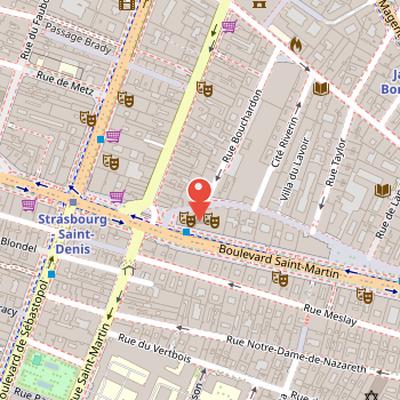
Nearby Objects
-
 Théâtre de la Renaissance 20 m away
 -
 Porte Saint-Martin 80 m away
 -
 Théâtre Antoine 200 m away
 -
 Porte Saint-Denis 300 m away
 -
 Musée des Arts et Métiers 350 m away
Historic Status and Scale
Theatre de la Porte Saint-Martin is a Parisian theater hall located at 16 Boulevard Saint-Martin in the 10th arrondissement of Paris. It has been listed as a historic monument since 1992. The theater originally had 1800 seats, which made it one of the largest boulevard theaters. Its size and protected status highlight its place in the urban and cultural history of the area.
From Opera House to Political Venue
Built in 1781, reportedly in only three months, the Ausweichquartier der Opra was designed by Nicolas Lenoir to house the Paris Opera after its former building had burned down. It was inaugurated on October 27, 1781, and continued to serve the company until the Opera moved to Rue de Richelieu in 1794. After this departure, the building stood empty for several years. It was later used for political events, marking a shift from theatrical to public and political functions. The state sold the building in 1799.
Early History and Repertoire of the Theatre
The Boulevardtheater opened under its current name on September 30, 1802, and established itself with a mixed repertory of spectacular plays, comedies, and ballets. It also staged melodramas by Pixerecourt, including Robinson Crusoe in 1805. In 1807, however, it was closed as a result of the Napoleonic theatre decree. The theater reopened in 1810 under the name Jeux Gymniques, but its license imposed strict limits: no more than two speaking actors were allowed on stage, and any additional roles had to be silent. These restrictions prevented it from securing a stable position, and it failed to establish itself under the new conditions. A new privilege in 1814 restored its original name and its right to perform melodramas. After this change, it first presented La pie voleuse by Louis-Charles Caigniez. The theater became known for ballets that were said to surpass those at the Opera, and among its greatest successes were Mandrin, les Petites Danaides, and Trente ans ou la vie d’un joueur. Charles-Francois Mazurier, a mimicker and leading comic dancer, contributed to its reputation and helped make it one of the best attended theaters of the period.
Romantic Drama at the Porte Saint-Martin
At the Porte Saint-Martin, Romantic drama opened the stage to elevated tragedies performed by actors such as Frederic Lemaitre, Bocage, Charles-Gabriel Potier, Mademoiselle Georges, and Marie Dorval, alongside melodramas. It also broadened the repertoire with works by Victor Hugo, Casimir Delavigne, Alexandre Dumas, Honore de Balzac, George Sand, and Victorien Sardou. The theater presented plays including Marino Faliero, Antony, Richard Dartington, La Tour de Nesle, Marie Tudor, and Lucrece Borgia, as well as key reform dramas of French Romanticism that had been expelled from the Comedie-Francaise. Its productions also allowed stage decorations to reflect contemporary local color. Among later performances, it staged Paul Feval's Le Bossu on September 8, 1862. The Porte Saint-Martin venue closed five or six times because of bankruptcies, notably in 1840, 1851, and 1868. It was destroyed by fire in May 1870 during the Paris Commune, then rebuilt on the same site and reopened on September 28, 1873 with Marie Tudor by Victor Hugo.
Sarah Bernhardt and Late 19th-Century Success
In 1883, Sarah Bernhardt bought a theatre, but sold it shortly afterward. She remained on stage until the end of the century, although her performances were interrupted by tours in America. During this period, she played the role of Hamlet and achieved great success in Victorien Sardou's historical drama Theodora in 1884. The theatre was also associated with the premiere of Edmond Rostand's Cyrano de Bergerac on December 27, 1897, a success that was repeated in 1925.
20th Century and Contemporary Management
At the beginning of the 20th century, the theater experienced frequent changes in management. After the First World War, it hosted performers such as Fernandel, and several plays by Maurice Rostand were staged there. Following the Second World War, the chansonnier Max Reignier took over. The theater became part of the Reignier family ownership in 1949, and from 1969 it was managed by Helene and Bernard Reignier with a conservative program. In June 2001, Michel Sardou and Jean-Claude Camus assumed control, while the theater building had been reduced to 1,000 seats by that year. Sardou later sold his share to Camus in 2003.