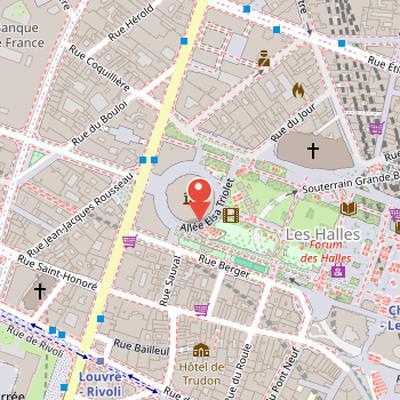
La colonne Médicis, also known as the Medicis Column, stands next to the Bourse de commerce in Paris, at the southeast of the building in the jardins des Halles. The site is served by the Louvre-Rivoli and Les Halles metro stations. Attributed to architect Jean Bullant, the hollow Doric column was erected by order of Catherine de Médicis in the courtyard of the hôtel de la Reine. It is the first isolated column constructed in Paris, measuring 30 meters high and 4 meters wide. A spiral staircase of 147 steps leads to a platform topped by a metallic structure, and the column communicates with the royal apartments through a door. Its decoration includes intertwined H and C letters, fleur-de-lys, broken mirrors symbolizing mourning, and horns of plenty. In the 18th century it was saved from destruction by Louis Petit de Bachaumont, later received a sundial, and in 1819 was adorned with a fountain. A Latin inscription reads: EXVRGIT VETVSTATE DERVSA HONORIBVS NOVIS INSTAT.
Nearby Objects
-
 Church of Saint-Eustache 150 m away
 -
 Saint-Germain l'Auxerrois 350 m away
 -
 Place des Victoires 400 m away
 -
 Equestrian statue of Louis XIV 400 m away
 -
 Les colonnes de Buren 400 m away
Location of the Medicis Column
La colonne Medicis is located next to the Bourse de commerce in Paris, in the jardins des Halles. It stands to the southeast of the Bourse de commerce. The site is served by the Louvre - Rivoli metro station and the Les Halles metro station.
Architecture and Later History of the Medicis Column
The Medicis column, also called the Histoire column, is a hollow Doric column attributed to architect Jean Bullant. It was erected by order of Catherine de Medici in the courtyard of the hotel de la Reine and is regarded as the first isolated column constructed in Paris. The structure is 30 meters high and 4 meters wide. Inside, a spiral staircase of 147 steps leads to a platform topped by a metallic structure, and the column communicates with the royal apartments through a door.
Its location near the church of Saint-Eustache limits its visual angle, yet it still dominates the center of Paris and may have served as a watchtower. It was also possibly used as an observation point for the sky by Come Ruggieri. The column is decorated on its circumference with intertwined letters H and C, representing the monogram of Henry II and Catherine de Medici. The decoration also includes fleur-de-lys, broken mirrors symbolizing mourning, and horns of plenty. The monogram is distinguished by the separate H and C, rather than the king's monogram with D letters. A Latin inscription on the column reads EXVRGIT VETVSTATE DERVSA HONORIBVS NOVIS INSTAT.
In the mid-18th century, the column and the hotel de Soissons were put up for separate sale. Louis Petit de Bachaumont acquired the column in 1748 to save it from destruction and offered it to the city of Paris, which reimbursed his investment. The hotel de Soissons was demolished and replaced by the Halle aux bles in 1763, and in 1889 the Bourse de commerce replaced the Halle aux bles on the adjacent site. The column itself survived multiple threats of destruction and architectural changes in the neighborhood. In 1786, astronomer Alexandre Guy Pingre installed a sundial at 22 meters high, but it is now missing. In 1819, the column was adorned with a fountain, though only the commemorative plaque and Paris coat of arms remain. It was classified as a historic monument in 1929.
Philippe Parreno's Light Installation
Since 2018, the summit of Histoire column has hosted a creation by artist Philippe Parreno. The installation transcribes, in light signals, the unfinished novel Le Mont Analogue by Rene Daumal. It also reacts in real time to color variations by generating associated sounds. The work links light and sound in a responsive public display, giving the column a contemporary artistic function.