The Musée de l'Armée is a military and national museum at the Hôtel des Invalides. It was created in 1905 by merging the Artillery Museum and the Historical Army Museum. The museum remained open during the First World War and acquired many objects from the Great War and the Franco-Prussian War of 1870. It also displayed war trophies, including Prussian regimental flags in the Cour des Invalides.
During the Second World War, the museum director Augustin Eugène Mariaux sent valuable pieces to the provinces in trucks in 1940 to protect them from the German advance. The convoy was attacked near Étampes, and some objects were later recovered, including a Saxon morion and relics of Napoleon I. After the war, the museum worked to recover lost objects, and most were eventually found, though some were destroyed or remain unlocated. The Cour des Invalides also displays two large howitzers from the First Empire given by the Red Army after the war.
Nearby Objects
-
 Musée Rodin 300 m away
 -
 Hôtel Biron 300 m away
 -
 Sainte-Clotilde Church 500 m away
 -
 La Pagode 650 m away
 -
 Hôtel Matignon 650 m away
A Museum Shaped by War and Recovery
The museum was created in 1905 by merging the Artillery Museum and the Historical Army Museum in the Hotel des Invalides. It did not close during the First World War and acquired many objects from that conflict as well as from the Franco-Prussian War of 1870. Among its public displays were war trophies, including Prussian regimental flags shown in the Cour des Invalides.
During the Second World War, the director, Augustin Eugene Mariaux, tried to protect important holdings by sending valuable pieces in trucks to the provinces in 1940. These vehicles were attacked by Junkers Ju 87 aircraft and abandoned near Etampes, but the objects were later returned to Paris. German soldiers found the trucks and informed the hospital at Etampes. Surviving items included a Saxon morion with traces from that day and relics of Napoleon I.
After the Germans entered Paris on June 14, 1940, they immediately sought flags captured during the First World War. German experts, including Alexander von Reitzenstein, compiled an inventory of German objects to be repatriated. The listed objects included cannons such as the Vogelgreif, described as the longest bronze cannon in the world, as well as weapons, uniforms, and Napoleon's relics. The Vogelgreif was sent back to Koblenz, its original city, while some cannons were later melted down when the Red Army entered Berlin.
After the war, the museum sent teams to recover as many lost objects as possible. Most were eventually recovered, although some were destroyed or may remain in Russia. The Red Army also gave the museum two large howitzers from the First Empire, which are displayed in the Cour des Invalides. The return of the Vogelgreif to Germany was part of postwar Franco-German reconciliation.
The Raoul and Jean Brunon Collection
The Château de l'Emperi has held the Raoul and Jean Brunon collection since it was sold to the State in 1967. The collection is exhibited in 25 rooms at the site and is described as one of the most important collections concerning the French army from Louis XIV to the Great War. Its presentation has been kept as Jean Brunon knew it when he served as museum director of this regional branch, which gives the exhibition a strong historical continuity.
Recent work has focused on preserving and updating selected areas of the museum. On 17 February 2023, the Army Museum launched a crowdfunding campaign to restore Vizir, the only naturalized horse in the collection. Vizir had been on display since 1977 in the modern department covering Louis XIV to Napoleon III. After one month of restoration, it returned to its original location in a new controlled-atmosphere showcase. In 2023, the Two World Wars room also underwent six months of restoration, with new multimedia and showcases on the post-World War I Near East and Eastern Europe. Following this work, soldiers of the navy received greater visibility in the museum.
Further changes are planned through a two-phase extension of the permanent collections. In 2024, reception and temporary exhibition spaces are to be reconfigured, new places dedicated to the site's history and current French military engagements are to be created, and a new reserve building is to be established in the suburbs. A hall dedicated to the museum's history opened in 2024, presenting masterpieces from the history of Les Invalides where mannequins were once displayed. The second phase is scheduled to begin in 2025 and will create a new itinerary on military history from 1945, the Cold War, to post-Iron Curtain events. After an inventory of 10,000 artifacts, a path titled Colonization, decolonization: a shared history will also be developed with historians and specialists from colonized countries, in order to recount the common past of France and its colonies considering all viewpoints.
Site and Scope of the Musee de l'Armee
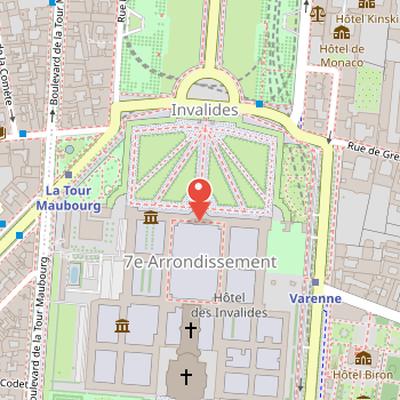
The Musee de l'Armee is part of the Hotel national des Invalides, which houses three museums and an active military hospital. It occupies the East and West wings around the Cour d'honneur, as well as one wing west of the Saint-Louis church, and it covers 40 percent of the buildings at the site. The museum also has a surface area that is increased for temporary exhibitions. Its public collections present French history from Prehistory to World War II and are arranged in six major chrono-thematic spaces. Within the wider complex, the Historial Charles de Gaulle is located in a subterranean construction under the Cour de la Valeur.
Selected Objects in the Galerie
The Galerie presents a varied group of military objects spanning several centuries. Among the older pieces are an ivory olifant from Italy, dated circa 1200, and a late 15th century Bombarde-mortier d'Aubusson, described as the largest known in the world. The collection also includes a bronze cannon from 1630 named after Cardinal Richelieu, with a female head adornment on the breech, and a Bourguignotte belonging to King Henri II from around 1550. Another notable armour is the detailed Armure aux lions of Francois, dated around 1540-1545.
The Galerie also holds several objects linked to French military history, including a sword of Francois I captured by the Spaniards at the Battle of Pavia and later recovered by Napoleon's Grande Armee. Other displayed items include a reduced model of a multiple bore mortar, a figurine called Cent-gardes, a field gun carriage, and a Renault FT tank. The collection further features a Taxi de la Marne, Renault AG-1 (G-7), a mandarin costume captured at the Battle of Hanoi by naval captain Francis Garnier, and a black flag of the Black Banners captured at the Battle of Hoa Moc. It also shows horse chasseurs of the Imperial Guard and an officer of the 1st regiment of foot chasseurs of the Guard from L'Emperi.
Shared Museum Site at the Invalides
The thematic and research departments mention two other museums located on the site of the Invalides. These museums share a common ticket office with the Army Museum, indicating that they are presented together as part of the same visitor site. This arrangement highlights the connected museum layout at the Invalides and the shared access structure used for the three institutions.
Acquisitions and Collection Growth
The acquisitions of the Musee de l'Armee are intended to enrich its collections and preserve the memory of French military history. Since 2009, the annual report of acquisitions has been made accessible to all. Among the documented acquisitions are Auguste Pierlot, invalid war by Louis-Auguste Bisson, a daguerreotype measuring 0.11 x 0.06 m and dated 1847, and a wheellock pistol by Francois Poumerol, from the former Crown collection and dated circa 1620. The pistol was acquired from the heirs of the collector William Keith Neal.
Museum Collections
The collections of the Musee de l'Armee comprise nearly 500,000 objects. A selection of object records is available on the museum's collections portal, which is regularly enriched with new additions. Among the works included in the collection are Napoleon I on the Imperial Throne by Jean-Auguste-Dominique Ingres, painted in 1806, Le Mamelouk Roustam Raza by Jacques-Nicolas Paillot de Montabert from 1806, and Le general Bernard Georges Francois Frere by Nicolas Gosse from 1808. The collection also includes later works such as Annamites dans un camp d'aviation by Othon Friesz and La Gare de l'Est by Maximilien Luce, both painted in 1917, as well as Bataille de Rezonville by Edouard Detaille and defense de la porte de Longboyau by Alphonse de Neuville. These records show the range of artists and subjects represented in the museum's holdings.
The Society of Friends of the Army Museum
Created in 1909 by General Niox, the first director of the Musee de l'Armee, the Society of Friends of the Army Museum was established to contribute to the museum's influence and development. It has provided more than one hundred collective donations, as well as many individual gifts, helping to enrich the collections with paintings, documents, uniforms, weapons, and emblems. These donations are fully financed by membership fees, making the society's support entirely independent of external funding. Beyond collecting, the society also plays an educational role through conferences and visits, and it publishes a scientific journal twice a year devoted to the collections of the Musee de l'Armee.
Public Programming and Events
The Musee de l'Armee develops a varied programming that includes guided tours, conferences, and cinema screenings. It also takes part in national and international events such as European Heritage Days, European Museum Night, Nuit Blanche, and the military celebration of Sainte-Barbe. Each year, the museum organizes about forty classical and jazz concerts, featuring internationally renowned artists. These concerts are held at the Saint-Louis des Invalides Cathedral or in public spaces that are usually closed to visitors.
Access and Opening Hours
Musee de l'Armee can be entered from 129 rue de Grenelle on the Esplanade des Invalides side or from 2 place Vauban on the Dome des Invalides side. The museum is open daily from 10h to 18h, and it remains open until 21h on Tuesdays during exhibition periods. Public transport access is provided by the Invalides, Varenne, and La Tour-Maubourg metro stations on lines 8 and 13, as well as by the Invalides RER station on line C.