The Musée de Cluny is a national museum located in the 5th arrondissement of Paris, in the Quartier Latin. It is housed in the hôtel de Cluny, a hôtel particulier whose origins date back to the 15th century. Its main entrance is at place Paul-Painlevé, opposite the Sorbonne and square Samuel-Paty. The museum also includes the Cluny thermal baths, which are contiguous to the building and form part of the site.
The hôtel de Cluny was once home to the abbots of the Cluny order in Burgundy and later accommodated important dignitaries. Over time, it was used for different purposes, including the imprisonment of Marie Tudor in 1515, the hosting of James V of Scotland in 1537, and service as a nunciature to papal legates from the 16th century. It was sold as national property during the French Revolution, later occupied by Alexandre Du Sommerard, and acquired by the state in 1843. After restoration by architect Albert Lenoir, it became the Musée des Thermes et de l'Hôtel de Cluny. The museum is known for one of the most important global collections of medieval objects and artworks.
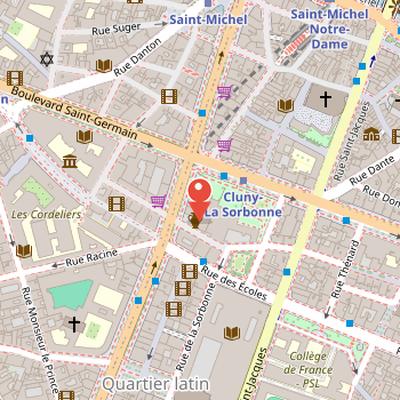
Nearby Objects
-
 Pillar of the Boatmen 20 m away
 -
 Thermes de Cluny 30 m away
 -
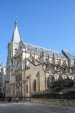 Saint-Séverin 250 m away
 -
 Fontaine Saint-Michel 300 m away
 -
 Place Saint-Michel 300 m away
Location and Setting
The Musee de Cluny is located in the 5th arrondissement of Paris, in the Quartier Latin. It is housed in a hotel particulier called the hotel de Cluny, whose origins date back to the 15th century. The museum's main entrance is at place Paul-Painleve, opposite the Sorbonne and square Samuel-Paty. It is a national museum and holds one of the most important collections in the world of objects and artworks from the medieval era. The Cluny thermal baths are contiguous to the museum and form part of it.
History of the Hotel de Cluny
The Musee de Cluny is housed in the oldest hotel particulier architecture in Paris, arranged between courtyard and garden. The buildings had belonged to the abbots of the Cluny order in Burgundy from the 9th century. The hotel was built by Jean de Bourbon and later enlarged by Jacques d'Amboise, abbot of Cluny from 1485 to 1510. Its facade includes the arms of Amboise, shown with three pales alternating gold and red on the dormer windows. The hotel accommodated the abbots of Cluny and important dignitaries, and it also served as a place of confinement and ceremony: Marie Tudor was imprisoned there for forty days in 1515, and James V of Scotland stayed there in 1537 for his marriage with Madeleine de France. From the 16th century, it served as a nunciature for papal legates, and the papal nuncio lived there with a household of about twenty people, including two secretaries. In the 18th century, printer-bookseller Nicolas-Leger Moutard installed his presses in the chapel at rue des Mathurins, Hotel de Cluni. After being sold as national property during the French Revolution, the hotel underwent transformations and damage until state acquisition in 1843. Before that purchase, it had been shared by several private owners or tenants, including astronomers Joseph-Nicolas Delisle and his students Joseph Jerome Lefrancois de Lalande and Charles Messier, who converted the tower into an observatory. In 1833, Alexandre Du Sommerard occupied the building and rented rooms to a printer in order to organize his collection of objects. The collection was purchased by the state in 1843, Edmond Du Sommerard was appointed the first director of the Musee des Thermes et de l'Hotel de Cluny, and architect Albert Lenoir restored the buildings. The hotel was classified as a historical monument in 1846. Later, the Gallo-Roman baths and lapidary collections were ceded to the state by the city of Paris on December 31, 1862, and the thermes were classified in 1862.
Architecture and Museum Reorganization
The Musee de Cluny is described as having a flamboyant Gothic style, with a U-shaped plan and two small wings that define a trapezoidal inner courtyard. Its history also includes major changes in museography and museum identity. In 1977, its collections were expanded and its museography reorganized to create the Musee national de la Renaissance in Ecouen, while deposits helped other museums and castles enrich their own collections. In 1992, the museum's vocation was confirmed by its new name, Musee national du Moyen Age.
A new renovation campaign began in 2014 under architect Bernard Desmoulin, with a budget of 21.5 million euros. The work aimed to add modern equipment and improve public access and museography. It also included restoration of Gallo-Roman thermal masonry by chief architect Paul Barnoud. The first renovation phase added an extension supported by Paul Boeswillwald's 19th-century building and reached by a footbridge over antique remains. It included a covered room facing the boulevard, an accessible basement entrance for guided visits, and spaces for the ticket office, bookstore-boutique, cloakroom, restrooms, temporary exhibitions, educational functions, and artwork management. The second phase, designed by Studio Adrien Gardere, restructured the museographic and scenographic routes across all buildings to create chronological and thematic coherence, improve visitor paths, highlight the spirit of the place and the richness of the collections, and ensure full accessibility.
Medieval Collections and Ancient Paris
The collections extend across an exhibition area that brings together objects ranging from Roman Gaul to the 16th century, with material from Europe, the Byzantine and Muslim Orient, and the Maghreb. Although the holdings focus on the Middle Ages, they also include sculptures from earlier periods. Several works preserve the ancient history of Lutetia, including the Pilier des Nautes, the oldest dated monument in Paris. This pillar was offered by the city boatmen to Emperor Tiberius between 14 and 37 AD and was discovered beneath the choir of Notre-Dame de Paris in the 17th century. The collections also include the Pilier de Saint-Landry, another monumental pillar found on Ile de la Cite in the 19th century and sculpted in the 2nd century AD.
Selected Works in the Medieval and Antique Collections
The collections of the Musee de Cluny bring together objects from the ancient world, the Byzantine sphere, and the Romanesque period. Among the antique works is a statue purchased in the 19th century and identified as a priest of Serapis from Italy under Emperor Hadrian. The museum also holds a pair of rock crystal lion heads sculpted toward the end of antiquity, a Roman diptych leaf from the 5th century, the Nicomachi and Symmachi diptychs, and a consular diptych leaf of Areobindus made in Constantinople in 506 AD. Later Byzantine or proto-Byzantine pieces include a group showing Ariadne with a satyr and putti, a Byzantine box with mythological scenes produced around the year 1000 during the Macedonian dynasty, and a Byzantine-inspired plaque made in the Germanic empire in 982-983 that shows Christ crowning Emperor Otto II and Empress Theophano. The collections also preserve late Antique or proto-Byzantine ivory elements, as well as a Carolingian binding plaque depicting an apostle.
Romanesque sculpture in the museum comes from different regions and countries. It includes four Corinthian capitals from the 12th and 13th centuries, possibly from the roof of Saint-Denis abbey, eight capitals from the abbey of Sant Pere de Rodes in Catalonia, and capitals representing the stories of Noe and Abraham. Other examples are a wooden statue of a holy woman produced in the Boi valley between 1120 and 1140, an elephant tusk carved in Sicily at the end of the 12th century representing the Ascension, and a morse ivory crosseron decorated with scrolls from the middle of the 12th century.
Late Medieval Sculpture in the Collections
The collections at Musee de Cluny bring together late Middle Ages sculpture from diverse origins, with a strong representation of French works alongside objects from other parts of Europe. The holdings include statues and reliefs from major religious contexts, as well as a smaller number of secular objects. Among the French pieces are works associated with Notre-Dame de Paris, the Sainte-Chapelle, Saint-Germer de Fly Abbey in Picardy, and Saint-Louis of Poissy. These include the statue of Adam from the south transept portal of the cathedral, four apostles from the Apostolic College of the Sainte-Chapelle created between 1243 and 1248, and other apostles from the 1320s from the church of the Saint-Jacques aux Pelerins hospital. The collections also preserve three statues of angels carrying the Passion insignia from Saint-Louis of Poissy, a headless statue of Pierre d'Alencon, and a retable with New Testament scenes and the life of Saint Germer, sculpted in the 1260s.
The museum also holds several important works from Italy, including two statues of the Virgin and Saint John from Prato, dated 1220 to 1230, and an Annunciation angel sculpted by Florentine Nino Pisano in the third quarter of the 13th century. A bust-reliquary of Saint Mabille, one of the legendary eleven thousand virgins with Saint Ursula, was made in Siena at about the same time. A Christ crucified by Giovanni Pisano was acquired by the museum in 2023, and the collections also include an ivory Christ crucified by Giovanni Pisano from around 1270 to 1280.
Small sculpture is represented mainly by numerous ivories, including diptychs and triptychs with religious decoration such as the triptych of Saint-Sulpice du Tarn and the mirror valve called Assembly. Secular production from Paris is represented by objects such as a casket with courtly scenes showing the siege of the castle of love from the first quarter of the 14th century, and a mirror box valve representing Tristan and Iseut from the second quarter of the 14th century. Other works include the group sculpture Presentation of Jesus at the Temple from the second half of the 14th century, the statue of Saint George slaying the dragon from 1380 to 1390, the Ascent to Calvary sculpture around 1400, and the Virgin's Fainting sculpture from the late Middle Ages.
The collections also extend across other European regions. French sculpture remains especially well represented in additions from Ducal Burgundy and Provence, including statuettes of saints from a dismantled retable possibly from Theuley Abbey, a statue of Virgin and Child from Sainte-Apollinaire, and a small statue of the wife of King Rene's chancellor in prayer. Further holdings come from Southern Germany, such as a Saint Anne trinitarian statue carved by Hans Greiff in Ingolstadt in 1472, a statue of Saint Marthe and the Penitents from Biberach dated to the late 15th century, a Virgin and Saint John of Calvary carved in Upper Swabia around 1520, as well as several retables from Antwerp and numerous Nottingham alabaster works.
Medieval Treasures in the Collections
Musee de Cluny preserves a major group of medieval objects spanning several materials and centuries. Its stained glass collection is described as the richest in France, with more than medallions or fragments covering a period from the 13th century to the early 16th century. The collection includes an important set of windows from Sainte Chapelle, and it was restored in a campaign that ran from 2000 to the end of 2004 with support from Fondation d'entreprise Gaz de France.
The museum also holds one of the finest ensembles of medieval goldsmith and enamel works at Musee national du Moyen Age. These objects include works in gold, silver, and copper, often enameled or decorated with gems, and they represent treasures from rich abbeys and princes of the West. Among them are a gilded silver reliquary of the Christ umbilicus, Virgin and Child, a chasse showing apostles and angels in enameled and gilded copper from Limoges, and Visigothic votive crowns from the Treasure of Guarrazar.
Its ivory collection is one of the two main Parisian collections, alongside the Louvre's. The range extends from the end of Antiquity to the end of the Middle Ages and includes both sacred and profane objects such as caskets, mirrors, combs, and engravers. The holdings include several pieces from the 4th century and mostly from the 13th century, as well as an ivory bishop's crook depicting Virgin and Child framed by two angels, an eagle-shaped reliquary clasp, and a plaque of the Adoration of the Magi from the Abbey of Grandmont.
Tapestry Collections
Musee de Cluny preserves a significant collection of secular and religious tapestries. Among its major tapestry pieces are La Dame a la licorne, La Legende de saint Etienne, and La Vie seigneuriale. La Dame a la licorne is especially emblematic within the collections, and several works or details from this series are associated with Musee de Cluny in Paris from the end of the 15th century, including A mon seul desir, L'Ouie, and a detail of Le Gout.
Visitor Access and Attendance
The museum's attendance figures cover both the permanent collections and temporary exhibitions. On average, it hosts two temporary exhibitions per year. It also took part in the Ministry of Culture's experiment on free permanent exhibitions at some French museums. Visitor numbers were lowest in December, when attendance fell to just over 10,000 visitors. The site is served by the Cluny - La Sorbonne metro station.
Student Mediation at the Musee de Cluny
At the Musee de Cluny, the activities du musee program offers free admission on the first Sunday of every month. It also includes four to six Sundays each year when students from the Ecole du Louvre, universities, and specialized schools welcome visitors and comment on museum works. These Sunday afternoons are organized around youth and mediation, and they attract a regular audience that benefits from the students' dynamism and interpretive work.
The program brings together twenty to thirty students who carry out documentary research in order to learn the practice of mediation and engage with visitors in the museum rooms. Working alone or in pairs, they provide interpretive keys that draw attention to major, unusual, and lesser-known artworks. In 2012, twenty students were trained through a partnership with the University of Paris-Dauphine to present five themes defined by the museum curators. Other sessions involved twenty student mediators discussing the collections from the perspective of creation techniques, including during the European Days of Crafts. Six ENSAAMA art students also recreated a stained-glass workshop in the museum courtyard, explaining the stages of production from cutting to mounting and painting. Visitors could take part in these accessible and educational presentations under the title A Sunday with students. The mediation activities were relaunched in 2023.