The Pillar of the Boatmen, known in German as Der Pfeiler der Nautae Parisiaci or Pariser Nautenpfeiler, and in French as Pilier des nautes, is a monument with depictions of deities from Roman and Gaulish mythology. It is dated by a dedication inscription to the first quarter of the 1st century AD and originally stood in a sanctuary in the Gallo-Roman civitas Lutetia, present-day Paris. The monument belongs to the earliest examples of inscriptions of figurative Gaulish art and is now located in the Musée national du Moyen Âge.\n\nThe pillar was made from limestone from Saint-Leu in the Département Oise. Its original form probably measured 5.24 m in height and tapered from 0.91 m wide at the base to 0.74 m at the top. It consisted of four quadrangular blocks, but the exact arrangement of these blocks is unclear. The preserved blocks show a range of figures, including Jupiter, Esus, Tarvos Trigaranus, Vulcanus, Cernunnos, Smertrios, Castor, and likely Pollux, as well as groups of men and a dedicatory inscription.
Nearby Objects
-
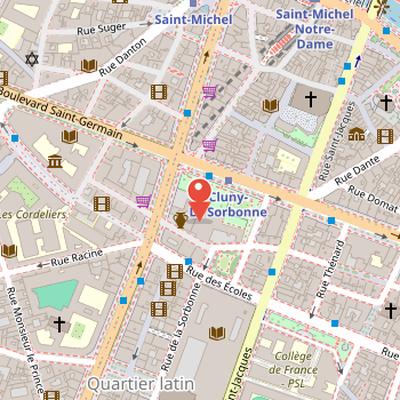
 Musée de Cluny 20 m away
 -
 Thermes de Cluny 40 m away
 -
 Saint-Séverin 250 m away
 -
 Fontaine Saint-Michel 300 m away
 -
 Saint-Julien-le-Pauvre 300 m away
The Pillar and Its Historical Context
The Pillar of the Boatmen, known in German as Der Pfeiler der Nautae Parisiaci or Pariser Nautenpfeiler and in French as Pilier des nautes, is a monument with depictions of various deities from Roman and Gaulish mythology. A dedication inscription dates it to the first quarter of the 1st century AD. It originally stood in a sanctuary in the Gallo-Roman civitas Lutetia, present-day Paris. The monument belongs to the earliest examples of inscriptions of figurative Gaulish art. It is now located in the Musee national du Moyen Age.
Material and Form of the Pillar
The Pillar of the Boatmen consists of a pillar made from pierre de Saint-Leu-d'Esserent limestone from Saint-Leu in the Departement Oise. Its original form probably measured 5.24 m in height, with a width of 0.91 m at the base and 0.74 m at the top. The pillar originally consisted of four quadrangular blocks with square bases that taper upward. The exact arrangement of these four blocks remains unclear, with 64 possible variations.
Decorated Blocks and Iconography
The pillar preserves several carved blocks with a range of divine and human figures. The fully preserved top block shows Jupiter, Esus, Tarvos Trigaranus, and Vulcanus. Jupiter is represented holding a spear in one hand and thunderbolts in the other. Esus holds a hippe in the right hand and interacts with a willow-like tree. Tarvos Trigaranus stands apparently between two trees, with three cranes on its body. Vulcanus is shown frontally with the usual blacksmith tools.
The second block survives only in its upper half and depicts Cernunnos, Smertrios, Castor, and likely Pollux. Cernunnos has short antlers with two torques and is shown in a Buddha-like posture. Smertrios appears in profile, torso visible, holding a club and attacking a serpent-like figure. Castor and Pollux are represented as the Dioscuri with lances beside their horses.
The third block preserves its upper half and includes a dedicatory inscription. It shows three men with shield and spear, with one group beardless and another group bearded and labeled EVRISES. It also includes a poorly preserved group of at least three persons in civilian clothing, possibly togas, with an incomplete inscription below reading SENAN.
The bottom block is wider than the upper blocks, with the lower half missing and the upper half split into two parts. It shows two figures on each of its four sides, but the inscriptions are mostly illegible or lost. Among the figures, Mars can be identified by his helmet and by the female figure beside him, Fortuna stands next to a god originally armed with a spear, and Mercurius and Venus are only tentatively identified with unknown companions.
The Dedication and Inscriptions
The stele is dated by its dedication to Emperor Tiberius, who reigned from 14 to 37 AD. The public dedication text names Tiberius Caesar Augustus and Iuppiter Optimus Maximus, and it declares the monument as a foundation by the Parisian boatmen, a guild of local Seine boatmen. The main dedication begins with Jupiter, followed by Mars, Fortuna, the Dioscuri Castor and Pollux, and Vulcanus. It also names several Gallic deities, including Esus, Tarvos Trigaranus, Smertrios, and Cernunnos. The inscription is notable for containing one of the rare mentions of the deity name Cernunnos, and it shows an absence of interpretatio Romana, since the local deities are not reinterpreted as manifestations of Roman gods.
Several names or titles appear on other surfaces, though some remain unclear. These include EURISES, SENANI U[S]EILONI, IOVIS, TARVOS TRIGARANUS, VOLCANUS, ESUS, [C]ERNUNNOS, CASTOR, [3], SMER[trios?], FOR[tuna?], ]TVS[. The inscription suggests that eurises could possibly be a Gallic expression naming the donors. The meaning of senani or senant is unclear, though it may contain the root *sen- meaning old. The further reading of u[s]eiloni remains very uncertain. Inscriptions on various figures, especially on the base piece, are missing or illegible because of time.
History and Findspot of the Pillar
The history of the Pillar of the Boatmen is linked to ancient Lutetia, which was largely confined to the Ile de la Cite. Caesar mentions Lutetia in De bello gallico, and during Gallo-Roman times a forum and several temples were built on the south bank of the Seine. The column is thought to have stood before one of these sanctuaries, although the findspot of the fragments does not prove that a Gallo-Roman temple stood there. It is possible that the column came from another place in ancient Lutetia.
In the 3rd century, the stone blocks of the column were broken up and reused to reinforce the city walls by the riverside. Over time, the island riverbanks were expanded, shifting a 3rd-century dock several dozen meters away from the present riverbank. The Roman wall lies under the current Notre-Dame de Paris cathedral, where fragments of the pillar were found. The column was discovered on March 6, 1710, during crypt excavation under the nave of the cathedral, and Charles Cesar Baudelot de Dairval published the inscription two years later. In 528, Childebert I built a Cathedral of Saint Stephen just west of the current cathedral, and Notre-Dame was constructed in the following centuries while the city wall remained intact in the 6th century.
Later History and Display
The history of the stele notes that some pieces were never recovered, including three blocks that are missing their lower halves. The blocks were taken to the Hotel de Cluny, a medieval clergy house built over a 2nd-century Roman bath, which houses the Musee national du Moyen Age today. Gottfried Wilhelm Leibniz later attempted an inscription and relief interpretation in his posthumously published Collectanea etymologica in 1717. He correctly identified Tarvos Trigaranus and Cernunnos, although he placed Cernunnos as Bacchus, and he wrongly equated Esus with Ares and a fictional Germanic god Erich. In 2001, the blocks were restored and cleaned of patina, and the individual blocks are now exhibited at the Musee national du Moyen Age.