The Thermes de Cluny are Roman baths located in Paris, in the Quartier latin. Dating from the Roman era, they are currently integrated into the Musée de Cluny. The surviving buildings belong to a larger complex that probably covered several hectares. The remains form part of an ancient urban site whose history reflects changing uses over many centuries.
The North baths, also called the Cluny baths, were built on the left bank of the Seine at the intersection of Lutèce’s cardo and decumanus. The complex suffered probable destruction during invasions and sieges, including attacks in the 3rd and 9th centuries and fire damage in 978. Later sources described the baths as a royal residence or a “palace of kings.” In the Middle Ages, the site passed into different ownerships, and the abbots of Cluny built their hôtel against the baths and used some halls for storage. From 1810, Paris established an antiquities museum in the frigidarium and began clearing the ruins. The site was excavated and restored in the 19th century, transferred to the State in 1843, and listed as a historical monument in 1862.
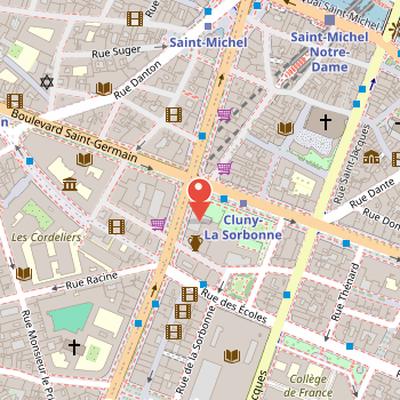
Nearby Objects
-
 Musée de Cluny 30 m away
 -
 Pillar of the Boatmen 40 m away
 -
 Saint-Séverin 200 m away
 -
 Fontaine Saint-Michel 250 m away
 -
 Place Saint-Michel 300 m away
Roman Baths in the Quartier Latin
The Thermes de Cluny are Roman baths in Paris, located in the Quartier Latin. They date from the Roman era and are now integrated into the Musee de Cluny. The present buildings form part of a larger complex that probably covered several hectares. As a Roman-period site preserved within a museum setting, they remain an important element of the city's urban heritage.
From Roman Baths to Cluny Property
The North baths, later called the Cluny baths, were built on the left bank of the Seine at the intersection of Lutetia's cardo and decumanus. Their history is marked by repeated damage and changing uses. They suffered probable destruction during the invasion of Paris by the Franks and Alamans in 275, and later were affected by Viking sieges and fires in 845, 856-857, 861, and 885-887. In 978, the siege of Otto II caused fire damage to the southern part of the city, which also affected the baths.
By the 6th century, Venance Fortunat described the baths as arx celsa, the residence of King Childebert I of Paris from 511 to 558. Queen Ultrogothe, his widow, also resided there with her daughters. In the 12th century, Jean d'Hauville called the baths the palace of kings in Architrenius. The site later changed hands several times: in 1218 the Terminis palatium belonged to Simon III of Poissy and was then granted in perpetuity to Henri le concierge by King Philippe Auguste. The domain, including the baths, was integrated into the city through Philippe Auguste's wall construction, which reused parts of the baths.
In 1340, Pierre de Chatelus, abbot of Cluny, bought the Thermes palace and its dependencies for his order. The Cluny abbots then built their hotel against the baths, using some halls as barns, and built the current Hotel de Cluny between 1485 and 1510. The central hall continued to serve practical purposes: it was used as a barn in 1456, as stables and coach sheds in 1691 for destinations such as Chartres and Laval, and around 1750 it housed a coach rental business, followed by an innkeeper and then coopers Falaise and Garnier from 1781.
Preservation and Museum Use
From 1810, Paris established an antiquities museum in the frigidarium and began clearing unhealthy constructions attached to the baths. In 1819, Interior Minister Elie Decazes ended the coopers' lease in the frigidarium with compensation and ordered demolitions of houses built on the ruins. The aim was to restore the site and prepare it to succeed the Musee des Monuments Francais, which had closed in 1816. Architect Louis Moreau cleared and excavated the ruins between 1820 and 1826, and restoration was then entrusted to Etienne-Hippolyte Godde and Charles Rohault de Fleury. In 1843, Paris transferred the baths to the State so they could be associated with the Cluny Museum, the Museum of the Middle Ages. The baths were classified as historical monuments in the 1862 list. Further excavations were carried out by Theodore Vacquer in the late 19th century, by Paul-Marie Duval from 1946 to 1957, and by Jean-Pierre Adam thereafter.
Architecture and Layout of the Thermes de Cluny
The Thermes de Cluny were built on the natural slope of the hill that later became the Montagne Sainte-Genevieve. The ensemble used opus vittatum mixtum, with alternating bricks and rubble stones covered by multiple layers of plaster. Its walls combined small square stones separated by rows of bricks, and the interior walls were once covered with mosaic, marble, or paint. The complex was organized around both heated and unheated areas: the southern part was built on a hypocaust, while the northern part had no heating.
Access to the southern palestre came through a portico lined with shops at the site of the present rue des Ecoles. The circulation route began in the apodyterium and continued either toward the palestras for sports activities or into the tepidarium and caldarium rooms. The tepidarium and caldarium contained basins before the route led to the frigidarium. Two caldarium rooms survive, one to the west along boulevard Saint-Michel and another to the south at the corner of boulevard Saint-Michel and rue Du Sommerard, although both have been partially ruined since the eighteenth century.
The frigidarium is the only room to preserve its original vault. Its rib vault rises to 14.50 meters, making it one of the highest still standing in the Western Roman world. Traces of blue pigment and ochre red pigment remain on the vault and walls. In the north section, the basin once held cold water and still preserves its drainage system and coating traces; the drainage passage is visible. The northern part of the facade was centered on a monumental fountain, and the baths were surrounded by galleries, with two gymnasiums in the northern area. The caves and vaulted galleries were built with small rubble stones and mortar, and the vaults now serve as technical rooms for personnel accessible from the museum.
Water Supply and Drainage
The Thermes de Cluny were served by a water system supplied from the Wissous plateau sources south of Paris, carried via Arcueil. The aqueduct gathered water at Wissous in the square basin known as the carre des eaux de Wissous, then transported about 5,000 cubic meters per day to Lutece. It also crossed the Biere valley at Val d'Arcueil-Cachan using an engineering structure whose traces have been found. Wastewater was evacuated through a sewer encircling the thermes and flowing into a collector sewer under boulevard Saint-Michel.