Rue Saint-Denis is a street in the 1st and 2nd arrondissements of Paris and is described as one of the oldest streets in the city. Its axis was traced by the Romans in the 1st century, and it later served as a triumphal route for royal entries into the capital. The street is situated parallel to boulevard de Sébastopol and rue Saint-Martin. It crosses several areas: quartier Saint-Germain l’Auxerrois between avenue Victoria and rue de Rivoli, quartier des Halles between rue de Rivoli and rue Étienne-Marcel, and quartier Bonne-Nouvelle from rue Étienne-Marcel to boulevard Saint-Denis. Its name comes from the road leading from Pont au Change to the city of Saint-Denis, where the necropolis of the kings of France was located. Historical accounts describe royal processions along the street, with decorated buildings, scented water jets, fountains flowing with wine, hypocras, and milk, and theatrical and musical displays.
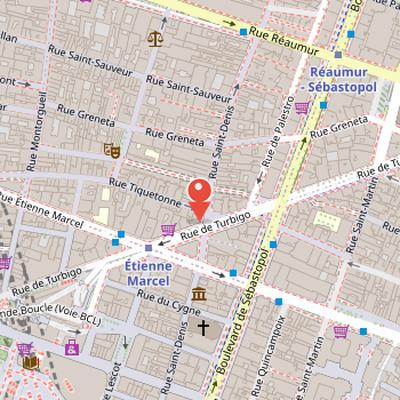
Nearby Objects
-
 Boulevard de Sébastopol 110 m away
 -
 Hôtel de Bourgogne 140 m away
 -
 Les Bains-Douches 150 m away
 -
 Saint-Nicolas-des-Champs 350 m away
 -
 Church of Saint-Eustache 400 m away
Historic Route in Central Paris
Rue Saint-Denis is located in the 1st and 2nd arrondissements of Paris. It is one of the oldest streets in the city, and its axis was traced by the Romans in the 1st century. The street also served as the triumphal route for royal entries into the capital, giving it a long association with ceremonial movement and urban history.
Situation and Access
Rue Saint-Denis runs parallel to boulevard de Sebastopol and rue Saint-Martin. Its situation and access place it within several adjoining parts of the city: the quartier Saint-Germain l'Auxerrois between avenue Victoria and rue de Rivoli, the quartier des Halles between rue de Rivoli and rue Etienne-Marcel, and the quartier Bonne-Nouvelle from rue Etienne-Marcel to boulevard Saint-Denis.
Origin of the Name
Rue Saint-Denis takes its name from the city of Saint-Denis, where the necropolis of the kings of France was located. The street was named because it was the road leading from Pont au Change to the city of Saint-Denis. Its name therefore reflects both its route and its destination.
Historical Role of Rue Saint-Denis
Rue Saint-Denis is closely tied to the earliest history of Paris, with the first houses of Parisians likely built near the path leading to ancient Catalocum that became Saint-Denis. The street also recalls Saint Denis, who preached the Christian faith in Gaul around the year 245 and was buried there. Its name, including forms such as Grant-Chaussiee-Monsieur-Denis, is linked to pilgrimages to Saint Denis' tomb promoted by Saint Genevieve.
The street played an important ceremonial role in royal entries into Paris. Kings and queens entered the city solemnly via rue Saint-Denis, while the streets along the procession to the cathedral were covered with silk and camelot fabrics. The atmosphere was further marked by scented water jets, fountains flowing with wine, hypocras, and milk, and the presence of deputies of six merchant corps carrying the royal canopy. Craftspeople also took part by representing the seven deadly sins, seven virtues, Death, Purgatory, Hell, and Paradise in costume. The route was animated by theaters staging scenes from the Old and New Testament, with musical choirs heard between performances.
Historically, the street had several names and boundaries. It was called Grant'rue in the southern part and rue Saint-Denis from rue des Lombards to the gate of Philippe Auguste's enclosure. In 1418 it was almost entirely bordered by buildings and extended from rue Mauconseil to rue des Deux-Portes, where a gate of the fourth enclosure under Charles V and Charles VI was located. The street was bombarded by the artillery of King Henri IV during the siege of Paris in 1590, and it was fully built under the reign of Louis XIV.
Rue Saint-Denis was also associated with notable urban events and perceptions. Rich merchant Philippe de Gastine lived there at the start of the religious wars, and his house was destroyed after the parlement condemned him for secretly establishing a Protestant temple there. The site was replaced by an expiatory monument forming place Gastine, later transferred in pieces to Saints-Innocents. Many travelers entering Paris by stagecoach also discovered the capital via rue Saint-Denis.
1817 Street Layout and Regulation
In 1817, Rue Saint-Denis began at 2 rue Pierre-a-Poisson and 3 place du Chatelet, and ended at 1 boulevard Bonne-Nouvelle and 19 boulevard Saint-Denis. Its street numbers were black that year. The historical record also notes that the last odd number and the last even number were not provided. In addition, the minimum width of the street was fixed by a ministerial decision of 22 prairial an V signed by Benezech, as well as by a royal ordinance whose date is not specified.
Rue Saint-Denis in Moments of Conflict and Celebration
Rue Saint-Denis appears in the historical record as a street repeatedly marked by political upheaval and collective reaction. During the solemn entry of Charles X into Paris, it was described as being in celebration. At other moments, however, it became a place of unrest. After a possible announcement of a Liberal electoral victory, the street was animated by bonfires and firecrackers that turned into riots and barricades. In 1830, during the Trois Glorieuses, Rue Saint-Denis was covered with barricades, and violent confrontations between insurgents and troops continued there until the end of July.
In 1832, the second cholera pandemic and the funeral of General Lamarque again led residents to cover the street with barricades, and the insurrection was violently repressed. The pattern repeated in 1848, during the Revolution and the June days, when residents revolted again and the street was once more covered with barricades. Rue Saint-Denis also took part in the protests against Louis-Napoleon Bonaparte's coup d'etat from June 2 onward, and Victor Hugo wrote a statement during these events.
The street continued to appear in wartime history as well: on March 30, 1918, a shell fired by the Grosse Bertha exploded there. By November 11, 1918, Rue Saint-Denis was again associated with celebration and a festive atmosphere.
Commercial Mix and Changing Uses
The area between boulevard Saint-Denis and rue Reaumur is identified as a historic center of Parisian prostitution, but this activity has declined. Activites attributes the reduction to changes in social customs, the rise of internet escort services, public actions, and the Sarkozy law on passive solicitation. The remaining prostitution in the area includes immigrant prostitutes, including Chinese prostitutes, and some sex shops still remain.
At the same time, rue Saint-Denis now shows a broad mix of uses. Clothing shops predominate, especially toward the Sentier district end, where wholesale textile trade is specialized. The street also includes bars, restaurants, tattoo shops, banking agencies, and the seat of the chamber of notaries. The church Saint-Leu-Saint-Gilles is also located there.
Activites notes that a city hall rehabilitation program has enabled new diversity in the street. This coexistence of activities and populations creates a sense of dynamism near the fontaine des Innocents. The result is a street marked by both its past associations and its present commercial and institutional functions.