Hôtel de Bourgogne was a theatre built in 1548 for the Confrérie de la Passion in Paris. It stood on the rue Mauconseil, now rue Étienne Marcel, in the 2nd arrondissement, on a site that had formed part of the residence of the Dukes of Burgundy. The building was long and narrow, with a stage depth of about 12 meters. Its auditorium was largely occupied by the pit, with a steep tier of benches on a base of about 4 meters and two levels of boxes, totaling 38 boxes.
The Confrérie de la Passion had received a monopoly on religious mystery plays in 1402 and used the new theatre for performances that included farce and secular drama. The venue was later rented to itinerant companies, including Italian commedia dell’arte troupes that introduced Harlequin, Pantalone, and burlesque. From 1628, the Comédiens du Roi were permanently established there and performed works including Andromaque and Phèdre by Jean Racine. Hôtel de Bourgogne was the most important French theatre until the 1630s. It remained in use until 1783, when it was closed, converted to a leather market, and eventually demolished.
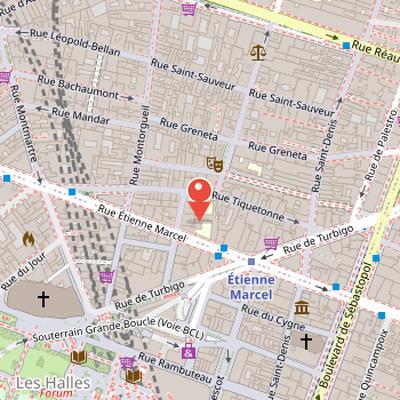
Nearby Objects
-
 Rue Saint-Denis 140 m away
 -
 Boulevard de Sébastopol 250 m away
 -
 Church of Saint-Eustache 250 m away
 -
 Les Bains-Douches 300 m away
 -
 Saints Innocents Cemetery 400 m away
History of the Hotel de Bourgogne Theatre
The Hotel de Bourgogne was a theatre built in 1548 for the Confrerie de la Passion in Paris. It stood on the rue Mauconseil, now rue Etienne Marcel, in the 2nd arrondissement, on a site that had once formed part of the residence of the Dukes of Burgundy. For much of the 16th and early 17th centuries, it was the most important French theatre, although the Confrerie de la Passion itself had limited success with farce and secular drama. The theatre was also rented to travelling acting companies, including Italian commedia dell'arte troupes, whose performances introduced figures such as Harlequin and Pantalone, as well as burlesque.
In 1628, the French company Comediens du Roi became permanently established at the theatre. There they performed classical works, including Andromaque and Phedre by Jean Racine. In 1680, the Comediens du Roi moved to the Guenegaud Theatre, where they merged with the French troupe from that theatre to form the Comedie-Francaise. The Italian company from Guenegaud then moved into the vacant Hotel de Bourgogne and became the Comedie-Italienne. Over time, that company began performing in French as well. In 1762, the Comedie-Italienne merged with the Opera Comique of the Theatre de la Foire. The theatre remained in use until 1783, when the company moved to the Salle Favart, after which the Hotel de Bourgogne closed permanently. It was later converted into a leather market and eventually demolished.
The 1548 Theatre
In 1548, the Confrerie de la Passion built a new theatre on the grounds of the Hotel de Bourgogne. The building was long and narrow in shape, with a stage depth of about 12 meters. Its auditorium floor was mostly occupied by the pit, while a steep tier of benches rose on a base of about 4 meters. The theatre also included two levels of boxes, for a total of 38 boxes.
Performance at the Bourgogne Theatre
The Confrerie de la Passion, which had received a monopoly on the performance of religious mystery plays in 1402, used the Bourgogne theatre as a major venue for its productions. In response to rival companies, it added comic scenes and burlesques to religious mysteries. After completing its new theatre, the company petitioned the parliament of Paris for permission to begin performances, and on 17 November 1548 the parliament issued a decree that favored the Confrerie de la Passion but imposed restrictions. The company was forbidden to present the Passion or any other sacred subject.
The theatre adapted the multiple setting technique that medieval mystery plays had originally employed outdoors. At the Bourgogne, this became a cramped and curved indoor version, which forced actors to declaim downstage. By the end of the 16th century, however, the audience for farces and secular drama had declined. The Confrerie de la Passion then began renting the theatre to itinerant French and foreign troupes. Among the companies associated with the venue were the Italian troupe I Gelosi, Agnan Sarat, who appeared there as early as 1578, and the English company of Jean Thays, believed to have performed at the Bourgogne about twenty years later.
The Comediens du Roi at the Bourgogne
From 1599, the Comediens du Roi of Valleran Le Conte and Adrien Talmy were associated with the Hotel de Bourgogne, though the company often faced money problems and appeared there only intermittently while also touring the provinces. The troupe was linked with the works of Alexandre Hardy, and its membership included several important performers who helped define its reputation on the Paris stage.
Bellerose joined the company in 1610, later returned in about 1622, and became an important member. He succeeded Gros-Guillaume as director in 1634 and remained in that role until 1647. Gros-Guillaume also joined in 1610, became co-director in 1612, and later sole director. From 1615, he worked closely with Gautier-Garguille and Turlupin, and the three were the leading farceurs on the Paris stage until about 1633. Another member, the tragedian Montdory, appeared with Valleran's company in 1612 before later helping found the Theatre du Marais in 1634.
The companys relationship with the Bourgogne was marked by rivalry and conflict. The appearances of the Prince of Orange's troupe at the theatre created disputes with the Comediens du Roi, and the company sometimes performed outside the theatre to prevent audiences from entering to see competitors. A council act of 29 December 1629 installed the Comediens du Roi exclusively at the Bourgogne for three years. Even after this period, rivalry continued, especially after Montdory founded the Theatre du Marais, which led to disputes with Jean Rotrou and Bourgogne leaseholders. Under Bellerose's leadership, the troupe received royal patronage and staged plays that had first been introduced at the Marais.
The theatre itself included a theatre superieur, a second stage above the main platform, which may have been removable. The quarrel between the Comediens du Roi and the Theatre du Marais later intensified with Moliere's The School for Wives in 1662.
Moliere and the Theatrical Debate of 1663
The Hotel de Bourgogne was part of the theatrical context in which Moliere became the subject of criticism in 1663. Donneau de Vise's Zeline was a literary critique of Moliere's play, and Moliere answered it with La Critique de l'Ecole des femmes. In the same year, Edme Boursault's Portrait de peintre attacked Moliere's moral character and insinuated incest with Armande Bejart. Moliere did not respond directly to this attack, but instead staged L'Impromptu de Versailles, a parody of Bourgogne actors. These exchanges show the intense public and theatrical debate surrounding Moliere at the time.
The Comedie Italienne at the Hotel de Bourgogne
In 1680, the Comedie Italienne merged with the troupe of the Gueneaud and moved to the Hotel de Bourgogne. It performed there until 1697, when it produced La Fausse prude and was then ordered by Louis XIV to return to Italy. After being invited back to France by Philippe II, Duke of Orleans, following 1715, the company performed at the Palais-Royal from 18 May 1716 and returned to the Hotel de Bourgogne in the same year.
The Comedie Italienne continued at the Hotel de Bourgogne until 1762. That year, it merged with the Opera-Comique of the Theatre de la Foire, and the combined company opened at the Hotel de Bourgogne on 3 February 1762. This new company remained there until 4 April 1783, when it moved to the Salle Favart. These successive uses made the Hotel de Bourgogne an important performance site in the history of the Comedie Italienne and its related companies.