Place des Victoires is a square located in the heart of the historical center of Paris, across two unnamed locations. Created for Louis XIV, it is the third Royal square built in Paris, after Place Dauphine and Place des Vosges, and it was constructed before Place Vendôme and Place de la Concorde. Its name refers to the military victories of Louis XIV, including successes against the quadruple Alliance confirmed by the Treaties of Nijmegen and victories against the Protestant minority following the revocation of the Edict of Nantes in 1685. The square is also near the basilica Notre-Dame-des-Victoires, which was established following a vow by Louis XIII during the siege of La Rochelle. In the early 17th century, the area was occupied by fields, mills, and the fortifications of Charles V’s enclosure. Later, Cardinal de Richelieu transformed the area, and a new district developed there with hôtels such as Hôtel de la Vrillière and Hôtel de Senneterre.

Nearby Objects
-
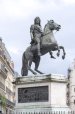 Equestrian statue of Louis XIV 0 m away
 -
 Notre-Dame-des-Victoires 100 m away
 -
 Galerie Vivienne 140 m away
 -
 Théâtre du Palais-Royal 250 m away
 -
 Cabinet des médailles 300 m away
A Royal Square in Central Paris
Place des Victoires was created as a place dedicated to Louis XIV. It is located in the heart of the historical center of Paris and is situated across two unnamed locations in the city. It was the third Royal square built in Paris, after place Dauphine and place des Vosges, and before place Vendome and place de la Concorde. Among these Royal squares, it was the first to be constructed.
Name and Commemorative Meaning
Place des Victoires is dedicated to the military victories of Louis XIV. Its name commemorates victories against the Quadruple Alliance by the Treaties of Nijmegen, as well as victories against the Protestant minority linked to the revocation of the Edict of Nantes, signed at Fontainebleau in 1685. The square is located near the basilica Notre-Dame-des-Victoires. That basilica was established following a vow by Louis XIII during the siege of La Rochelle from 1627 to 1628, a campaign intended to crush the Protestant stronghold. The nearby Rue de la Victoire in the 9th arrondissement also reflects this commemorative use of urban naming, honoring the Italian campaign of General Bonaparte.
Early Site History
In the early 17th century, the area now occupied by Place des Victoires was covered by fields, mills, and the fortifications of Charles V's enclosure. A windmill was built on the dilapidated enclosure during the 17th century. Excavations in 1895 revealed the substructures of this windmill, confirming the site's earlier use before it became the square known today.
Creation of the Square and Royal Monument
Place des Victoires was created after a major reshaping of the area that had begun under Cardinal de Richelieu, who destroyed the enclosure between 1634 and 1639 and enlarged the gardens of the Cardinal's palace, later the Palais Royal. This led to the formation of a new district in which important figures built hotels such as Hotel de la Vrilliere and Hotel de Senneterre. In 1683, Marshall de La Feuillade bought Hotel de Senneterre, which stood between four streets, and the demolition of that building and others made way for a square centered on a royal statue.
The project was ordered by the King's Buildings and the Paris City Council, which authorized the creation of the square and loans for the expropriation of houses. Its characteristics were set by a King's Council decree in 1685, and Jules Hardouin-Mansart was entrusted with the urban planning. The layout was carefully designed: it formed a circle interrupted by a chord, with Rue des Fosses-Montmartre ending at the gap. A traffic lane followed the quasi-tangent formed by Rue Vide-Gousset and Rue du Reposoir, while Rue La Feuillade and Rue Croix-des-Petits-Champs also ended at the square. None of these three streets aligned with one another, which focused perspectives on the King's statue. The monument stood in an enclosed space surrounded by buildings.
The statue itself had been commissioned by Marshall de La Feuillade after the 1678 Peace of Nijmegen. He first ordered a marble statue of the King dressed in antique style, placed in the orangery at the Chateau de Versailles, and then commissioned a bronze group by Martin Desjardins in 1682 showing the King in coronation costume, crowned by Victory and trampling a Cerberus symbolizing enemies. Four bronze slaves at the base represented Germany, Piedmont, Spain, and Holland. Place des Victoires was inaugurated with pomp by the Dauphin on 1686-06-23, with a fireworks display at Place de Greve. During the Revolution, the municipal council ordered the statue destroyed on 1792-07-21, the bronze slaves were dismantled and moved to the Roule depot, and the square was temporarily renamed Place des Victoires-Nationales. Nine years later, Rue de la Vrilliere, now Rue Catinat, was opened on the axis of Rue des Fosses-Montmartre and led to Hotel de la Vrilliere, now Hotel de Toulouse.
Facade Design of Place des Victoires
The facade arrangement featured solid arcades on the ground floor and a high second noble floor. The second floor was linked to the first by Ionic pilasters, giving the elevation a more ordered vertical structure. Above this, the third mansard floor included dormers that alternated between semicircular and horizontal tops. These elements defined the architectural composition of the facade.
The Monuments of Place des Victoires
The center of Place des Victoires was marked by four successive monuments, including three statues. The original statue was created by the sculptor Martin Desjardins and represented Louis XIV standing. It showed the king in coronation costume trampling Cerberus, a reference to the Quadruple Alliance defeated by France. The pedestal carried four bronze figures that allegorically represented nations defeated by Louis XIV and different sentiments, while the inscriptions celebrated military glory after the signing of the Treaty of Nijmegen. Decorative elements from the monument are now exhibited in the Puget courtyard of the Louvre Museum.
The statue of Louis XIV was toppled by revolutionaries in 1792 and melted to produce cannons. Before that, four chained slaves had been removed from the statue by the National Assembly in 1790, and the four statues were transported to the depot du Roule after being saved from melting in the same year. In 1804, four statues were installed at the corners of the facade of the Hotel des Invalides. They were relocated to Parc de Sceaux in 1962, and four statues are placed at the Louvre Museum today. The statue including its pedestal measured an unspecified height and is now displayed at the Louvre Museum.
Replacements after the Louis XIV statue
After the Louis XIV statue was removed, Place des Victoires received a wooden pyramid or obelisk that named citizens who died on 10 August 1792. The structure deteriorated under sun and heat, collapsed in 1798, and was demolished in 1800. A later legend says that the wood from the pyramid was given to a guard corps for heating.
In 1800, a decision was made to erect a new statue at the site on the date of the Consulate under the Constitution. The first project of that year was intended to glorify Jean-Baptiste Kleber and Louis Charles Antoine Desaix. On 6 March 1800, First Consul Bonaparte laid the foundation stone of an Egyptian temple-shaped edicule, but construction stopped after this initial step. A decree of 1802 removed Kleber from the work, officially for artistic reasons, although this was probably a political decision.
The Desaix Monument at Place des Victoires
A bronze statue of General Desaix was commissioned to Claude Dejoux for the center of the square, with a pedestal designed by the architect Jean-Arnaud Raymond. The first project showed Desaix dying, supported by Mars, but Bonaparte wanted a standing and valiant figure instead. Dejoux therefore represented Desaix in antiquity as a heroic nude, while the pedestal listed the battles won by the general. The statue was completed after ten years of work and inaugurated by the emperor Bonaparte on a national and religious holiday corresponding to Napoleons birthday and the Assumption feast.
The monument is 5.5 meters tall and stands on a 6 meter base. Its 40 tons of bronze came from 24 enemy cannon pieces taken at the battle of Eylau. Desaixs arm points southeast to represent the Italy and Egypt campaigns. A pink granite obelisk from the Albani princes collection, brought from Italy by Bonaparte, was also added to the composition. The statue caused public controversy because of the nude representation and because Desaix was shown as a gladiator with a Roman sword rather than in French uniform.
Historic Protection and Later Changes
The square is now marked by several historic protections. Its ground was listed as a historic monument in 1962, and the Louis XIV statue was listed in 1992. The private mansions facing the square are all either listed or registered, and the buildings surrounding the square are former or built as private mansions. A panel entitled Histoire de Paris, located at the corner of the square and rue d'Aboukir, explains this history. The protections were delayed, and as a result the square is less uniform than originally, with later height increases and taller buildings on both sides of Rue Etienne-Marcel. The statue itself had a more troubled history: at an unspecified date it was hidden behind a wooden fence, then removed from the square in 1814 during the Restoration. Its bronze was later melted down under Louis XVIII to create the equestrian statue of Henri IV on the Pont Neuf.