The Vendôme Column is a victory column standing 44 metres high with an average diameter of about 3.60 metres. It is made of stone and covered in bronze, and rests on a porphyry base from Algajola. The shaft is formed by 98 stone drums and contains a spiral staircase 180 steps long and 93 centimetres wide, leading to a platform below the summit statue. Its external decoration consists of classical bas-reliefs depicting trophies and battle scenes, arranged in a sequence 280 metres long and winding around the shaft in 22 turns. The column includes 76 bas-reliefs made from 425 bronze plates. The design of the bas-reliefs was commissioned in 1806 to Pierre-Nolasque Bergeret, François Mazois, and Benjamin Zix, under the direction of Dominique Vivant Denon. The monument is directly inspired by Trajan’s Column in Rome. It is topped by a statue of Napoléon, the current version dating from the Second Empire and attributed to Auguste Dumont.

Nearby Objects
-
 Place Vendôme 0 m away
 -
 Hôtel Ritz Paris 70 m away
 -
 Hôtel Costes 130 m away
 -
 Couvent des Jacobins 200 m away
 -
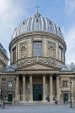 Notre-Dame-de-l'Assomption Church 300 m away
Design and Structure of the Vendome Column
The Vendome Column reaches a height of 44 meters and has an average diameter of about 3.60 meters. It is made of stone and covered in bronze, and it stands on a porphyry base from Algajola. The monument is topped by a statue of Napoleon. Its form was directly inspired by the Trajan Column in the Imperial Forums in Rome, and this reference is noted as similar to the inspiration for the July Column in Place de la Bastille.
The shaft is composed of 98 stone drums and contains an internal spiral staircase with 180 steps, measuring 93 centimeters wide. The staircase leads to a platform immediately below the summit statue. The external decoration consists of classical style bas-reliefs showing trophies and battle scenes. This decorative sequence extends for 280 meters, spirals around the shaft in 22 turns, and includes 76 bas-reliefs made from 425 bronze plates.
The bas-relief designs were commissioned in 1806 to Pierre-Nolasque Bergeret, Francois Mazois, and Benjamin Zix. Dominique Vivant Denon directed the work and assigned its plastic realization to established sculptors and young emerging talents. The bronze covering was traditionally said to have been cast from metal taken from about 1200 cannons captured from Russian and Austrian armies in the Third Coalition War, although this number is probably propagandistic.
The Statues of Napoleon on the Vendome Column
The current statue on the Vendome Column dates from the Second Empire and is attributed to sculptor Auguste Dumont. It depicts Napoleon Bonaparte in Caesar Imperator attire with a short cloak, and presents the usual attributes of glory: the gladius, winged victory, and imperial laurel crown. Unlike the original, Dumont's version shows Napoleon holding the sword in the left hand and the globe in the right. The globe itself comes from Antoine Denis Chaudet's original statue.
Chaudet created the first statue of Napoleon as Roman emperor, dedicating the last years of his life to it before his death. The sculpture was cast in 1808, placed atop the column on 5 August 1810, and officially inaugurated on 15 August 1810. It was removed in 1814 and melted in 1818, with only the globe of Victory preserved and later reused.
During the July Monarchy, Charles Emile Seurre made a new statue of Napoleon in a corporal's coat. It was placed on the column on 28 July 1833 in the presence of King Louis Philippe. This statue measured 3.5 meters in height and weighed 4.5 tons. Removed in 1863, it was displayed until 1870 at the Courbevoie intersection, now Place de la Defense, and since 1911 it has been located in the courtyard of Hotel des Invalides. In 1863, Seurre's statue was replaced by Dumont's copy of Chaudet's original, inaugurated on 4 November 1863. The present statue was restored and re-inaugurated on 28 December 1875.
From Napoleonic Monument to Revolutionary Target
The Colonne Vendome was created in a political setting shaped by changes around Place Vendome itself. The square had originally been commissioned by Louis XIV and designed by architect Jules Hardouin-Mansart. It was first known as Place Louis-le-Grand in honor of Louis XIV, and an equestrian statue of the Sun King stood at its center. In 1792, revolutionaries tore down that statue as a symbol of absolute monarchy. A decree in 1800 then required a commemorative column in each departmental capital, and on March 20, 1800, Napoleon Bonaparte ordered two columns in Paris. One was to be national and planned for Place de la Concorde, but it was never built. The other was departmental and intended for Place Vendome, which was then called Place des Piques.
The first stone was laid on July 14, 1800, by Lucien Bonaparte. Napoleon resumed the project in 1803 and had it developed as a column modeled after Trajan's Column in Rome. The design called for 108 spiral figures representing French departments, and the monument was to be topped by a statue of Charlemagne. It was first dedicated to the glory of the French people, but was soon rededicated to the glory of Napoleon I. Construction slowed until 1805, then gained momentum through the use of cannons captured from Russian and Austrian armies. Dominique Vivant Denon is credited with revitalizing the project in 1805. The column was completed in 1810 and named Colonne de la Grande Armee, dedicated to the glory of victorious Napoleonic armies. A statue of Napoleon as Roman emperor by Antoine Denis Chaudet was placed on top.
The monument's appearance changed several times after Napoleon's fall. In spring 1814, coalition troops occupied Paris and Napoleon's statue was removed. Jacques Marie Armand Guerry de Beauregard and Sosthenes de La Rochefoucauld initiated the removal. A white flag decorated with lilies replaced the statue, symbolizing the Bourbon monarchy. Conflicting accounts say that metal from the original statue may have been reused for monuments to Louis XIV and Henry IV. In the same year, Emile Debraux composed the song La Colonne in homage to the monument and Napoleon I. The song was an immediate success, helped Debraux's career, and remained popular for a long time before falling into oblivion.
Under the July Monarchy, Charles Emile Seurre created a new statue of the emperor as a corporal. It was placed on the column on 28 July 1833 in the presence of King Louis-Philippe, as part of a symbolic strategy to evoke and politically appropriate the Empire's legacy. This statue is now kept at the Hotel des Invalides. In 1863, Napoleon III ordered its removal because of its elevated and risky position. Auguste Dumont then created a replacement that replicated Antoine Denis Chaudet's original work, and the Seurre statue was exhibited on a pedestal at the Courbevoie rotunda until the 1870 Paris siege, after which it was dismantled and secured.
By 1871, the column had also become a focus for revolutionary debate. Karl Marx had predicted its fall in The Eighteenth Brumaire of Louis Bonaparte, writing that the bronze statue of Napoleon would fall from the top of the Vendome Column, a prediction he saw fulfilled in 1871. After the proclamation of the French Third Republic on 4 September 1870, Gustave Courbet sent a petition on 14 September proposing that the monument be transferred and dismantled under the supervision of the Artillery Museum administration. He asked that the materials be stored at the Hotel de la Monnaie and wished to rebuild the monument at the Invalides with a new column topped by a Phrygian cap, dedicated to the universal Republic. His proposal had no result, but during the Paris Commune insurrection in March to May 1871, the destruction of the monument acquired a more radical revolutionary meaning. An official decree of the Commune concerning the monument was published on 12 April 1871 in the Journal officiel de la Republique francaise.
Demolition of the Colonne Vendome
The demolition of the Colonne Vendome was initially planned for May 5, 1871, and was intended to coincide with the anniversary of Napoleon Bonaparte's death. It was postponed several times because of the worsening military situation. The demolition ceremony finally took place on May 16, 1871, at 17:30. Despite significant technical difficulties, the demolition went ahead, and the crowd responded with applause.
Reconstruction After the Fall
After the fall of the Paris Commune, the Colonne Vendome was ordered rebuilt in May 1873 by President Patrice de Mac-Mahon. The decision assigned Gustave Courbet the reconstruction expenses, which were set at 323,091.68 francs and to be paid in annual installments of about 10,000 francs over 33 years. Courbet died on December 31, 1877, before making the first payment. His death was attributed to liver disease aggravated by an intemperate lifestyle.
The reconstruction began in 1873 and was completed in 1875. It was directed by architect Alfred-Nicolas Normand and executed by the company Gaget Gauthier et Cie, based at 25 rue de Chazelles. During this rebuilding, the bronze plaques covering the shaft were recovered, while the Victory globe, originally from 1810, was lost.
The destruction of the column had already been documented by photographer Bruno Braquehais in a series titled La chute de la colonne Vendome. Victor Hugo also lamented the monument's destruction in L'Annee terrible. The rebuilding itself was not without criticism: on December 17, 1873, Albert Blanquet, writing as Chrysale in La Liberte, objected that the reconstruction ignored the original projects by Jean-Baptiste Lepere and Pierre-Nicolas Gondouin. Architect Dusillion proposed instead a copy of the original projects and offered to direct the work for free, but his offer was not accepted.