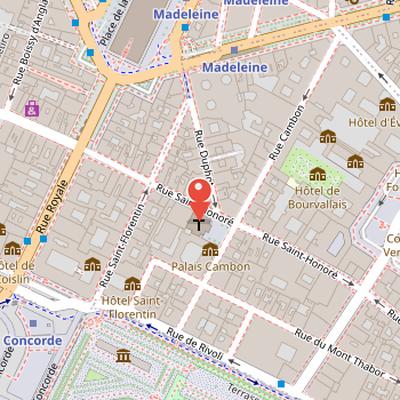
Notre-Dame-de-l'Assomption is a church building in Paris, located at place Maurice-Barrès, at the corner of rue Saint-Honoré and rue Cambon. It is a Polish Catholic place of worship and depends on the Notre-Dame-de-l'Assomption convent founded in 1622. The church was constructed between 1670 and 1676 after the congregation of the Dames de l'Assomption transformed the former house into a convent and later called on architect Charles Errard to build a new church. The building was decommissioned during the Revolution, then reopened for worship in 1802 as the church of the Madeleine parish. It was later decommissioned as a parish church and assigned to the Polish Catholic Mission by Archbishop of Paris Denys Affre in 1844. The site and its buildings were affected by revolutionary changes, including conversion of the convent buildings into a caserne and partial demolition of the south wing.
Nearby Objects
-
 Hôtel Costes 200 m away
 -
 Jeu de Paume 200 m away
 -
 Hôtel Ritz Paris 250 m away
 -
 Boulevard de la Madeleine 250 m away
 -
 Vendôme Column 300 m away
History and Ecclesiastical Use
Notre-Dame-de-l'Assomption is a Polish Catholic place of worship located at place Maurice-Barres, at the corner of rue Saint-Honore and rue Cambon in Paris. It was constructed between 1670 and 1676 and depends on the Notre-Dame-de-l'Assomption convent, which was founded in 1622. During the Revolution, the building was decommissioned. It reopened for worship in 1802 as the church of the Madeleine parish, but it was later decommissioned as a parish church. In 1844, Archbishop of Paris Denys Affre assigned it to the Polish Catholic Mission.
Formation of the Convent
Cardinal de la Rochefoucauld intended to reform the congregation of the Haudriettes in the ancient rue des Haudriettes, and decided to transfer their establishment to a house on rue Saint-Honore near the porte Saint-Honore. This house had been sold to the Jesuits in 1605 and was officially resold from the Jesuits to the Haudriettes on May 13, 1630. After the abolition of the Haudriettes, the congregation became known as the Dames de l'Assomption. They transformed the house into a convent and initially had a modest chapel.
Historical Transformations of the Assomption Site
The site of Notre-Dame-de-l'Assomption has a long history of reuse and transformation. It was acquired as an hotel particulier belonging to sieur Desnoyers, after which Charles Errard was called to design a new church. Construction began in 1670 and was completed in 1676. The church itself was preserved, unlike the rest of the convent, which later underwent major changes.
After the decree suppressing religious congregations in 1790, the buildings remained available to the religious of Assomption for a time. At the expulsion in 1791, the community counted 26 choir nuns and 9 converses. During the French Revolution, the church served as a decoration store. In 1793, the convent buildings were converted into a caserne for the Cent-Suisses, and on May 24, 1796, the land was ordered for sale by decree.
The surrounding area was then further altered by the cutting of rue de Rivoli, rue-Neuve Luxembourg, rue de Mondovi, and rue du Mont-Thabor across the Assomption site. A large part of the south wing was demolished, and the caserne was named Saint-Honore, or more commonly de l'Assomption. During the Restoration, it was assigned first to the foot guard and then to a line battalion.
By decree of March 24, 1836, the buildings were assigned to the Ministry of Finances. A central post office was eventually built on rue du Louvre rather than at Assomption. Later proposals to reuse the old caserne were not carried out, including a 1874 proposal to assign it to the Academie de medecine. In 1895, deputy Georges Berger proposed demolishing the old caserne. In 1897, the decision was taken to build a new structure on the site of the school and finance buildings for the Cour des comptes, which moved there in 1912. In 1924, the parvis of the church was transformed into place Maurice-Barres.
Historical Development of the Parish
Notre-Dame-de-l'Assomption was intended to become a succursal parish by imperial decree on October 1, 1844, but the decree was never carried out. The church later came under the care of the Resurrectionist fathers, who managed the Polish chaplaincy until 1903. During the interwar period, Polish priests were sent to serve the church, reflecting the continued religious link with the Polish community. Between the two world wars, both the Polish community and the Mission grew greatly, marking an important stage in the church's institutional history.
Architectural Form and Interior Features
Notre-Dame-de-l'Assomption has a centralized plan and is built as a rotunda with an 18-meter diameter. Its lower part is marked by simple pilasters, while the upper volume is covered by a dome pierced by eight bays that alternate with statue niches. The facade includes a peristyle with six Corinthian columns supporting a triangular pediment, and it is said to resemble the north facade of the Sorbonne. The exterior is also adorned with a bust of Pope John Paul II. In the church crypt, there is a Polish restaurant owned by the Polish Catholic Mission, adding a distinct cultural use to the building.
The Grand Organs History and Restoration
The grand organ Cavaille-Coll in Notre-Dame de l'Assomption is an organ by Aristide Cavaille-Coll dating from the very end of the 19th century. Its instrumental part is installed in the church and is housed in a more ancient case of French classical style from the late 18th or very early 19th century. The instrument has 19 stops, two manuals of 56 notes, and a pedalboard of 30 notes. It also carries the signature of Aristide Cavaille-Coll, visible inside on some pipes.
The organ underwent important modifications in 1970 by the Danion-Gonzalez workshop, when the key and stop action were electrified, the stoplist was rearranged, and the overall tuning was redone. It was restored again by Sebire and Glandaz in 1981, with re-harmonization carried out during a new cleaning. A further restoration was completed by Dargassies in 2017-18.
The Cavaille-Coll Grand Organ
The grand organ Cavaille-Coll has been in a precarious structural state for several years. Its interior dust has also increased since the churchs interior decoration restoration began in 2013. The most recent restoration of the organ started in 2017 and was completed in 2018 by the Bernard Dargassies organ workshop. That program included repairs and sound improvements.