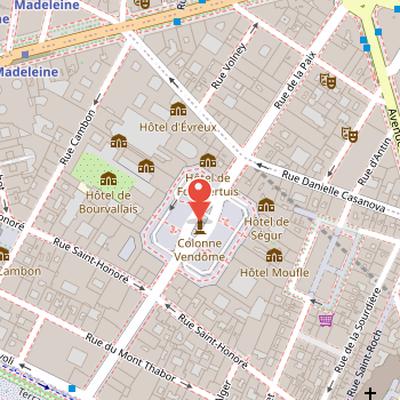
Place Vendôme is a public square in the 1st arrondissement of Paris, located north of the Tuileries Gardens and east of the Église de la Madeleine. It has the aspect of an octagon, with regular architecture by Jules Hardouin-Mansart and pedimented screens canted across the corners. The square is the starting point of the Rue de la Paix.
The site was formerly the hôtel of César de Bourbon, Duke of Vendôme. In 1698, the square was begun as a monument to the armies of Louis XIV and was originally called the Place des Conquêtes. It was later renamed the Place Louis le Grand when those conquests proved temporary. François-Michel le Tellier, Marquis de Louvois, purchased the ground to build a square modelled on the Place des Vosges, but the project was not completed during his lifetime. After his death, Louis XIV bought the plot and commissioned Hardouin-Mansart to design house-fronts for the square, with buyers of the surrounding plots required to agree to the design. The square’s original Vendôme Column, erected by Napoleon I to commemorate the Battle of Austerlitz, was torn down on 16 May 1871 by decree of the Paris Commune and later re-erected; it remains a prominent feature today.
Nearby Objects
-
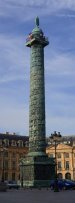 Vendôme Column 0 m away
 -
 Hôtel Ritz Paris 70 m away
 -
 Hôtel Costes 130 m away
 -
 Couvent des Jacobins 200 m away
 -
 Notre-Dame-de-l'Assomption Church 300 m away
Architecture and the Vendome Column
Place Vendome is a public square in the 1st arrondissement of Paris, located to the north of the Tuileries Gardens and east of the Eglise de la Madeleine. It is also the starting point of the Rue de la Paix. The square is marked by a regular architectural design attributed to Jules Hardouin-Mansart, with pedimented screens canted across the corners, giving it the aspect of an octagon. A central feature of the square is the Vendome Column, originally erected by Napoleon I to commemorate the Battle of Austerlitz. The column was torn down on 16 May 1871 by decree of the Paris Commune, then subsequently re-erected, and it remains a prominent feature of the square today.
Origins and Early Monument
Place Vendome began in 1698 as a monument to the armies of Louis XIV. It was originally called the Place des Conquetes, but after the conquests proved temporary, it was renamed the Place Louis le Grand. In 1699, an over life-size equestrian statue of Louis XIV by Francois Girardon was made and donated by city authorities for installation in the centre of the square. The statue was believed to be the first large modern equestrian statue cast in a single piece. It was destroyed during the French Revolution, although a small version of it is held in the Louvre.
History of Place Vendome
The site of Place Vendome was formerly the hotel of Cesar de Bourbon, Duke of Vendome, the illegitimate son of Henry IV and Gabrielle d'Etrees. Jules Hardouin-Mansart later bought the building and its gardens, initially intending to turn them into building lots, but this plan did not materialize. Louis XIV's Minister of Finance, Francois-Michel le Tellier, Marquis de Louvois, then purchased the ground to create a square modeled on the Place des Vosges of the previous century. Louvois, however, had financial difficulties and did not finish the project. After his death, Louis XIV bought the plot and commissioned Hardouin-Mansart to design the house fronts, and buyers of the surrounding plots had to accept this facade design.
When state finances became strained, the financier John Law took over the project and built a residence behind a facade. The square was completed by 1720. Around that time, Law's paper-money Mississippi bubble burst, and he paid back taxes amounting to tens of millions of dollars. Unable to meet these obligations, he sold the property he owned on the square. The buyers were members of the exiled Conde branch of the House of Bourbon, who later returned to France to reclaim their land in the town of Vendome. Between 1720 and 1797, the Conde branch acquired much of the square, including freehold parts of the site where the Hotel Ritz Paris now stands, and they still maintain apartments there. The restoration of a family palace by the Conde branch depended on the Justice Ministry's expansion intentions.
Place Vendome also hosted the Foire Saint-Ovide in 1764, and the fair remained there until 1771. In a later diplomatic context, France housed the Texan legation at Hotel Bataille de Frances at 1 Place Vendome during relations with the Republic of Texas.
The Vendome Column
The Vendome Column was started in 1806 at Napoleon's direction and completed in 1810. It was modelled after Trajan's Column to celebrate the victory of Austerlitz. Its veneer consists of 425 spiralling bas-relief bronze plates made from cannon taken from the combined armies of Europe. The plates were designed by sculptor Pierre-Nolasque Bergeret and executed by about 30 sculptors, including Jean-Joseph Foucou, Louis-Simon Boizot, Francois Joseph Bosio, Lorenzo Bartolini, Claude Ramey, Francois Rude, Corbet, Clodion, Julie Charpentier, and Henri-Joseph Ruxthiel.
A statue of Napoleon by Antoine-Denis Chaudet was placed on top of the column. It showed Napoleon dressed in Roman attire, bare-headed, crowned with laurels, holding a sword in the right hand and a globe surmounted with a statue of Victory in the left hand. In 1816, a mob attempted to pull down the statue using a cable attached to its neck, but the statue did not move. After the Bourbon Restoration, the statue was pulled down and melted to provide bronze for the recast equestrian statue of Henry IV on the Pont Neuf. Bronze from sculptures on the Column of the Grande Armee at Boulogne-sur-Mer was also used for that recasting. The statuette of Victory from the original statue is kept in the salon Napoleon of the Hotel des Monnaies, which also contains a model of the column and a likeness of Napoleon's face copied from his death mask. Later, a replacement statue of Napoleon in modern dress was erected by Louis-Philippe, followed by a more augustly classicizing statue erected by Louis-Napoleon, later Napoleon III.
The Vendome Column in Revolution and Controversy
The Vendome Column was not only a landmark in Place Vendome but also a site of political symbolism and conflict. In 1852, Karl Marx predicted its collapse in his political pamphlet Le 18 Brumaire de Louis Bonaparte, ending with the claim that the bronze statue of Napoleon would fall from the height of the column if the imperial mantle fell on Louis Bonaparte. During the Paris Commune in 1871, the column became a major issue in debates over war, national identity, and public monuments. Painter Gustave Courbet proposed that it be dismantled and preserved at the Hotel des Invalides, expressing dismay that it was a monument to war located on the Rue de la Paix.
The column was also the scene of violence on 22 March 1871, when disturbances broke out against the National Guard outside Place Vendome. Demonstrators carrying banners calling themselves Friends of Peace were blocked by guardsmen, and after shots were fired at the guardsmen, they opened fire on the crowd. At least 12 people were killed and many more were wounded. Legislation authorizing dismantling was passed on 12 April 1871, and the column was taken down on 16 May 1871, with its bronze plates preserved. After its destruction, Place Vendome was renamed Place Internationale in repudiation of the column's perceived glorification of national chauvinism and bellicosity.
Following the suppression of the Paris Commune by Adolphe Thiers, the decision was made to rebuild the column with the statue of Napoleon restored at its apex. Courbet was condemned to pay the rebuilding costs, estimated at 323,000 francs, in yearly installments of 10,000 francs. Unable to pay, he went into self-imposed exile in Switzerland, and the French government seized and sold his paintings for a minor amount. The column was re-erected at the center of Place Vendome in 1874 with a copy of the original statue on top. An inner staircase leading to the top is no longer open to the public.
Architecture and Changing Urban Life
Place Vendome was defined by a restrained and highly ordered architectural composition. Along the long sides of the square, Hardouin-Mansart used ranges of Corinthian pilasters that break forward beneath a pediment at the center. The buildings also feature formally rusticated ground floors with arcading, though unlike the Place des Vosges there is no arcaded passageway. The windows are linked visually from one floor to the next, and the increasing arch of the windowheads gives an upward movement that lightens the strong horizontal lines formed by the rows of windows.
The square was originally accessible by a single street, which helped preserve an atmosphere of aristocratic quiet, except during the annual fair held there. This changed when Napoleon opened the Rue de la Paix. In the 19th century, the new street brought increasing traffic into the square. After the opening of the Palais Garnier in 1875, the center of Parisian fashionable life also began to shift toward the Rue de la Paix and Place Vendome.
Place Vendome in Popular Culture and Fashion
Place Vendome has long been linked with fashion, luxury, and public institutions. Its fashionable and deluxe hotels include the Ritz, and many famous dress designers had salons in the square. Charvet has been located at number 28 Place Vendome since 1877, while the couturier Cheruit was at number 21 and was reestablished in 2008. The square is also home to major offices and institutions, including the Ministry of Justice at the Hotel de Bourvallais, numbers 11 and 13, where it has been based since 1718. Other offices include JP Morgan at number 14 and Ardian at number 20.
The square has also appeared in literature, film, and television. Michael Arlen described Place Vendome in detail in the 1924 novel The Green Hat. The 1998 film Place Vendome, directed by Nicole Garcia and starring Catherine Deneuve, took its title from the square. Place Vendome also appears as the setting for the theft of the Black Pearl in Episode 1 of Season 3 of the Netflix series Lupin. In another cultural reference, Mark Twain mentioned the Vendome Column in his speech Some Thoughts on the Science of Onanism.
Place Vendome has even been connected to personal memorial acts: after Keith Haring was cremated in 1990, Yoko Ono brought one handful of his ashes to the square. In the 1920s, American architect Alonzo C. Webb also worked there, making advertisements in English for fashionable houses along Place Vendome.
Notable Residents of Place Vendome
Place Vendome has been associated with a number of notable residents from different periods and professions. At 10, Place Vendome, Claude Dupin, a financier and contracted tax-collector, lived in the same location later linked to Samuel Jean de Pozzi, the surgeon and gynaecologist. Augustin Blondel de Gagny also lived at Place Vendome, while Abel-Francois Poisson, marquis de Marigny, the brother of Madame de Pompadour, was based at 8, Place Vendome.
Other residents included Franz Mesmer, the German physician known as the discoverer of animal magnetism, at 16, Place Vendome, and Anne Lister, the English landowner and diarist, who stayed at 24, Place Vendome in 1824 to 1825. Frédéric Chopin, the Polish composer, lived at 12, Place Vendome, where he died. Virginia Oldoini, Countess di Castiglione, the former mistress of Napoleon III, lived in seclusion at 26, Place Vendome. Later occupants included Coco Chanel at 15, Place Vendome and Prince Jefri Bolkiah at 3 to 5, Place Vendome.