The Couvent des Jacobins de la rue Saint-Honoré was a Dominican convent in Paris. In France, members of the Order of Preachers were commonly called Jacobins, a designation linked to the early Dominican presence at Hospice Saint-Jacques and its chapel dedicated to Saint James. The first Dominican brothers occupied that site soon after arriving in Paris, and the name was used throughout France afterwards.
The community was confirmed by Pope Honorius III in 1216. Its origins lie in the group Frères de la Prédication de Toulouse, formed around Dominic, which became the Order of Preachers in 1216. Two Dominican groups reached Paris in 1217 and first settled on the Île de la Cité. The order later had two major convents with renowned schools in Paris and a novitiate. The monastery churches also served as burial sites for the founders of three royal lines and for high dignitaries of secular and ecclesiastical power.
Nearby Objects
-
 Place Vendôme 200 m away
 -
 Vendôme Column 200 m away
 -
 Hôtel Ritz Paris 250 m away
 -
 Hôtel Costes 300 m away
 -
 Théâtre des Bouffes-Parisiens 300 m away
The Jacobin Convent in Paris
The Couvent des Jacobins de la rue Saint-Honore was a Dominican convent in Paris. The term Jacobin was a common French designation for a member of the Order of Preachers. According to the provided facts, the religious community was confirmed by Pope Honorius through a bull in 1216. The community had two major convents with renowned schools in Paris, as well as a novitiate. Its monastery churches also served as burial sites for the founders of three royal lines and for high dignitaries of both secular and ecclesiastical power.
The Origin of the Jakobiner Name in Paris
In Paris, the Dominican order was called Jakobiner for reasons linked to Hospice Saint-Jacques and its small chapel dedicated to Saint James. Soon after their arrival in Paris, the first Dominican brothers occupied this hospice and chapel. The site was located on the former Gallo-Roman Cardo, now Rue Saint-Jacques, a road that also served as the southern exit route and starting point for the northernmost French pilgrimage route to Santiago de Compostela in Galicia. Pilgrimages to the tomb of Saint James had developed since the mid-11th century and became more important in the 12th century, which helped associate the area with Saint James and the Dominican presence.
The monastery street was officially named Grand’rue du Petit Pont in the inner city until the 12th century, and later Grand’rue Saint-Jacques des Precheurs, a name that reflected both the pilgrimage destination and the Order of Preachers. However, the term Jakobiner did not originate from the street name itself, nor from the nearby commandery of St. Jacques-du-Haut-Pas about 500 meters away outside the old city gates. The name was later confused with the Order of San Giacomo di Altopascio, an Italian spiritual knight and hospital order. Afterward, Dominicans were called Jakobiner throughout France.
Origins of the Dominican Presence in Paris
The Dominican presence in Paris began with a small group known as the Freres de la Predication de Toulouse, formed around Dominic. In 1207, the group consisted of about 30 to 40 preachers whose goal was to convert the Albigensians in Languedoc. In 1216, Pope Honorius III elevated the community to the Order of Preachers. Despite opposition, Dominic decided at Pentecost 1217 to send the Dominicans in all directions, and by the summer of that year he had succeeded in dispatching two groups to Paris by different routes.
Early Site and Expansion in Paris
The religious community arrived in Paris in 1217 and first settled in a house on the Ile de la Cite, where construction of Notre-Dame de Paris had begun in 1163. One or two years later, it moved to the Hospice de Saint-Jacques on the Rive Gauche. This hospice, founded in 1209 by Jean Barastre, was used to assist Jacobus pilgrims, and its entrance was at 156 Rue Saint Jacques, south of the Sorbonne. At this site, the community built a two-nave church and gradually expanded the monastery with the support of King Louis IX from 1226 to 1270. The order also held land bounded by Rue de la Harpe, Rue des Cordiers, Gand'rue du Petit Pont, and a street near the city wall. In addition to the church, it constructed a dormitory and a nursing home on the sites now numbered 151 and 172 Rue Saint-Jacques. A monastery cemetery was established in 1220, despite opposition from the parish priest of St. Benoit. In 1358, after a moat was dug beyond the old city wall, the order ceded the extramural land.
Ecoles Saint-Thomas at the Monastery District
Along the southern wall of the monastery district, the Ordensniederlassungen in Paris built the Ecoles Saint-Thomas schools. These schools were associated with the education of Albertus Magnus, Thomas Aquinas, and Meister Eckhart. Around 1461, Alanus de Rupe, later known as the founder of the first rosary confraternity, taught there. The schools were closed in 1649, marking the end of this educational function within the complex.
The Jacobin Monastery on Rue Saint-Honore
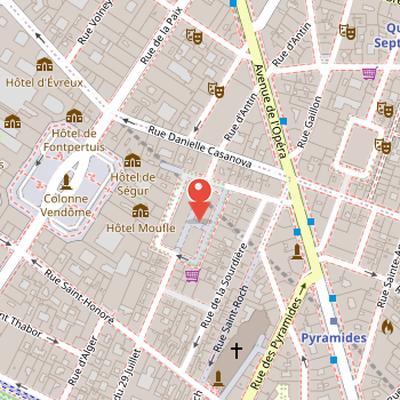
The Couvent des Jacobins de la rue Saint-Honore was founded in 1613, when the order obtained permission from Queen Mother and Regent Maria de Medici to establish a second monastery on the right bank of the Seine. The order had earlier reformed under Sebastien Michaelis in the early 17th century under Jesuit influence, and the new foundation was created after the monastery in Paris had become known as the Grand Couvent des Jacobins. The property comprised a 10-acre plot on Rue Saint-Honore, with donations including one from Henri de Gondi, Bishop of Paris. Its boundaries were described as bordering the Hotel de Vendome to the west, impasse de la Corderie to the north, and Rue de La Sourdiere to the east. The main entrance was aligned with the present Rue du Marche Saint-Honore near number 328 Rue Saint-Honore.
The convent complex included convent buildings, a cloister, and a garden behind the church. Before the monastery was dissolved during the Revolution, it housed 60 brothers and 20 novices. The convent church also contained a famous library of 30,000 volumes in the roof structure. The church held the remains, hearts, or entrails of 22 kings, queens, princes, and princesses of noble blood, and it also buried the progenitors of the three royal houses Valois, Evreux, and Bourbon. The monastery was associated with music as well: the organist office was held from 1719 by Louis-Nicolas Clerambault, and later by his sons Cesar-Francois-Nicolas and Evrard-Dominique.
During the French Revolution, the monastery was suppressed in 1790. Its chapter hall, library, and entire nave were used as meeting places by the Societe des Amis de la Constitution, and the site became known as the Club des Jacobins. Maximilien de Robespierre was the main representative of the club, and he was arrested on 9 Thermidor Year II (27 July 1794) and executed the next day at the same location. The meeting place was closed on the day of his execution. The cloister was used temporarily as a ballroom. In 1795, the National Convention decreed the grounds for market halls, and this use was considered in 1806 and completed by 1810. The entire monastery complex was demolished except for the portal, which survived until 1866. No remains of the monastery survived, and the site is now Rue du Marche-Saint-Honore and the square of the same name.
Later Construction and Decoration
From 1682, Pierre Bullet worked on the construction of a larger church, St. Thomas d'Aquin, associated with the site. The interior decoration was later enriched in 1723, when Francois Le Moyne painted the ceiling murals in the church. Construction works continued for several decades and were completed after 1765, indicating a long and extended building process.
The Cloister, Library, and Later Uses
In 1735, the Parisian religious house added two wings and a connecting third wing, creating a square cloister. Above the cloister galleries were monastery cells and a library. At the start of the Revolution, the library held 14,000 volumes and two globes by Vincenzo Maria Coronelli. The novitiate housed 21 brothers when it closed in 1790.
After 1796, the novitiate was used as a weapons depot and museum. The museum included spoils from Napoleonic campaigns, and it was looted during the July Revolution on 28 July 1830. Weapons were later returned after the July Revolution ended. The museum fund eventually formed the basis for the Musee de l armee in 1905.
The premises remained almost entirely preserved, apart from furniture looted during the Revolution. The former monastery church is now the parish church St. Thomas d Aquin. Today, the cloister, monastery cells, and great hall house military authority offices. Burials had also taken place in the novitiate on Rue du Bac, and grave monuments were removed by the Musee des Monuments francais in 1795 to prevent destruction.