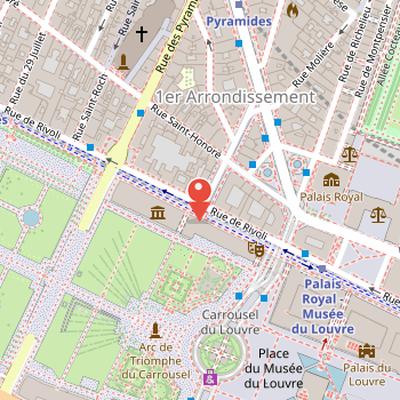
The Musée des Arts Décoratifs is a Parisian museum located on rue de Rivoli in the Marsan wing of the Palais du Louvre. It was established in the Pavillon de Marsan following designs by architect Gaston Redon. The museum is part of the larger private association MAD, founded in 1882 and formerly known as Les Arts Décoratifs. Its objective is to promote applied fine arts and to develop links between industry and culture, creation and production. It also continues the foundation’s aim of maintaining in France a culture of arts pursuing the realization of beauty in utility. The museum preserves one of the most important collections of decorative arts in the world. Renovated in 1996 during the Grand Louvre project, it later permanently installed the musée de la Mode et du Textile and added the musée de la Publicité, designed by architect Jean Nouvel. Its collections include furniture, table arts, graphic arts, goldsmithing, glass, ceramics, wallpaper, tapestry, painting, and sculpture.
Nearby Objects
-
 Hôtel de Rambouillet 140 m away
 -
 Equestrian Statue of Joan of Arc 150 m away
 -
 Place du Carrousel 200 m away
 -
 Marly Horses 200 m away
 -
 Comédie-Française 200 m away
Museum Mission and Collection
The Musee des Arts Decoratifs is a Parisian museum located on rue de Rivoli in the Marsan wing of the Palais du Louvre. It aims to promote applied fine arts and to develop links between industry and culture, as well as between creation and production. The museum preserves one of the most important collections of decorative arts in the world. It also continues the objective set at its foundation: to maintain in France a culture of the arts devoted to the realization of beauty in utility. The museum is part of the larger private association MAD, formerly known as Les Arts Decoratifs, which was founded in 1882.
Development of the Museum Complex
The Musee des Arts Decoratifs was established in the Pavillon de Marsan of the Palais du Louvre following designs by architect Gaston Redon. In 1996, it was renovated as part of the Grand Louvre project implementation. The reopening also included the permanent installation of the Musee de la Mode et du Textile. Later, the museum complex was expanded with the addition of the Musee de la Publicite, designed by architect Jean Nouvel.
Collections and Chronological Departments
The musee des Arts Decoratifs gathers approximately collections, with part of the holdings presented to the public. Its collections are divided into five chronological departments, including Moyen Age - Renaissance, Art nouveau - Art deco, and Moderne-Contemporain, as well as into seven thematic departments covering arts graphiques, bijoux, jouets, papiers peints, verre, mode et textile, and publicite et graphisme. The collections represent furniture, table arts, graphic arts, goldsmithing, glass, ceramics, wallpaper, tapestry, painting, and sculpture. Most of the holdings have been obtained through donations and legacies since the establishment of the museum, and the collection was regrouped with an encyclopedic vocation from the origins of the museum.
The museum also houses the Jean Dubuffet donation and the toy museum. Within the chronological path, the painting collection covers a period of 400 years and includes many Gothic Spanish, Italian, and Flemish panels. Artists represented in this collection include Jan van Kessel, Alessandro Magnasco, Alexandre-Francois Desportes, Charles de La Fosse, Jean-Baptiste Oudry, Francois Boucher, Giambattista Tiepolo, Giandomenico Tiepolo, Hubert Robert, Philippe-Jacques de Loutherbourg, Bernardo Bellotto, Gaspare Diziani, Jacques-Louis David, Camille Moreau-Nelaton, Paul Gauguin, Henri-Edmond Cross, James Ensor, Henri Matisse, and Jean Dupas. Individual works named in the collection include La Rencontre de Jason et Medee by Biagio di Antonio Tucci, Venus et l'Amour voleur de miel by Lucas Cranach l'Ancien, L'Epouse indiscrete and La Lecture by Pierre-Antoine Baudouin, La Famille Gohin by Louis-Leopold Boilly, Petit Cireur de bottes a Londres by Jules Bastien-Lepage, Portrait de Georges Goursat, dit Sem by Giovanni Boldini, and Portraits de Jean Paulhan, Hotel du Cantal, and Pisseur a droite by Jean Dubuffet.
The museum also exhibits works by the sculptor Emmanuel Collin, noted as the youngest artist to exhibit in the museum in 1987.
Collections and Period Rooms
The collections of the Musee des Arts Decoratifs present a broad panorama of decorative arts, with nearly complete coverage of the period represented in the holdings. They are displayed in galleries that include reconstructed period interiors such as the salon Talairac and the salon of the hotel de Serres, allowing visitors to encounter objects in settings that evoke their original context. The museum's collections encompass a little more than 800 pieces, with over 800 displayed in 13 rooms, and they are spread over 5 levels in the Pavillon de Marsan, which is also visible from the collections.
The furniture holdings are especially notable, with 450 pieces on display, including complete Empire and Restoration ensembles, royal furniture deposited by the Mobilier national, and exceptional furniture from industry and World Exhibitions. Among the individual objects cited are a Dutch wardrobe dated 1620, a cabinet from Paris around 1670, 18th century chairs, a chest of drawers made of oak with marquetry from Paris in 1755, and a fall-front desk from Paris in 1780. The collections also include lacquer panels with chinoiserie motifs and the Cabinet des Fables from the hotel d'Ange.
Other departments add to the historical range of the museum. The holdings include more than pieces of porcelain from Sevres, Paris, or Limoges, and about pieces of goldsmithery showing the work of manufactures such as Odiot and Christofle. A monumental Surtout des cent couverts is among the notable examples. The museum also contains over three hundred paintings and more than five hundred sculptures.
The decorative arts collections extend into the 19th and 20th centuries through pieces such as the Console premier Empire, the Mobilier de la duchesse de Berry from Paris around 1825, a Salon second Empire, the Lit de Valtesse de La Bigne from the Second Empire circa 1875 in Paris, and a Salle a manger from around 1880. They also include reconstituted Art nouveau ensembles, a section of Art deco with unique ensembles such as the apartment of Jeanne Lanvin from 1925, the bureau-bibliotheque of the Pavillon d'une ambassade francaise designed by Pierre Chareau for the 1925 Exposition des arts modernes et decoratifs de Paris, the Grille des Paons, an Art nouveau piano from 1900 by Henri Hertz with sculpture by Francois-Rupert Carabin, a coupe Art nouveau titled Vol d'ephemeres by Emile Galle from Nancy, a Salle Art deco, and Art deco stained glass. The collections begin with the Exposition internationale des arts et techniques of 1937 and continue to the current period, including a Salle of the Memphis Group.
Jewelry, Textiles, and Decorative Arts
The Musee des Arts Decoratifs brings together approximately 150,000 items spanning from the Middle Ages to the present day. Among its most notable holdings is a jewelry gallery that offers a chronological view of jewelry history from Antiquity to the contemporary period. This section includes representative pieces from the Middle Ages and the Renaissance, as well as Art Nouveau jewelry by Georges Fouquet, Lucien Gaillard, Maison Vever, and Rene Lalique. It also presents Art Deco and 1930s jewelry, with creations from Place Vendome jewelers such as Boucheron and Cartier, and features a section devoted to jewelry since 1940 with many works by French creators, artist jewelry, and European and independent jewelers. The collections also received major donations from houses including Cartier, Boucheron, Van Cleef and Arpels, JAR, Chanel, Mellerio, and Lorenz Baumer.
Beyond jewelry, the museum holds a wallpaper department created in 1967, with items representing over three centuries of creation, and a glass collection extending from the 19th century to the present. Its glass holdings, including works by Lalique, Baccarat, Saint-Louis, Tiffany, Gallé, and Daum, are described as the richest and most diverse in France. The toy collection, started in 1905, includes objects from the mid-19th century onward and is shown through two annual thematic exhibitions. The textile collection, already important in 1905, contains silks, embroideries, lace, and printed fabrics, and was enriched after 1948 with assistance from the Union francaise des arts du costume. It also includes costumes, accessories, textiles, a photography fund, and graphic art, and contains more than 152,800 works from the present day, including pieces by Paul Poiret, Popy Moreni, Madeleine Vionnet, Christian Lacroix, Christian Dior, and Yves Saint Laurent.
The Posters and Advertising Collections
The collections acquired their first posters in the early years of the institution's history. A Posters Department was created in 1972, marking a formal step in the development of this area. In 1978, the musee de l'Affiche was officially established, and in 1981 it was located at rue de Paradis. The institution was later renamed the musee de la Publicite. In 1999, the musee de la Publicite reopened at 107 rue de Rivoli, continuing the public presentation of the collections under its new name.
Collections and Reserve Management
The collections galleries at 107 rue de Rivoli were designed by Jean Nouvel. The museum's holdings include about 1,919 objects, together with advertising films, press announcements, radio spots, and promotional objects. The collections also organize numerous thematic exhibitions. Among the notable additions is a personal collection donated by Jean Dubuffet in 1967, and the museum presents works by Dubuffet from 1942 to 1966 in a dedicated gallery with changing displays. These presentations may include paintings such as Hotel du Cantal and Pisseur a droite.
Only about 20 percent of the museum's owned works are exhibited at any time. The rest are kept in reserves, which were formerly located in the museum basements. Because of the risk of flooding from the Seine, stored works were moved to large secure warehouses. Some works are also kept under buildings for renovation, transit, replacement, or exhibition use. The reserves are under very high surveillance, with air conditioning constantly controlled and a constant temperature and 70 percent humidity maintained to prevent any deterioration of the contents.