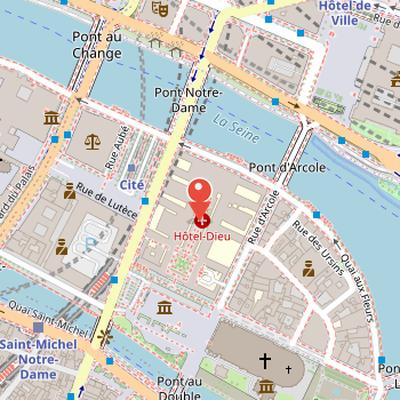
Hôtel-Dieu de Paris is a hospital complex on the Île de la Cité, on the north edge of the parvis Notre-Dame in Paris. Traditionally founded around 650 by Saint Landry, bishop of Paris, it is the oldest hospital in the city. The institution originally served as a hotel for pilgrims praying for souls at holy sites such as Jerusalem and Saint-Jacques de Compostelle. It was managed by Augustinian sisters, and doctors did not begin practicing in Paris hospitals until the 18th century.
The history of Hôtel-Dieu de Paris reflects the links between piety, hospitality, and medical care. Confirmed care buildings date back to 829, and the complex was repeatedly rebuilt and expanded over the centuries. Major reconstruction took place from 1867 to 1878 under the architects Émile Jacques Gilbert and Arthur-Stanislas Diet. The hospital is also served by the Cité metro station.
Nearby Objects
-
 Île de la Cité 100 m away
 -
 Charlemagne et His Guards 200 m away
 -
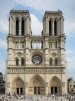 Notre-Dame de Paris 200 m away
 -
 Shakespeare and Company 250 m away
 -
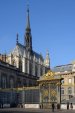 Sainte-Chapelle 300 m away
Origins and Rebuilding of the Hotel-Dieu
The Hotel-Dieu de Paris was established around 650 by the bishop Saint Landry, making it the oldest hospital in Paris. It is located on the Ile de la Cite, on the north edge of the parvis Notre-Dame in Paris, and is served by the Cite metro station. Originally, it functioned as a hotel for pilgrims praying for the souls of others at holy sites such as Jerusalem and Saint-Jacques de Compostelle. The institution was managed by Augustinian sisters with some nursing skills, but there were no doctors at first. This reflected a wider pattern in which doctors began practicing in Paris hospitals only in the 18th century, while earlier they treated wealthy patients at home and hospitals provided free care for poor patients. The present building was rebuilt between 1867 and 1878 under the architects Emile Jacques Gilbert and Arthur-Stanislas Diet.
Early Development of the Hotel-Dieu de Paris
The history of the Hotel-Dieu de Paris links piety, hospitality, and medical care. It was traditionally founded by Saint Landry around 650, and confirmed care buildings are recorded from 829 opposite the old Saint-Etienne church. In 1157, it was called Hotel-Dieu-Saint-Christophe because of a chapel dedicated to Saint Christopher. A major rebuilding began in 1165 under Maurice de Sully, bishop of Paris. The old buildings were destroyed in 1195, and new construction was completed with the Saint-Denis hall and chapel. Further additions followed in the 13th century, including the Saint-Thomas hall in 1210, the Infirmerie hall by the Seine between 1225 and 1250, commons along the rue des Sablons in 1226, and the New hall with Sainte-Agnes chapel near Rue du Marche-Palu from 1250 to 1260. The complex expanded again in 1531 near Petit-Pont with the Legate hall, which replaced a house donated by Chancellor Antoine Duprat.
Expansion, Care, and Rebuilding
The Hotel-Dieu de Paris preserved a distinct role in caring for poor sick patients, separate from the Hospital General. Patients from the Hospital General, except for venereal cases, were systematically sent there for treatment. Care at the hospital included operations performed by barbers, including amputations, and the institution was also known for food distributed by nuns. Compared with general hospitals, patients were said to be well fed, although doctors complained that the portions were too generous and could harm health. The hospital received letters patent in 1781 recommending one patient per bed to reduce disease transmission, a sign of the precarious accommodation conditions that existed there. In practice, living and dead patients could sometimes occupy the same bed, and Jacques Tenon's 1788 report recorded severe overcrowding, including the Saint-Pierre Saint-Paul room, which had 111 beds for 345 people for operations. New regulations were implemented in 1787.
The hospital complex expanded repeatedly on both sides of the river. In 1606, it built the annex Saint-Charles on the left bank and formed vaulted cellars, called les cagnards, in the basement for storing hospital supplies. The building was connected to the other bank by the pont au Double, built in 1626, which included two superimposed rooms named Saint-Cosme and du Rosaire and a pedestrian passage. In 1654, the pont Saint-Charles doubled the pont au Double and served as a private hospital path and patient promenade between the pont au Double and Petit-Pont. Later, between 1714 and 1719, the hospital added new rooms, Saint-Antoine and du Rosaire, along rue de la Boucherie. After the demolition of Petit-Chatelet in 1782, the left bank rooms were extended onto part of its former site, and until 1878 the hospital buildings occupied the south side of the current parvis Notre-Dame between Petit-Pont and pont au Double.
The hospital was also affected by major disruptions and later rebuilding plans. A fire in 1772 partially destroyed it, and many plans and modifications were conceived afterward. Burial practices formed another part of its history: sick people who died at the hospital were buried in the cemetery of the Innocents until that cemetery became saturated in 1348, after which the dead were transferred to the cemetery of the hospital of La Trinite on Rue Saint-Denis. In 1673, the Hotel-Dieu de Paris and the hospital of La Trinite opened the cemetery of Clamart on a purchased plot near the suburbs of Saint-Victor and Saint-Marcel. The cemetery was located southwest of the cross of Clamart and west of the horse market of the suburb Saint-Victor. In 1782, moralist Louis Sebastien Mercier described the burial conditions and transport to Clamart.
During the late eighteenth and nineteenth centuries, the hospital came under increasing pressure to change. In 1790, the Constituent Assembly confiscated Church assets to finance reforms and the revolutionary army, and religious congregations were dissolved while convents were requisitioned or sold to bring doctors into hospitals. Future practitioners were admitted through competitive exams and trained and practiced there. The buildings were declared insufficient during the Second Empire for evolving medical and hospital missions, and on August 23, 1867, the demolition of the old hospital and reconstruction north of the Notre-Dame forecourt were declared of public utility. The demolition of the Saint-Charles, Saint-Antoine, and Saint-Roch rooms on the left bank was also required. A new annex designed by Jean-Jacques-Marie Huve was built in 1840 between the new quay and Rue de la Boucherie, then demolished in 1908.
Nouvel Hotel-Dieu and the Haussmann Transformation
The Nouvel Hotel-Dieu replaced the old hospital buildings in a major reconstruction carried out between 1867 and 1878, as part of the wider urban project initiated by Baron Haussmann. Built on land bounded by quai Napoleon, place du Parvis, rue de la Cite, and rue d'Arcole, it occupied a central part of Ile de la Cite near Notre-Dame cathedral. Its placement faced the administrative building facade of the former hospital on the cathedral parvis.
The project involved major changes to the surrounding street pattern. Streets between rue d'Arcole and rue de la Cite were replaced, straightened, and widened. The northern part of rue Saint-Christophe disappeared to make room for the hospital, while the southern part was removed to enlarge the parvis Notre-Dame. The northeast portion of the site also covers the area of the former Saint-Landry church and its cemetery, which had been removed in 1829.
The present buildings were designed by Emile Jacques Gilbert with the assistance of Arthur-Stanislas Diet. Constructed from 1866 to 1876 under Haussmann's initiative, the complex was completed by the French Republic at the end of the 19th century. Its main entrance is at 1, place du Parvis. The complex includes facades, exterior galleries overlooking the courtyard, roofs, a portico, chapel steps, the porch on quai de la Corse, the main entrance hall, an adjoining gallery, two winter galleries, six staircases, the courtyard in upper and lower parts with its peristyle, enclosure walls, low walls, and gates. In 1975, the central courtyard was converted into a French garden. The Augustinian nuns left the hospital permanently in 1908, moving to a convent on rue Maison-Dieu. Facades and parts of the building are registered as historic monuments by official decree.
Medical Specialties at Nouvel Hotel-Dieu
Nouvel Hotel-Dieu is one of the hospitals of Assistance Publique - Hopitaux de Paris (AP-HP) and belongs to the hospital group Hopitaux universitaires Paris centre. It forms a hospital group in Paris with Cochin, Broca, La Rochefoucauld, and La Collegiale hospitals, and its hospital center depends on the Faculty of Medicine Paris-Descartes.
The hospital has housed the diabetology and endocrine diseases department for 50 years. This department focuses on the detection, treatment, and prevention of complications linked to diabetes mellitus. It is also a reference service for hypoglycemia and provides patient education and therapeutic information. Its care structures range from light to intensive care, and it is involved in diabetes research on new insulins, medications, the effects of diet, pumps, glucose sensors, and the artificial pancreas.
Nouvel Hotel-Dieu also developed an important ophthalmology service, including emergency care, surgery, and research. This service is directed by Yves Pouliquen.
Hospital Functions and New Proposals
Hotel-Dieu de Paris has been the subject of major debate over its future as a hospital and as a historic urban site. A hospital university transformation project was challenged by medical staff, users, unions, and politicians, and the association L'Hopital pour tous also opposed it under the leadership of Doctor Dinah Vernant and emergency physician Gerald Kierzek. The planned transfer of hospitalization services to the Cochin site was announced, while headquarters services were consolidated in the vacant premises of Hotel-Dieu. At the same time, several services were retained on site, including emergency reception, the mobile emergency and resuscitation service, medico-judicial emergencies, and the diagnostic center. The hospital kept emergencies open 24 hours a day in cooperation with Cochin hospital, even after AP-HP decided to stop receiving firefighters and SAMU in emergencies starting in an early unnamed month.
The site also required substantial renovation work. Emergency upgrades cost around 5 million euros, and firefighting detection upgrades cost around 4 million euros. A broader compliance program was estimated at 280 million euros, showing the scale of investment needed to adapt the building.
Beyond its medical role, Hotel-Dieu has been included in redevelopment and cultural proposals. In 2023, reports described a redevelopment project with shops, cafes, a central garden, and a business incubator, and stated that the hospital would have to cede one third of its surface to a property developer for 80 years. The site was also connected to plans for a museum dedicated to Notre-Dame. On July 16, 2020, Emmanuel Macron supported creating such a museum, and on July 16, 2021, he announced that it would be installed within Hotel-Dieu. Charles Personnaz said that Hotel-Dieu was the only suitable site because of its historical connection to the cathedral. He and Jonathan Truillet proposed a museum of about 7,000 square meters in a confidential report, and later suggested opening a permanent free exhibition space near the cathedral in 2026 or 2027. They also urged swift action so that the museum could open within five years.
The 2019-2025 Redevelopment Project
Between 2019 and 2025, the AP-HP selected Novaxia to reconvert the Hotel-Dieu under an 80-year construction lease. The project provides for a hospital-university hub, offices, a health incubator, a hotel, shops, and housing, and it has also been linked to the @Hotel-Dieu innovation platform, including the BioLabs Hotel-Dieu health technology incubator since 2020. The start-up echOpen has been incubated at the hospital since 2015.
The redevelopment generated strong criticism from resident groups, hospital unions including CGT AP-HP, health professionals, and local officials. Critics denounced privatization, a reduction in medical space, potential nuisances, and a lack of transparency in the lease conditions. Suspicion also arose around a possible conflict of interest because Jean-Louis Missika took part in the project selection jury before joining Novaxia in 2021; he was later sentenced by the Paris correctional tribunal to a 90,000 euro fine and two years of ineligibility.
A public inquiry ran from April 26 to June 27, 2022, on the project's general interest declaration and compatibility with the local urban plan. Hundreds of citizen contributions expressed concern about the transformation of the site, damage to heritage, gentrification, and access to documents. The inquiry commission made its report public on August 23, 2022, noted concerns regarding financing, heritage, urbanism, and the environment, and recommended changes concerning Agora, the museum, the urban plan, governance, and public information. It nevertheless unanimously approved the general interest declaration and the PLU compatibility for the Nouvel Hotel-Dieu. The project was exempted from an environmental impact study despite being in a protected heritage sector near Notre-Dame, and multiple administrative appeals remain pending against the declaration and the PLU derogations. Paris Centre green and communist elected officials oppose the project, while Mayor Ariel Weil expressed reservations about tourism pressure but generally supported the reconversion objective.