Cimetière de Loyasse is located in Lyon on the north side of the Fourvière hill, about 500 metres west of the Basilica of Fourvière and about 200 metres northwest of the Gallo-Roman theatre. Created in 1807, it is the oldest cemetery in Lyon still in use. The cemetery was originally located east of Rue du Cardinal-Gerlier at number 40, then expanded in September 1853 to the other side of the street at number 43. Its official divisions are named the ancien cimetière and the nouveau cimetière.
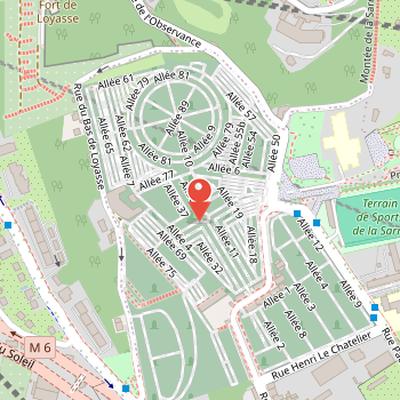
The site covers about 12 hectares in total. The old cemetery covers about 4.5 hectares and is bounded by Rue du Cardinal Gerlier, Rue Pauline-Marie Janicot and Rue Henri Le Châtelier. The new cemetery is bounded by Rue du Cardinal Gerlier, Montée de l'Observance, Chemin du Bas de Loyasse, Fort de Loyasse and private land. A Muslim section, section 43, is located in the old cemetery. The cemetery is accessible by TCL bus line 90 at the Cimetière Loyasse stop.
Nearby Objects
-
 Fourvière Hôtel 550 m away
 -
 Parc des Hauteurs 650 m away
 -
 Lugdunum Musée et théâtres romains 700 m away
 -
 Ancient Theatre of Lyon 700 m away
 -
 Les Subsistances 750 m away
Location and Expansion
Cimetiere de Loyasse is located in Lyon, on the colline de Fourviere. Created in 1807, it is the oldest cemetery in Lyon still in use. The cemetery was first situated east of rue du Cardinal-Gerlier at number 40. In September 1853, it was expanded to the other side of rue du Cardinal-Gerlier at number 43. Its official divisions are named the ancien cimetiere and the nouveau cimetiere.
Location and Layout
Cimetiere de Loyasse is situated on the north side of Fourviere hill, about 500 meters west of the Basilica of Fourviere and approximately 200 meters northwest of the Gallo-Roman theater. The site covers a total area of about 12 hectares. Its old cemetery occupies around 4.5 hectares and is bounded by Rue du Cardinal Gerlier, Rue Pauline-Marie Janicot, and Rue Henri Le Chatelier. The new cemetery is bounded by Rue du Cardinal Gerlier, Montee de l'Observance, Chemin du Bas de Loyasse, Fort de Loyasse, and private land. The cemetery can be reached by TCL bus line 90 at the Cimetiere Loyasse stop. It also includes a Muslim section, section 43, located in the old cemetery.
From Churchyard Burials to the Loyasse Cemetery
The history of Cimetiere de Loyasse is linked to the burial problems that arose in Lyon in 1775, when cemeteries next to churches became overcrowded. In the dense Vieux Lyon district, the cemetery adjoining Saint-Just church was among those affected. A royal declaration by Louis XVI in 1776 set out burial rules in eight points, although Histoire notes that these measures had no real effect before the decree of 23 Prairial, year XII, which regulated French cemeteries in their essential dispositions.
Several cemetery projects were then proposed. Jean-Jacques Coindre presented a project designed by Jacques Marcoux, including sixty common graves, and the municipal council approved it. Later, a treaty was signed and work began to open a new cemetery on Sablons territory in Montchat, where a 6-hectare plot was available. At the same time, the Quatre-Vents cemetery of Saint-Just church reached saturation. After this, the acquisition of land in Loyasse was signed, and the municipal council adopted Montchat, Loyasse, and Croix-Rousse as possible cemetery sites. This choice was validated by a decree of the Ministry of Interior and confirmed by an imperial decree, although Cardinal Fesch and the clergy opposed Montchat as being too distant. The Croix-Rousse site was eventually abandoned.
The Loyasse land acquisition covered 6.35 hectares and was signed with Rivay, followed by a definitive purchase act. The cemetery plan was designed by Joseph Jean Pascal Gay, city architect. When Quatre-Vents cemetery was closed, burials began immediately at Loyasse. The site was then enlarged through several later acquisitions: four adjacent plots were bought between 1807 and 1810, Canon Joseph Caille donated 30,000 francs on July 30, 1812 for the burial of clergymen and also sold 6,000 square meters to enlarge the general cemetery, the last extension of the old cemetery was made on March 17, 1817 with the purchase of the Lièvre enclosure, and two properties were acquired in 1826 to form the new cemetery.
Early Burials and Priest Graves
According to Histoire, the first graves were installed in 1807 after the land had been enclosed in a simple way. Burial activity was substantial from the beginning, with 269 persons buried in 1807 and 1,094 in 1809. The oldest existing graves date from 1809, including those of Philibert Jambon's family and Jacques Barraband. In the 1830s, only a limited number of annual burials took place at Loyasse, while most other burials were directed to mass graves at Madeleine cemetery in La Guillotiere. Histoire also notes that a simple burial at Loyasse on a non-renewable site had a specific cost, and that the space available for ordinary graves decreased with the creation of concessions. The priest's square, which remains in use, includes more than 750 priest graves and is a notable part of the cemetery's burial landscape.
Concessions and Cemetery Administration
The history of Cimetiere de Loyasse includes the city council's vote on a decree allowing the sale of square plots called masses in perpetual concessions. Tariffs and conditions were then set, and the application decree was published later. A register was opened in a later year, with the oldest visible concession dated to a specific day. On a later date, the city council voted new tariffs and abolished perpetual concession. This abolition was not retroactive, which left many unused concessions abandoned. By the end of the century, efforts were made to protect heritage by seeking heirs and assigning concessions for one franc.
Site Conditions and Access
Cimetiere de Loyasse was built on unstable ground west of the Sarra plateau, above Roman ruins of west Lugdunum. This terrain instability caused a terrace wall to collapse in 1810, and the impermeable ground also prevented decomposition of bodies. The site was exposed to all winds, and the entrance cross was knocked down by a storm in 1825. Later, a tornado in 1847 damaged the walls and led to the replacement of two thousand tiles. The cemetery was difficult to reach because it stood at the city edge on a plateau more than one hundred meters above the center of Lyon. Access to the plateau required either steep stairs or long detours, although transport of bodies was improved by the funicular from Saint-Paul to Fourviere and a train from Fourviere to the cemetery. By 1996, no tombs had been classified as historic monuments, and important graves continued to disappear.
Architectural Interest and Memorial Uses
Cimetière de Loyasse is located on the heights of Lyon, at the limit of the commune of Sainte-Foy-les-Lyon, and it offers a view of the center of the city. Its architectural interest lies in the wide variety of styles represented there, as well as in the significant variety of chapels and monuments. The site is compared with cemeteries in regional cities, particularly the cemetery of Loyasse, and it includes works representative of the art of the period. Among the artists named in connection with the site are Pierre Bossan, Paul Chenavard, Joseph Chinard, Charles Dufraine, and Henri Prost. Beyond its architectural value, the cemetery also has a commemorative role, with a ceremony held twice a year to remember soldiers who died in combat, and another held on January 4 for the disaster of Feyzin.
Notable Tombs at Loyasse Cemetery
The cemetery of Loyasse in Lyon contains tombs of several notable figures. Among them is Antoine Gailleton (1829-1904), who served from 1881 to 1900. The presence of such tombs gives the cemetery a particular historical and commemorative significance within the city.
Archaeological Hypotheses and Finds at Loyasse
Archieologie reports that Hippolyte Bazin placed the hypothetical antique circus of Lyon northwest of the Fourviere plateau, along Pauline-Marie-Jaricot street and limited to the south by Roger-Radisson street, with the site extending north over the Loyasse cemetery. The publication notes that this hypothesis has no archaeological evidence to date, although the 2019 Atlas topographique de Lugdunum includes it. The cemetery area has also produced material remains of earlier occupation. In 1967, archaeologist Rene Pelletier discovered a pottery workshop installed at the end of the 1st century. He also found ceramics dating from the reign of Augustus, from 27 to 14 BC, as well as ceramics dating to the end of the Antonines, around 190 AD. More recently, excavations in April 2025 uncovered 1st-century remains, including the foundations of a monumental gate and a Roman road.