Les Subsistances is a cultural centre of diffuse artistic production located in the 1st arrondissement of Lyon. The site covers 22,500 square metres of buildings and land, including 8,300 square metres of renovated surface, and is partly classified as a monument historique. Since March 2007, it has housed a creative laboratory for theatre, dance and contemporary circus, as well as the École nationale des beaux-arts de Lyon. The director is Guy Walter and the vice director is Cathy Bouvard.
The site has a long history on the quay of the Saône. In 1640, the Sisters of the Order of the Visitation of Holy Mary established a small monastery and a church there, forming the convent of Sainte-Marie des Chaînes. After various changes during the French Revolution and the 19th century, the army used the site for storage and military purposes, later adding mills, a bakery, a metal canopy over the courtyard, and large industrial buildings. Since 1995, the city of Lyon has owned the site, and several renovations have transformed its former bakery, mills and hangar into performance and administrative spaces.
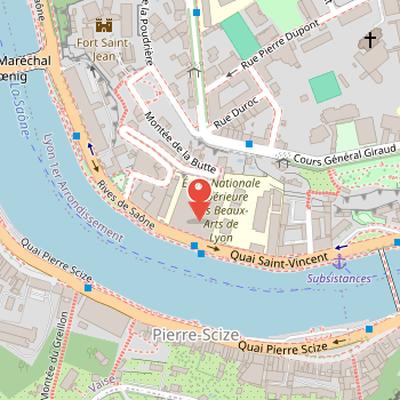
Nearby Objects
-
 Fort Saint-Jean 300 m away
 -
 Château de Pierre Scize 400 m away
 -
 Institution des Chartreux 500 m away
 -
 Church of Saint-Bruno des Chartreux 550 m away
 -
 Parc des Hauteurs 650 m away
Les Subsistances as a Cultural Centre
Les Subsistances is a cultural centre for diffuse artistic production located in the 1st arrondissement of Lyon. Since 2007, it has housed a creative laboratory dedicated to theater, dance, and contemporary circus, as well as the Ecole nationale des beaux-arts de Lyon. The site covers 22,500 square metres of buildings, including 8,300 square metres of renovated surface, and 16,000 square metres of land. Part of the site is classified as a monument historique. Its director is Guy Walter and its vice director is Cathy Bouvard.
From Convent to Revolutionary Property
In 1640, the Sisters of the Order of the Visitation of Holy Mary acquired the site on the quay of the Saone and built a small monastery and a church there. The convent became known as Sainte-Marie des Chaines, a name referring to the customs chains stretched across the Saone to deter smugglers. As the community grew and there was not enough space for younger sisters, the convent decided to build a larger monastery. However, the newly constructed building collapsed before it could be rebuilt, further weakening the convent's financial situation. During the French Revolution, the site was declared national property in 1789, and the nuns were expelled in 1791.
From Military Depot to Cultural Venue
Les Subsistances occupies a site in Lyon that was seized by the army in 1807 and transformed into a storage center and military camp. The army later built the large square known as Manutention Sainte-Marie des Chaines in 1840, and the site became a place for manufacturing flour and bread while also storing coffee, tobacco, and wine until 1991. Its built fabric reflects successive military and industrial phases, including three flour mills constructed in 1853, 1870, and 1890, a bakery, and a metal canopy added over the central courtyard in 1870. The site was occupied by the army again in 1941 and renamed Military Subsistances, a designation it kept until 1995, when it was handed over to the city of Lyon.
Since 1997, the buildings have been renovated several times and adapted for cultural use. Since March 2007, the site has housed a laboratory for creation and the Ecole Nationale des Beaux-Arts de Lyon. The former mills now serve as administration spaces, while the old bakery has been transformed into a 120-seat theater. A hangar with removable bleachers can accommodate between 260 and 800 spectators, and La Verriere can host up to 2000 spectators. The complex also includes seventeen rooms and residence studios, eight workshops, and the restaurant Quai des Arts.
Leadership Changes at Les Subsistances
Les Subsistances experienced several changes in leadership over a short period. In May 1998, the administration appointed Paul Gremeret as director. He was succeeded by Klaus Hersche in September 2000. In 2003, the administration appointed Guy Walter as director of Les Subsistances, and Cathy Bouvard was also appointed director in the same year. These appointments mark a sequence of administrative changes in the management of the site.