La Friche la Belle de Mai is a cultural center in Marseille’s Belle de Mai district, established in 1992 in the city’s former tobacco factory. It presents itself as a pôle d’auteurs, with an emphasis on creation and production. The site groups more than sixty artistic and cultural structures working across disciplines including theatre, dance, music, contemporary art, and radio.
La Friche includes artist workshops, rehearsal studios, a fablab, and construction workshops for permanent and temporary residents. Its performance venues include Cabaret aléatoire, Plateaux, and Cartonnerie, while exhibition spaces include the panorama and the tower rooms. The site also hosts media and production structures in several fields, as well as Radio Grenouille and Radio Galère. Over time, it has developed daycare services, a planned primary school, a Media Hub, and a skatepark, while supporting neighborhood access to urban cultural practices and third-sector businesses.
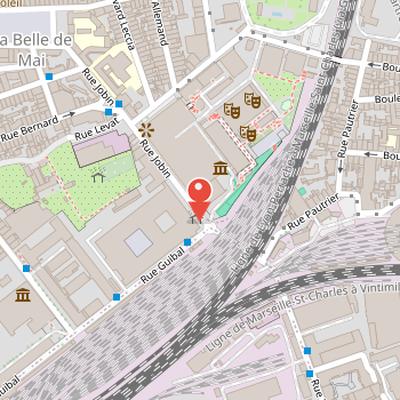
Nearby Objects
-
 Musée des beaux-arts de Marseille 650 m away
 -
 Palais Longchamp 650 m away
 -
 Natural History Museum of Marseille 700 m away
 -
 Musée Grobet-Labadié 700 m away
 -
 Église des Chartreux 950 m away
A Cultural Complex in Marseille
La Friche la Belle de Mai is a cultural wasteland in Marseille. It brings together artistic and cultural workplaces, performance rooms, and exhibition spaces. The site includes more than sixty artistic and cultural structures covering a wide range of disciplines. These include theatre, dance, music, contemporary art, and radio. Its diversity of uses makes it a broad cultural complex rather than a single-purpose venue.
A Former Factory Turned Creative Hub
La Friche opened in 1992 in the former tobacco factory of Marseille, in the Belle de Mai district. It presents itself as a pôle d'auteurs, with a focus on creation and the production of works. The site was developed to include artist workshops, rehearsal studios, a fablab, and construction workshops, and it hosts both permanent and temporary residents.
Its facilities also include performance spaces such as Cabaret alatoire, Plateaux, and Cartonnerie, as well as exhibition areas including the panorama and the tower rooms. La Friche brings together a wide range of producers and organizations across several disciplines. In the visual arts, it hosts Fraeme, Triangle-Astérides, Documents d'Artistes, and le Dernier Cri. For theatre and dance, the site includes Théâtre Massalia, Théâtre de Cuisine, Erac, Marseille Objectif Danse, Cie Cervantés, La Liseuse, and La Réplique.
The site also accommodates music-related organizations such as L'Ami, Gmem, and Cola Production, along with groups devoted to writing and thought, including La Marelle, le Bec en l'Air, and Alphabetville. In audiovisual work, it hosts Lieux Fictifs, Shellac, Instants Vidéo, Lemon, and Le Labo d'image. Zinc is present for digital writing, and the site also houses the media outlets Radio Grenouille and Radio Galere.
Social and Cultural Uses
La Friche combines cultural, educational, and social functions that extend beyond its artistic role. The site includes a daycare center for 60 children, and it was planned to open a primary school in 2022. Its long-term development has also included sustained economic growth and the creation of a Media Hub on Island 2, with structures such as Intermade and the Dynamo project incubator.
The site has developed several public and community-oriented facilities over time. A skatepark opened in 2009 and is managed by BSM (Board Spirit Marseille). La Friche also carried out extensive neighborhood opening work over 20 years, enabling all urban cultural practices. La Maison du Vallon and Maison pour tous Belle de Mai work with site producers to support young audiences.
Commercial and civic activities have been part of this broader model. Les grandes Tables opened in 2006, together with the bookstore-cafe Salle des Machines and the Skateshop, as successful third sector businesses. La Friche has also advocated for independent venues and third places as ways to embody the cultural dimensions of public spaces. More broadly, it promotes the role of artists and publics as drivers of political, economic, social, educational, and urban change.
From Industrial Site to Cultural Project
In 1990, Christian Poitevin asked Phillippe Foulqui and Alain Fourneau to develop artistic actions in city wastelands under Mayor Robert Vigouroux. This led to the creation of the association Systeme Friche Theatre, with Fabrice Lextrait as coordinator. The association then obtained a convention with the Regie des Tabacs, the Seita, after the closure of its Belle de Mai factories. In 1992, the site was revived through precarious occupation conventions, and the association invested in it directly.
La Friche opened quickly to music, plastic arts, and urban cultures, while also hosting theatrical and choreographic projects. The presidency of the association by Jean Nouvel helped Jean-Claude Gaudin integrate the project as a priority, and later support from Michel Duffour, secretary of state, strengthened its place within a policy for culture in 2001 and 2002. Since 1992, La Friche has been described as a unique artistic, cultural, economic, and political adventure. To continue this development, it chose to create one of the first cultural cooperative interest companies, or SCIC, with Alban Corbier-Labasse as director since 2021 and Marc Bollet as president.
La Friche in Marseille 2013
La Friche was presented as a central project element of Marseille Capitale Europeenne de la Culture 2013. The program included major development work that provided roof access at the site, allowing it to host new types of events. In 2013, La Friche reported 500,000 visitors, reflecting its role as an active cultural venue during the year.
Architecture and Urban Transformation
Architecture has been central to the La Friche project from its use of industrial wastelands and through the directions associated with Jean Nouvel and Patrick Bouchain. In 1995, the project affirmed its political character through artistic action aimed at reinventing a historic Marseille neighborhood. At its foundation in 2008, Patrick Bouchain presided over the cooperative society of collective interest. The sensitive architectural approach to modifying the site was produced by Matthieu Poitevin.
Several buildings and spaces reflect this process of transformation. La Tour-Panorama was constructed as a new contemporary art diffusion space for the European Capital of Culture event. An extension was added on the roof of the Magasins and connected to La Tour-Panorama. The Magasins building was rehabilitated into offices and workshops for resident artists and producers, with created workspaces. Its rooftop terrace was redeveloped as a large open public space with a city overlook. The Plateaux venues were inaugurated with two performance halls with graded seating capacity. Other features, including the Ists, Erac, Crche, Cartonnerie, playgrounds, and parking, integrate La Friche into contemporary architecture.