The Musée des beaux-arts de Marseille is the oldest museum in the city and is located in the Palais Longchamp in the 4th Arrondissement. Founded in 1802 during the French Revolution era, it was established under the cultural reforms associated with Jean-Antoine Chaptal. Early artworks were shown from 1804 in the chapel of the Benedictine monastery Couvent des Bernardines before the museum moved into its current setting.
The museum’s collection includes European paintings, drawings, and sculptures from the 16th to the 19th century. It also places particular emphasis on works by artists from the Provence-Alpes-Côte d’Azur region. Its holdings were formed through state allocations, transfers from the French government, donations from citizens, and purchases by the city of Marseille. Among the Italian Baroque paintings cited in the collection are works by Giovanni Francesco Barbieri, Giovanni Lanfranco, Marcantonio Bassetti, Gioacchino Assereto, Giuseppe Vermiglio, Lavinia Fontana, Giovanni Domenico Tiepolo, Bartolomeo Passarotti, and Carlo Maratta.
Palais Longchamp, built between 1832 and 1869 by Henri-Jacques Espérandieu in a historicist style, houses the museum in one wing and the Muséum d’histoire naturelle in the other. The museum facade includes inscriptions of artists such as Michelangelo, Tizian, Raffael, Velázquez, and Rubens. After extensive renovation beginning in 2005, the museum reopened in 2013 during Marseille-Provence 2013 as cultural capital event.
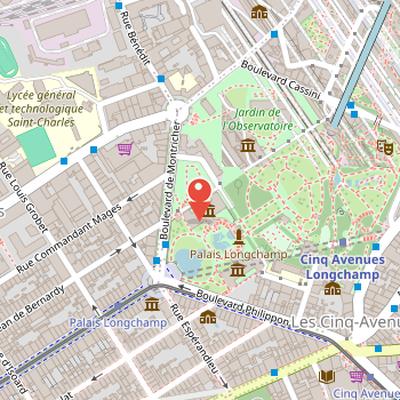
Nearby Objects
-
 Palais Longchamp 50 m away
 -
 Natural History Museum of Marseille 80 m away
 -
 Musée Grobet-Labadié 150 m away
 -
 La Friche 650 m away
 -
 Église des Réformés 900 m away
Location and Collection
The Musee des beaux-arts de Marseille is the oldest museum in the city of Marseille. It is located in the Palais Longchamp in the 4th Arrondissement. The museum's collection includes European paintings, drawings, and sculptures from the 16th to the 19th century. A particular focus of the collection is on works by artists from the Provence-Alpes-Cote d'Azur region.
History and Setting
The Musee des beaux-arts de Marseille was established during the French Revolution by Jean-Antoine Chaptal and was founded in 1802 as the city's oldest museum. The Chaptal decree of 1801 had created 15 regional museums in France for art drawn from church and private collections. From 1804, artworks were exhibited in the chapel of the Benedictine monastery Couvent des Bernardines.
The museum is now housed in Palais Longchamp, which was built between 1832 and 1869 by the architect Henri-Jacques Esperandieu in a historicist style. The building contains the Musee des beaux-arts in one wing and the Musee d'histoire naturelle in another. Its facade carries inscriptions of artists including Michelangelo, Tizian, Raffael, Velazquez, and Rubens. The museum began an extensive renovation in 2005, with redesigned interior spaces, and reopened in 2013 during the Marseille-Provence 2013 cultural capital event.
Formation of the Collection
The museum's collection began with initial artworks received through state allocations during its founding in Marseille. It later expanded through additional works transferred from the French government. The collection also grew through donations from citizens and through purchases made by the city of Marseille. These different sources shaped the early development of the museum's holdings.
Italian Baroque Paintings in the Collection
The museum's collection includes a group of Italian Baroque paintings by several artists. Among the works named in the collection are Giovanni Francesco Barbieri's Cato von Utica verabschiedet sich von seinem Sohn, Giovanni Lanfranco's Elija wird von den Raben ernährt, Marcantonio Bassetti's Der heilige Sebastian wird durch Irene gepflegt, and Gioacchino Assereto's Tobias heilt die Augen seines Vaters. The collection also includes Giuseppe Vermiglio's Toter Christus von Engeln betrauert, Lavinia Fontana's Weihe der Jungfrau, and Giovanni Domenico Tiepolo's Christus und die Ehebrecherin. Additional portraits and scenes represented include Bartolomeo Passarotti's Bildnis eine Mannes, Carlo Maratta's portrait of Cardinal Alderano Cibo, and Giovanni Paolo Pannini's Die Galerie des Kardinals Valenti Gonzaga. Together, these works indicate a collection with a strong emphasis on Italian Baroque religious subjects, portraits, and gallery scenes.
Flemish and Dutch Painting Collection
The museum's collection includes a notable group of Flemish and Dutch paintings. Among them is Peter Paul Rubens' Die Wildschweinjagd. Other works in the collection include Frans Pourbus the Younger's portrait of Archduke Albrecht of Habsburg, Michiel Sweerts' portrait of a man, and two portraits by Jan van Bijlert. The collection also features Jacob Jordaens' Geheimnisvoller Fang and Matthias Stomer's Konig David. Together, these works show the range of artists represented in this part of the museum's holdings.
Paintings and Sculptures in the Collection
The museum collection contains extensive works by French artists from the 17th century onward, with a strong emphasis on painting and sculpture. Among the 17th century works are Die Himmelfahrt der Maria Magdalena by Philippe de Champaigne, Maria Magdalena in Verzuckung by Louis Finson, Madonna mit einer Rose by Simon Vouet, Darbringung der Jungfrau im Tempel by Eustache Le Sueur, Das Urteil des Midas by Noel Coypel, and a Vanitas still life by Simon Renard de Saint-Andre. The collection also includes landscape paintings by Francisque Millet and Nicolas Mignard.
A dedicated room is reserved for Pierre Puget, who was active as both a painter and sculptor in Marseille. His presence in the collection is substantial, with sculptures including a Faun and two portrait busts of King Ludwig XIV, as well as paintings such as Heilige Cacilia and Die Erziehung des Achilles. This focus highlights the museum's connection to an artist closely linked with the city.
The 18th century holdings include Der heilige Rochus bittet die Jungfrau Maria um Heilung der Pestkranken by Jacques-Louis David, Der Sturm by Claude Joseph Vernet, Portrat des Comte Saint-Florentin by Louis Tocque, Marquise de la Tournelle als Morgenrote by Jean-Marc Nattier, Die Herzogin von Orleans by Elisabeth Vigee-Lebrun, and Portrat des Giuseppe Fravega by Anne-Louis Girodet-Trioson. The collection also contains works by Michel Serre, Francoise Duparc, and Michel-Francois Dandre-Bardon from Marseille and Aix-en-Provence.
Nineteenth century painting is represented by Portrat der Madame Goldschmidt by Emile Auguste Carolus-Duran, Le Reve by Charles Chaplin, Frauenbildnis by Eva Gonzales, Portrat Henri Didier by Thomas Couture, Le cuisinier comptable by Augustin Theodule Ribot, Roter Hirsch im Wasser by Gustave Courbet, La Bouillie by Jean-Francois Millet, Blick auf Riva by Jean-Baptiste Camille Corot, Unterholz by Narcisso Virgilio Diaz de la Pena, and Les Graves a Vilerville by Charles-Francois Daubigny. The museum also includes works by Provenzal artists Emile Loubon, Paul Guigou, Jose Silbert, Felix Ziem, and Adolphe Monticelli from Marseille. Notable sculptures in the collection include Le Ratapoil by Honore Daumier and Die innere Stimme by Auguste Rodin.