The Muséum d'histoire naturelle de Marseille, also known as the Natural History Museum of Marseille and abbreviated as MHNM, is a natural history museum in the Palais Longchamp in the 4th arrondissement of Marseille. Founded in 1819 by Jean-Baptiste, marquis de Montgrand, and Christophe de Villeneuve-Bargemon, prefect of the Bouches-du-Rhône department, it was first located at the Chapelle des Bernardines before settling at the Palais Longchamp in 1869. The Palais Longchamp was built according to the plans of Henri-Jacques Espérandieu, and the museum shares the building with the Musée des Beaux-Arts. Classified as a museum of France in 2002, it is under the supervision of the Ministry of Higher Education and Research. Its collections include zoological, botanical, fossil, and mineral specimens, and its exhibition areas cover subjects such as accidental imports through the port, Provence wildlife, comparative anatomy, and prehistory and evolution. The museum also organizes conferences and temporary exhibitions.
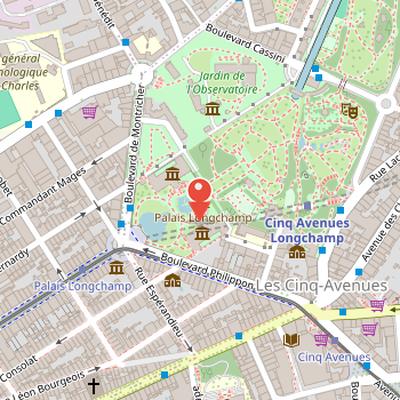
Nearby Objects
-
 Palais Longchamp 40 m away
 -
 Musée des beaux-arts de Marseille 80 m away
 -
 Musée Grobet-Labadié 160 m away
 -
 La Friche 700 m away
 -
 Église des Réformés 900 m away
Museum Location and Origins
The Muséum d'histoire naturelle de Marseille, also known as the Natural History Museum of Marseille and abbreviated as MHNM, is located in the Palais Longchamp in the 4th arrondissement of Marseille. The Palais Longchamp was built according to the plans of Henri-Jacques Espérandieu. The museum was founded in 1819 by Jean-Baptiste, marquis de Montgrand, and Christophe de Villeneuve-Bargemon, who was prefect of the Bouches-du-Rhone department. It is one of the most visited natural history museums in France.
History and Location
The Muséum d'histoire naturelle de Marseille was created in 1819 and was first located at the Chapelle des Bernardines. In 1869, it settled at the Palais Longchamp, which it shares with the Musee des Beaux-Arts. The museum is under the supervision of the Ministry of Higher Education and Research. It was classified as a museum of France in 2002.
Exhibitions and Collections
The Muséum d'histoire naturelle de Marseille presents extensive collections across four exhibition areas: Salle safari, Salle de Provence, Salle d'osteologie, and Salle de prehistoire. Its holdings include 83,000 zoological specimens, 200,000 botanical specimens, 81,000 fossils, and 8,000 mineral specimens. The Salle safari section concentrates on accidental imports through the port, while the Salle de Provence section concerns Provence wildlife. Salle d'osteologie is devoted to comparative anatomy, and Salle de prehistoire focuses on prehistory and evolution. In addition to its permanent displays, the museum also organizes conferences and temporary exhibitions. The museum was visited by 103,543 people in 2014. During the late 19th century, Antoine-Fortune Marion served as director, linking the institution to an important phase in its history.