Musée Grobet-Labadié is an art museum in Marseille housed in an hôtel particulier constructed in 1873 and facing the Palais Longchamp. The building was designed by architect Gabriel Clauzel for Alexandre Labadié (1814–1892), a wealthy industrialist and merchant who served as prefect of Bouches-du-Rhône, president of the Conseil général, and deputy.
The museum is linked to the collection assembled by Marie, Alexandre Labadié’s daughter, and her husbands, Bruno Vayson and later Louis Grobet. Between 1873 and 1917, they traveled through Europe to collect art, eventually acquiring more than seven thousand pieces. Marie donated both the family collection and the hôtel particulier to the city of Marseille, and she also financed part of the museum’s arrangements when the city was initially reluctant. The city accepted the donation, and the museum was later inaugurated by Mayor Siméon Flaissières. Today, the city of Marseille preserves the museum and its collection. It is part of the Pôle Arts-décoratifs, directed by Marie-Josée Linou.
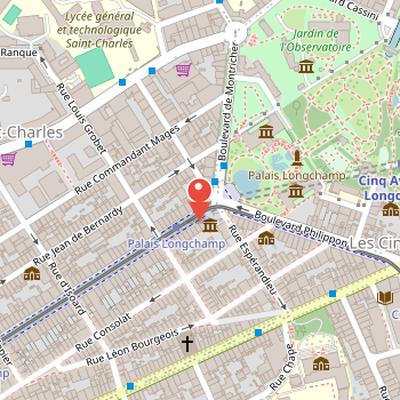
Nearby Objects
-
 Musée des beaux-arts de Marseille 150 m away
 -
 Natural History Museum of Marseille 160 m away
 -
 Palais Longchamp 200 m away
 -
 La Friche 700 m away
 -
 Église des Réformés 750 m away
The Museum Building and Its Origins
The Musée Grobet-Labadié is located in Marseille and is housed in an hotel particulier constructed in 1873. The building faces the Palais Longchamp and was designed by the architect Gabriel Clauzel. It was built for Alexandre Labadié (1814-1892), a wealthy industrialist and merchant who also served as prefect of Bouches-du-Rhone, president of the Conseil general, and deputy.
The history of the house is closely linked to the Labadie family. Alexandre Labadie''s daughter Marie first married Bruno Vayson, who was the brother of Paul Vayson, a property owner with several chateaux and mayor of Murs. After 1896, Marie remarried Louis Grobet, who had been her music professor and was also a painter. Louis Grobet died in 1917 of Spanish flu. The museum therefore preserves a residence associated with both the civic career of Alexandre Labadie and the later family and artistic connections of the Grobet name.
Donation, Collection, and Museum Status
From 1873 to 1917, Marie traveled across Europe with her first and second husbands to collect art. Using the wealth of Marie and her husbands, the couple assembled more than seven thousand works. The collection included furniture, paintings, tapestries, sculptures, faiences, carpets, silks, and musical instruments. Marie later donated the family collection and the hotel particulier to the city of Marseille by an unspecified act date, and the city accepted the donation by resolution on an unspecified date. Because the city initially showed little enthusiasm, Marie financed part of the museum arrangements herself. The museum was inaugurated by mayor Simeon Flaissieres on an unspecified date and opened to the public on an unspecified date. The city of Marseille preserves both the museum and its collection.
The museum is located in an hotel particulier with a ground floor and two upper floors. These levels are connected by a staircase decorated with paintings. The museum obtained the label musee de France in 2003. It is also associated with heritage protection, having first been registered as a historic monument by an order dated on an unspecified date and later classified by a replacement order dated on an unspecified date. Today, the museum is part of the Pole Arts-decoratifs directed by Marie-Josee Linou. Visitors can reach it by metro line 1, Bus 81, or tramway at Longchamp station.
Ground Floor Exhibition Rooms
The ground floor of the Musee Grobet-Labadie is arranged as four exhibition rooms: an antichamber, a lounge, a boudoir, and a dining room. The display combines furniture, textiles, ceramics, and paintings to recreate a richly furnished interior. In the antichamber, a Provencal console table in wrought iron and gilded sheet metal with a breccia violet top and base is shown beneath an Aubusson tapestry, Paisage exotique avec chien. A Brussels manufacture tapestry, representing a landscape with a French formal garden, fountain, and architecture, is also on view, along with Moustiers faiences including a cooling bucket, table knives with a leather case, plates, and dishes in a showcase. The walls carry portraits including a young man by Gerard ter Borch and a man with ruff attributed to Cornelis Ketel.
In the lounge, the center is occupied by a harpsichord, a copy of an Italian model decorated in gilded wood and copper painting. Around it stands a set of eight armchairs and a sofa covered with Aubusson tapestries representing La Fontaines fables. A marble statue of harmony, sculpted by Albert-Ernest Carrier-Belleuse, is placed on the fireplace. The walls are decorated with five Aubusson tapestries called aux alentours after cartoons by Jean-Baptiste Huet, and the room also contains portraits by Dominique Papety, Jean-Baptiste Isabey, and Tiaze. A small two-drawer Regence period commode in rosewood and walnut, an Aubusson tapestry representing fruit harvesting, a table center with Moustiers faience tableware by widow Perrin, and a two-body oak wood buffet complete the ensemble.
Premier Etage Collections
The premier etage of the Musee Grobet-Labadie includes a Primitive room, an antechamber, a curiosity cabinet, a Louis XV room, an office, a Louis XVI lounge, and a faience cabinet. Among its furnishings is a two-body cabinet in walnut and olive wood dating from the 17th century. This cabinet is topped by a pediment decorated with a mask and horns of abundance, while its upper panels show an antique warrior and Diana the huntress. The panels are separated by three carved olive branch uprights with fruits. The floor also displays a showcase of oriental objects, including a 17th-century Turkish helmet with Arabic engravings, a 17th-century Iranian copper basin inlaid with chased silver, and a flat-bottomed Egyptian copper basin from the 17th century. Additional Iranian objects from the 18th century include powder flasks, vases, pyxides, and cups.
Paintings on the First Floor
The premier etage walls are decorated with a group of paintings that contribute to the museum's interior character. Among them are Virgin in adoration, attributed to Alesso Baldovinetti; The Virgin, Child, and donor, attributed to Joos van Cleve; Portrait of a woman with white coif by Bartholomaeus Bruyn the Elder; Virgin and Child in a landscape by Jan van Scorel; and Portrait of a woman attributed to Nicolas Neufchatel. The floor also includes a painting attributed to Pierre Vilatte representing Saint Bernardino of Siena and two donors. The predella donors are identified as Isabelle Ire de Lorraine and her son Jean de Calabre. Together, these works reflect a curated display of devotional and portrait subjects on the museum's first floor.
The Premier Etage Collection
The premier etage of the Musee Grobet-Labadiie presents a dense ensemble of furniture, paintings, textiles, and decorative arts arranged as an interior display. Among its furnishings are a gilded Regence style console from 1700 to 1730, an early 18th-century gilded table console attributed to Bernard Turreau, a 17th-century portable Italian cabinet in stained pearwood and ebony inlaid with ivory plaques, and a marquetry-top table from the second half of the 17th century on which the cabinet rests. The room also includes an armoire from the Rennes countryside, a half-commode with three drawers labeled J.B. Detroulleau, a set of four armchairs, a commode secretary with a donkeys back, a cylinder desk from the 19th century marquetried with violet wood, mahogany, and sycamore, two chiffonieres from 1770 to 1790, a bonheur-du-jour with shutters, a secretaire a abattant marquetried with sycamore, mahogany, rosewood, and ebony, and a commode and a table.
Textiles and wall hangings form an important part of the display. The walls hold two 17th-century tapestries, The fortune teller from Brussels and Luncheon on the grass from Beauvais, as well as two wool tapestries from the late 17th-century Royal Gobelins manufacture based on paintings by Charles Le Brun from the Pavilion of Dawn in the Parc de Sceaux. Another tapestry set includes six pieces illustrating the four seasons: Spring in two pieces, Summer in one, Autumn in two, and Winter in one. The premier etage also shows two Aubusson tapestries, Le festin de Bacchus or L'alliance de Bacchus et de l'Amour and L'education d'Apollon, based on cartoons by Antoine Coypel.
Several objects are displayed in showcases or placed as focal points within the room. These include a 17th-century microscope with its case, a 17th-century magic lantern, various boxes and cases, and a 17th-century cartel signed N. Delaunay in Paris, decorated with copper and scale marquetry and a gilded bronze sunrise with the sun's chariot. At the center of the room stands a canopy bed called the angel's bed. The table surfaces and desk are also used to present objects, including two bronzes by Antoine-Louis Barye representing a lion on the cylinder desk.
The walls and other surfaces support a varied picture collection. Works displayed include Portrait of a man in cuirass attributed to Jean-Marc Nattier, Portrait of a half-length woman from the Fontainebleau school, Adoration of the shepherds by Esteban Bartolomeo Murillo, a sketch for the Virgin cycle at the Capuchin convent in Genoa by the same artist, a portrait of a woman in a park by Adele Romany, a painting of a swan and ducks from a Dutch school, and illuminations representing Resurrection, Saint Margaret and the dragon, and Christ with Saint John the Baptist. The room also exhibits paintings including works by Arles painter Antoine Raspal.
Decorative arts from ceramics and porcelain complete the ensemble. The premier etage exhibits plates and dishes from the Olerys factory in Moustiers and the widow Perrin factory in Marseille, as well as faience from Rouen. A cabinet contains Imari porcelain from Japan dated to the late 17th century, including a circular dish with floral peony decoration and various plates with floral decoration. Together, these objects give the premier etage the character of a carefully layered historic interior, where furniture, tapestries, painting, and tableware are displayed as part of a single domestic setting.
Second-Floor Collections
The second floor of the Musee Grobet-Labadie brings together a varied set of historical objects, with displays that range from decorative arts and sculpture to weapons, textiles, musical instruments, and paintings. Among the metalwork are several locks, including a moraillon chest lock from the late 17th century decorated with small figures and saints, a late 17th-century door lock called a vertevelle, and an early 18th-century door lock with bolt and key. The weapons on display include an Italian morion, a woman's crossbow, and a 16th-century halberd.
The floor also presents textile and ceramic works, notably a late 17th-century Flemish tapestry measuring 275 by 275 cm and representing Solomon and the Queen of Sheba. In the faience displays, visitors can see a 17th-century rosewater pitcher, a pharmaceutical amphora inscribed aqua rosata, dishes and Ottoman ceramics decorated with flowers such as tulips, sweet briar, carnations, and hyacinths, and a pharmaceutical jar from the Saint-Jean du Desert manufacture in Marseille, made in grand feu faience in the early 18th century.
Sculpture is represented by numerous 16th-century works from different European regions, including Germany, Austria, Flanders, and Burgundy. These include a polychrome wood armoured knight from Germany dated around 1520, a polychrome stone Saint Madeleine from Provence, another Saint Madeleine from the 16th century originating from the Celestins church in Avignon and linked to a set with two statues at the Calvet museum, and a statue of the Virgin and Child. The collection also includes musical instruments such as an 18th-century harp, a hurdy-gurdy dated 1757 and decorated with mother-of-pearl and ebony, and a musette bagpipe made of copper, brocaded silk, and ivory. The second floor is further completed by numerous paintings by well-known painters, including Paul-Camille Guigou's Deux lavandieres devant la Sainte-Victoire and Felix-Francois Ziem's Le Bucentaure.
Closure and Intermittent Reopening
The museum was closed by the municipality in 2013 because renovation was needed, and it had already been affected by a regular lack of staff before that closure. It reopened in 2019 for the exhibition Sophie Calle : Cinq by Sophie Calle. In 2020, it closed again during the COVID-19 pandemic. Since then, it has not reopened except temporarily for heritage days or Museum Night.