Brasserie Georges is a brewery and restaurant in Lyon founded in 1836 by Georges Hoffherr, a brewer who emigrated from Alsace. The location was chosen on reclaimed land at the confluence of the Saône and Rhône, on the route of the former coaching stage between Paris, Lyon, Saint-Étienne, and Marseille. The nearby Perrache station later opened next to the brewery. The building includes a ceiling supported by four pine beams from the Chartreuse and Vercors, transported by ox carts. In 1924, painter Bruno Guillermin redecorated the dining room in Art Deco style, adding four rural scenes on the ceiling, bas-reliefs on the walls, and chandeliers. The site was requisitioned between 1942 and 1944 and used as a soldiers’ recreational establishment. The current decor includes a 1946 exterior sign, a portrait of Gambrinus, four stained glass windows, a copper basin with a lion head, and a marble-dressed restaurant room.
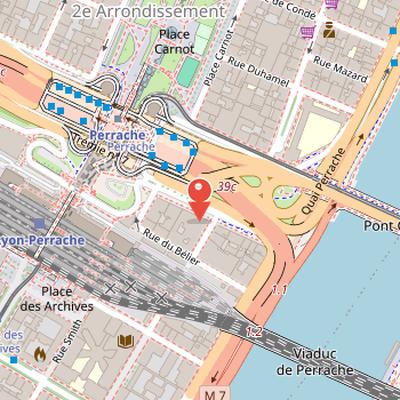
Nearby Objects
-
 Perrache 200 m away
 -
 Gare de Lyon-Perrache 200 m away
 -
 Prison Saint-Paul 250 m away
 -
 Place Carnot 300 m away
 -
 Les Rails de la Mémoire 300 m away
Brewing Tradition and Everyday Use
Since its creation, Brasserie Georges has brewed beer on site through Presentation, linking the establishment directly to its original brewing function. The brewery was founded at a time when the water in Lyon was considered to be of exceptional quality, a detail associated with its early production context. The brasserie is also notable for its scale of service, with seven hundred covers served at each meal service. In everyday use, it is known by several familiar names among regulars, including la BG, La Georges, and Chez Georges, which reflects its established place in local habits and recognition.
From Brewery to Historic Brasserie
Brasserie Georges was built in 1836 by Georges Hoffherr, a brewer who had emigrated from Alsace. Its location was chosen on reclaimed land at the confluence of the Saone and Rhone, in an area that corresponded to the coaching stage on the Paris-Lyon-Saint-Etienne-Marseille route. Perrache station later opened next to the brewery, further linking the site to the citys transport network.
The restaurant interior reflects several distinct phases of decoration. Its ceiling is supported by four pine beams from the Chartreuse and Vercors, which were transported by ox carts. In 1924, the painter Bruno Guillermin redecorated the dining room in an Art Deco style. He created four rural scenes on the ceiling, added bas-reliefs to the walls, and installed chandeliers weighing each at the brewery.
The history of the establishment also includes a period of wartime requisition. Between 1942 and 1944, after the German invasion of the southern zone, the brasserie was taken over and used as a soldiers recreational establishment. Later, in 1985, Didier Rinck became CEO and helped restore the prestige of the brewery. The brasserie celebrated its 150th anniversary under his leadership. In 2002, it was sold to the Helea Financiere group of Christian Lameloise.
Decorative Features of the Current Interior
The current decor of Brasserie Georges combines several layers of historic decorative elements in both the exterior and interior. On the facade, there is an exterior sign dating from 1946 and a portrait of Gambrinus, the king of beer. At the entrance, four large stained glass windows represent sculpture, geography, painting, and music, while a gigantic copper basin with a lion head decoration stands above the entrance door. The restaurant room is dressed with marble and includes 1920s tiling arranged in a faux mosaic with Art Deco geometric patterns. It also contains two Biere Rinck signs from the 1950s, illuminated by fluorescent lights, with one mounted on a panel of juxtaposed mirrors and the other mounted on mirrors decorated with barley ears and hop cones. Above another large wall mirror, the famous motto of the House is inscribed. The building also retains large bay windows, including five sash windows dating from the 1930s. In addition, a private lounge contains stained glass windows from 1900 with floral decoration.
Interior Decor and Historic Roof Structure
The current decor of Brasserie Georges includes a grand ceiling painted by the Lyonnais painter Bruno Guillermin of the Lyon school. The ceiling is decorated with four large rural scenes on the themes of harvesting, grape harvesting, water, and beer, along with geometric motifs and large bouquets of roses. The room also contains five chandeliers made by Forges de Vulcain; each weighs 50 kg and is lowered once a month by four people using a metal winch for cleaning. In addition, there are eleven large plaster bas-reliefs, including four showing cherubs celebrating wine and beer. Two marble pillars are also part of the decor, although they do not support the ceiling. The attic, dating from 1836, consists of three fermes and a distinctive interlacing of beams, and its beamwork may have been created by a disciple of Riondelet.
Public Record Dishes
Brasserie Georges has been associated with certified record-breaking dishes prepared by its team. The records note that the restaurant achieved a world record for the largest sauerkraut, and that this certification was entered in the Guinness Book of Records. Another recorded event concerned an omelette prepared under the direction of Didier Rinck, who assigned the task to his chef and a team of 19 cooks and pastry chefs. The omelette was made in front of the public in about thirty minutes, browned using a gas ramp on wheels, then flambed before tasting. The record also listed details of the omelette's composition, total length, and weight.