Gare de Lyon-Perrache is a railway station in Lyon, in the Auvergne-Rhône-Alpes region, located in the Perrache district between the confluence and the rest of the Lyon peninsula. It stands south of the Perrache transport hub, above the urban boulevard linking the A6 to the A7 motorway at the Fourvière tunnel. The station was constructed starting in 1855 from plans by architect François-Alexis Cendrier for the Compagnie du chemin de fer de Paris à Lyon.
After 18 months of work, it was put into service and inaugurated in early 1857, following the extension of the Paris-Lyon railway from Gare de Vaise through a 428-metre tunnel. A ministerial decision had fixed Perrache as the new Lyon central station despite its cramped situation. The station became an essential element of the Lyon railway junction and a terminus or origin point on several lines. As traffic increased, it quickly became cramped, leading to enlargement projects from 1863 and the construction of the metallic Halle Saint-Étienne in 1890 to house the tracks.
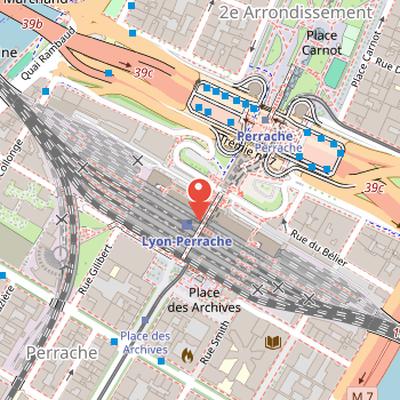
Nearby Objects
-
 Perrache 10 m away
 -
 Hôtel Terminus 140 m away
 -
 Brasserie Georges 200 m away
 -
 Prison Saint-Paul 250 m away
 -
 Les Rails de la Mémoire 300 m away
Location and Early Construction
Gare de Lyon-Perrache is a French railway station in Lyon, in the Auvergne-Rhone-Alpes region. It is located in the Perrache district, between the confluence and the rest of the Lyon peninsula, south of the Perrache transport hub. The station stands above the urban boulevard that links the A6 to the A7 motorway at the Fourviere tunnel. Construction began in 1855, following plans by architect Francois-Alexis Cendrier for the Compagnie du chemin de fer de Paris a Lyon.
Railway Junction Role
Lyon-Perrache station is identified as an essential element of the Lyon railway junction. It is located at altitude PK 510,915 on the Paris-Lyon to Marseille-Saint-Charles line, between Lyon-Vaise station and Lyon-Jean-Mace station, via the Saint-Irenee tunnel and the Quarantaine viaduct. The station is also marked as the terminus at PK 558,750 of the Moret - Veneux-les-Sablons to Lyon-Perrache line after Oullins station. In addition, it is defined as the origin at PK 0,000 of both the Lyon-Perrache to Marseille-Saint-Charles line via Grenoble, before Vénissieux station, and the Lyon-Perrache to Geneve line, before Lyon-Part-Dieu station.
Creation of Lyon's Central Station at Perrache
A ministerial decision fixed the new Lyon central station at Perrache, even though the site was already cramped. At the time, three railway companies serving Lyon each operated their own terminus stations: the Societe du chemin de fer de Paris a Lyon par le Bourbonnais at Gare du Bourbonnais, the Compagnie du chemin de fer de Paris a Lyon at Gare de Vaise, and the Compagnie du chemin de fer de Lyon a la Mediterranee at Gare de La Guillotiere. After 18 months of work directed by Francois-Alexis Cendrier, Gare de Perrache was put into service when the Paris-Lyon railway company extended its line from Gare de Vaise through a 428 meter tunnel. The tunnel of Saint-Irenee was pierced under the hill for this extension, and a bridge over the Rhone linked Gare de La Guillotiere, origin of the Lyon to Marseille line, in the same year the new station opened. The Saint-Etienne to Lyon line was also extended from Gare du Bourbonnais to the new central station. The inauguration took place in early 1857.
The station quickly became a focal point for railway traffic in Lyon. The three railway companies using Gare de Perrache agreed to merge into the Compagnie des chemins de fer de Paris a Lyon et a la Mediterranee, or PLM. On July 2, 1857, the line between Lyon and Bourgoin was put into service by the PLM, and in 1859 the Lyon-Perrache to Geneva line was connected to Perrache from Gare des Brotteaux. The Perrache railway corridor runs on an east-west axis above ground level, with three vaulted passages under the station building linking place Carnot in the north and the industrial sector in the south. Due to increased traffic, Gare de Perrache quickly became cramped.
Station Enlargement and Later Additions
From 1863 onward, several enlargement projects were proposed for the track plateau and changes to the station building. A new metallic hall with a 45 meter span, called the halle Saint-Etienne, was built in 1890 to house the tracks. Two underground passages were then constructed under the building to provide access to different platforms to the north and south of the station. In 1905, a large chimney designed by Raoul Michelet was added, and in 1906 the PLM company opened the current Hotel Terminus.
The station building was expanded several times in 1913, 1921, 1922, and 1926. In 1928 and 1929, the halls were reconstructed on common metal piles to clear space on the platforms. A cantilevered embankment was also built over rue Dugas-Montbel to make room for three new tracks and a fifth platform. More recently, the station has been served by the BlaBlaCar Bus network, formerly known as Ouibus and before that iDBUS. Nearby, a Shoah memorial was inaugurated on December 5, 1992, and its rails were donated by SNCF.
Station functions and interchange
Gare de Lyon-Perrache functions as an SNCF station with a station building equipped with facilities and services of a large station. It has a sales area open from Monday to Friday and serves as a major line station for TGV services, including TGV inOui and Ouigo, as well as Frecciarossa and Intercites trains. The station is also an important part of the TER Auvergne-Rhone-Alpes regional network.
The railway station is connected to the Perrache exchange center by a pedestrian bridge at level 1. This exchange center brings together several transport modes, including a Lyon metro station, which is the terminus of line A, and a Lyon tramway station served by lines T1 and T2. It also includes parking areas and a bus station used by TCL buses and long-distance coaches. The long-distance coach bus station was temporarily moved to Palais des sports de Gerland on a specific date, and its closure is scheduled for 2032, with a new bus station planned near Venissieux.
Depot Facilities in Lyon
The Lyon railway depots, known as the depots lyonnais, comprise several locomotive depots distributed across the city. These include the technicentre TGV in the Gerland district, as well as the Lyon-Vaise, Venissieux, and Lyon-Mouche depots. In addition to these depots, equipment is also stored at several other railway sites in Lyon. These storage locations include Lyon-Guillotiere station, the Lyon-Mouche workshops, the Lyon-Scaronne workshops, the Lyon-Croix-Barret workshops, and the tracks of the former Brotteaux station. Together, these facilities form a network of operational and storage areas associated with railway equipment in Lyon.
Perrache in Art and Film
Gare de Lyon-Perrache has appeared in both visual art and film. A work by Louis Beysson, La gare de Perrache, has been held at the Musee des Beaux-Arts de Lyon since 2003. The station was also filmed in 1896 for two short films produced by the Societe Lumiere: Arrivee dun train a Perrache and Panorama de larrivee en gare de Perrache pris du train. Later, a scene in Jacques Deray's film Symphonie pour un massacre was shot at Perrache station.