Place Carnot is a square in the Ainay and Perrache neighborhoods of the 2nd arrondissement of Lyon, France. Its history reflects successive political changes, having been known at different times as Place des Victoires, Place Louis XVI, Place Louis XVIII, Place de la Liberté, Place de la République, Place Napoléon, and Place Perrache before receiving its official name of Place Carnot by municipal decree in honor of general Lazare Carnot. The square is also associated with the inauguration of the Monument de la République by President Sadi Carnot, Lazare Carnot’s grandson.
Before the 18th century, the area was described as a confluence with regularly flooded and uninhabited islands to the south. In 1770, Antoine Michel Perrache proposed draining the marshes and moving the confluence to the southern end in order to gain fertile agricultural land and extend the city over watercourses. Later, the City of Lyon undertook the development of a large square there. In 1852, a monument dedicated to Napoléon was built on the square, with a marble pedestal designed by Pierre Manguin and Antonin Louvier, an equestrian statue by Émilien de Nieuwerkerke, and allegories by Georges Diebolt.
Nearby Objects
-
 Les Rails de la Mémoire 40 m away
 -
 Brasserie Georges 300 m away
 -
 Hôtel Terminus 300 m away
 -
 Lycée Juliette Récamier 300 m away
 -
 Basilica of Saint-Martin d'Ainay 300 m away
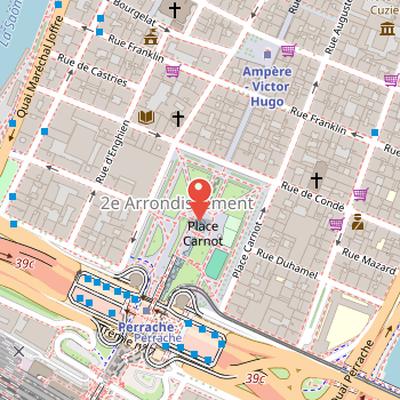
Location of Place Carnot
Place Carnot is a square in the neighborhoods of Ainay and Perrache in the 2nd arrondissement of Lyon, France. Its position in these two districts places it within a central urban area of the city. The square is identified primarily by its location, which links it to both the Ainay and Perrache neighborhoods.
Changing Names and Civic Commemoration
The square now known as Place Carnot underwent a series of official name changes before receiving its present designation. During the First Empire, it was called Place des Victoires. Under Charles X, it was named Place Louis XVI, and from 1821 to 1848 it was Place Louis XVIII. During the 1848 revolution, the square became Place de la Liberte, then Place de la Republique from 1848 to 1849. It was renamed Place Napoleon from 1849 to 1871, and Place Perrache from 1871 to 1889. The name Place Carnot was officially attributed by municipal council decree in honor of General Lazare Carnot. Odonymie also records that President Sadi Carnot, Lazare Carnot's grandson, inaugurated the Monument de la Republique on the square the same year. Sadi Carnot later became a victim of assassination by an Italian anarchist during his second visit to Lyon.
From Marshland to Place Carnot
Before the 18th century, the confluence was located at the square, with regularly flooded and uninhabited islands to the south. In 1770, Antoine Michel Perrache proposed draining the marshes and moving the confluence to the southern end. The aim was to gain fertile agricultural land and extend the city over water courses. In 1805, Napoleonic plans for Lyon included an imperial residence, and construction began in 1813, but it stopped in 1815 after the fall of the Empire. A debate then took place between the City of Lyon and the Compagnie des travaux du midi. After obtaining the retrocession of the lands in 1816, the City of Lyon decided to sell lots and undertake the development of a large square called place Carnot.
The Monumental History of Place Carnot
Place Carnot has a history shaped by successive monuments and relocations. Histoire describes an original monument dedicated to Napoleon, built in 1852 under the Second Empire. The work involved architects Pierre Manguin and Antonin Louvier, who designed a marble pedestal 9 meters high. Sculptor Emilien de Nieuwerkerke created the equestrian statue of Napoleon, while Georges Diebolt sculpted two allegorical figures, La Loi as Themis and La Force as Mars. The bronzes were cast by the fonderie Eck et Durand. According to Histoire, the Napoleon statue measured 5 meters high, and the allegories were each 3.30 meters high. After the fall of the Second Empire in 1870, the emperor's statue was destroyed, and the two bronze allegories were later moved to palais Saint-Pierre and then to palais des vingt-quatre colonnes.
In 1880, counselor Bizet proposed a statue of the Republique for the centenary of the Revolution. A competition followed, and Emile Peynot won it and created the bronze statue, which was inaugurated in 1889 and still stands on the square. Architect Victor-Auguste Blavette designed a 15-meter pedestal for this statue. Histoire describes the Republique as 7.5 meters high, caressing a lion and holding an olive branch. It dominates six allegories: La Liberte, L'Egalite, La Fraternite, La Ville de Lyon, Le Rhone, and La Saone.
The square changed again in 1975, when metro construction forced the statue and the three motto allegories to be moved to parc Bazin. Histoire also notes that a statue of Sadi Carnot stood at place de la Republique in the 2nd arrondissement for 75 years, was dismantled in 1975, and currently faces the Prefecture du Rhone. The original monument state is noted as being before the 1975 dismantling. In 2024, the statue of La Ville de Lyon was removed. Le Memorial de la Shoah de Lyon, also called Les Rails de la Memoire, was inaugurated on 5 February 2023.
Location and Access
Place Carnot is located next to Lyon-Perrache station. It is bordered by Rue de Condé, and can be accessed via Rue Victor-Hugo, Rue Henri-IV, and Rue Auguste-Comte. To the south, it is bordered by Cours de Verdun and the Perrache exchange center. The square also allows passages to the Sainte-Blandine district and Cours Charlemagne through the Lyon-Perrache station hall or the vaults below. On the west side of the square, the Bissuel barracks occupied the site from 1839 to 2004, before housing the Catholic University of Lyon from 2005.
Public Amenities on Place Carnot
Place Carnot includes several recreational facilities that shape its everyday use as a public square. It has a children's playground, providing a space for play and family use. A carousel is also located on the square, adding a leisure feature that contributes to its public character. In addition, the square contains a small sports field, extending its role beyond circulation and gathering to include active recreation. These amenities indicate that Place Carnot serves not only as an urban open space, but also as a place for children's activities and informal sport.
Christmas Market Activities
Each year, Place Carnot hosts the Christmas market of Lyon for the four weeks before the holiday. The event includes 140 chalets, creating a regular seasonal use of the square. In addition, farm producers set up on the north side of the square every Wednesday from 16:00 to 19:30. These recurring activities make the square an important venue for holiday commerce and local food production during the winter period.