The Shoah Memorial, also known as Les Rails de la Mémoire, is a memorial inaugurated at Place Carnot in Lyon. Located at the heart of the Lyon peninsula, it was placed near Perrache station, a departure point for trains to Drancy and the death camps. The memorial also forms an axis with the Veilleur de Pierre monument. Its inauguration took place on a Sunday, the day before the commemoration of the liberation of Auschwitz concentration camp, in the presence of officials and citizens.
The project was launched in 2018 under Mayor Gérard Collomb with three associations to establish a Holocaust Memorial near Gare de Perrache. It later received confirmation from Métropole de Lyon for installation at Place Carnot. The project, led by Jean-Olivier Viout, included honorary presidents Benjamin Orenstein and Claude Bloch, both concentration camp survivors. After a public subscription opened with a total budget of 500,000 euros, the memorial received support from the city of Lyon, Métropole de Lyon, Région Auvergne-Rhône-Alpes, Caluire-et-Cuire, and private donors. A jury selected the project Les Rails de la mémoire by architects Quentin Blaising and Alicia Borchardt from 96 proposals.
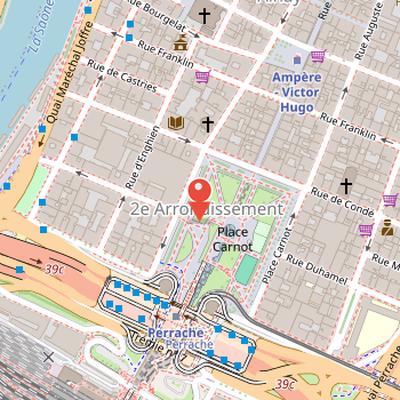
Nearby Objects
-
 Place Carnot 40 m away
 -
 Hôtel Terminus 250 m away
 -
 Brasserie Georges 300 m away
 -
 Basilica of Saint-Martin d'Ainay 300 m away
 -
 Gare de Lyon-Perrache 300 m away
Inauguration and Naming
The Shoah Memorial was inaugurated at place Carnot in Lyon. It is also called Les Rails de la Memoire. Its inauguration took place on the day before the commemoration of the liberation of Auschwitz concentration camp, giving the memorial a direct link to remembrance of that historical event.
Selection and Funding of the Memorial Project
The association Historique was formed in 2018 under Mayor Gerard Collomb together with three associations in order to establish a Holocaust Memorial near Gare de Perrache. The project was delayed by the transformation of the Centre d'echanges de Perrache, but it later received confirmation by letter from Metropole de Lyon for installation at Place Carnot. Historique was presided over by Jean-Olivier Viout, a magistrate and former member of the prosecution at Klaus Barbie's trial, and its honorary presidents were Benjamin Orenstein and Claude Bloch, both concentration camp survivors.
The project was officially launched with a public subscription and a total budget of 500,000 euros. Funding was supported by a unanimous vote of the Lyon municipal council for a subsidy, followed by an identical decision from the Metropole council. Additional public contributions included 150,000 euros from Region Auvergne-Rhone-Alpes and 10,000 euros from the municipality of Caluire-et-Cuire. The remaining funds were obtained through donations from individuals, associations, and private organizations.
Historique then launched an international call for projects during a press conference at the Centre d'histoire de la resistance et de la deportation. After opening the submission period, it received 96 proposals, including 52 from France. The projects were assessed according to readability, durability, safety, accessibility, educational approach, and suitability as a memorial space. A unanimous jury selected Les Rails de la memoire, the project by architects Quentin Blaising and Alicia Borchardt.
Construction and Inauguration
The first step in the Memorial's project was the relocation of the statue of the allegory of the city of Lyon, which cleared space for the work. Historique then officially began construction with preparatory infrastructure works to support the artwork. A public ceremony was held for the laying of the commemorative inscription stone. The Memorial was inaugurated on a Sunday shortly before the anniversary of the liberation of Auschwitz, in the presence of officials and citizens.
Location and Design of the Shoah Memorial
The Shoah Memorial is located at the heart of the Lyon peninsula, at Place Carnot. Its placement was chosen because of its proximity to Perrache station, which was the departure point for trains to Drancy and the death camps. The memorial also forms an urban axis with the Veilleur de Pierre monument.
The structure is made from a stack of crossed rails weighing 65 tons of steel. These rails symbolize, at a 1/1000 scale, the aerial distance between Perrache station and Auschwitz camp. The memorial has two distinct faces. On the Perrache station side, an urban facade serves as a place for commemorations. It includes a metal inscription honoring the six million Jewish victims of the Shoah, including 1.5 million children, and also mentions the period 1941-1945 and 6,100 victims from the region.
On the opposite side, a garden invites individual reflection and includes benches and QR codes. A passage connects the two sides of the memorial. Each rail section and the commemorative inscription were sanded and varnished to give them a polished reflective appearance.
Vandalism and Restoration
On a Saturday, vandalism was discovered on the presentation stele of the Shoah Memorial. The inscription prompted Lyon mayor Gregory Doucet to denounce the act, and it also led the prefect of Rhone, Fabienne Buccio, to react. That same morning, the city hall removed the stele for restoration. In response, Jean-Olivier Viout filed a complaint on behalf of the memorial association.