LUMA Arles is an artistic and cultural complex initiated by Maja Hoffmann’s Luma Foundation in Arles, France. Officially launched in 2013, it is conceived as an interdisciplinary cultural center and an idea workshop for culture and ecology. The project brings together architecture, art, research, and environmental protection, and it works closely with artists, curators, scientists, innovators, and audiences to support the development of new works through interdisciplinary collaboration.
The complex is located on an abandoned industrial site acquired by Maja Hoffmann in 2010 and occupies former railway machine workshops on the Parc des Ateliers site. Its campus spans 20 hectares and includes research and reference facilities, workshops, seminar rooms, artist studios, and presentation rooms, as well as a hotel. A research laboratory on site seeks local resources for the development of new, less environmentally harmful materials. The ensemble also includes six large historic industrial buildings and a 56-meter irregular tower designed by Frank Gehry, whose glass base and faceted stainless steel exterior reference local and regional forms and light.
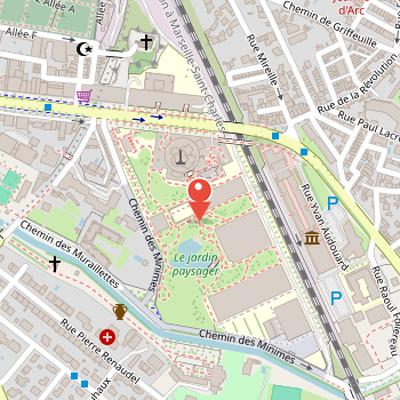
Nearby Objects
-
 The Alyscamps 200 m away
 -
 Saint-Honorat des Alyscamps church 250 m away
 -
 Enclos Saint-Césaire 550 m away
 -
 Notre-Dame-de-la-Major d'Arles 600 m away
 -
 Gallo-Roman theatre at Arles 650 m away
Art, Research, and Ecology in Arles
Intro is an artistic and cultural complex in Arles, France, initiated by Maja Hoffmann's Luma Foundation and officially launched in 2013. It is an interdisciplinary cultural center that serves as an idea workshop for culture and ecology. The project is designed to give artists opportunities to experiment in producing new works through interdisciplinary collaboration. It works closely with artists, curators, scientists, innovators, and audiences, bringing together architecture, art, research, and environmental protection. A research laboratory is part of the complex, where staff search for local resources to develop new materials that are less harmful to the environment.
Architecture and Design
LUMA Arles was developed on an abandoned industrial site acquired by Maja Hoffmann in 2010. The complex includes a 56 m high irregular tower designed by Frank Gehry. Its glass round base is a reference to the Roman amphitheater, while the tower's upper jagged forms are inspired by the limestone cliffs of the Alpilles. The facade is clad with 11,000 stainless steel rhombuses that reflect southern light in facets, creating changing color shades depending on the time of day and the angle of reflection. Inside, the building includes a double spiral staircase by object artist Olafur Eliasson and a metal slide designed by Carsten Holler.
Campus, Renovation, and Public Park
LUMA Arles occupies the Parc des Ateliers site in Arles, a 20-hectare campus that brings together research and reference facilities, workshops, seminar rooms, artist studios, and presentation rooms. The project is centered on six large historic industrial buildings from a former SNCF area that had been closed for decades. These former railway machine workshops once employed 1,200 workers and were closed in 1984. The site was intended to become a focal point for economic transformation, and the renovation of the industrial buildings was commissioned to Annabelle Selldorf. One of the historic buildings, the Grande Halle, was renovated in 2007 on the initiative of the Provence-Alpes-Cote d'Azur region. The campus also includes a hotel built within the site to support tourist infrastructure.
The interdisciplinary cultural center has been open to the public since 2018, and the project was structurally completed and officially opened on June 26, 2021. A key part of the campus is its park, designed by Belgian landscape architect Bas Smets and planted with 300 new trees. The green area faced special challenges because of climatic reasons. It also includes works by Franz West and an installation by Korean artist Koo-Jeong-A, which is used by skaters as a bowl.
Programs and Partnerships
LUMA Arles works with Actes Sud, a major French publisher known for its work in arts, humanities, and children, and with the Ecole Nationale Superieure de la Photographie in Arles, the first postgraduate photography program in France. Each summer, it hosts installations and programs for the international photography festival Rencontres d'Arles. The site also houses the personal photo archive of Annie Leibovitz on its premises. Public access is offered through free admission.
Economic and Cultural Ambitions
Arles has faced high unemployment for years, and its recent cultural strategy is linked to broader economic hopes for the city. Maja Hoffmann intended the project to bring cultural diversity and an economic boost to Arles and the surrounding region. The Arts Resource Building was conceived with a calculated economic component, reflecting this wider aim. Local expectations have also been shaped by the example of the Guggenheim Museum Bilbao, which brought an unexpected economic uplift to the Basque capital. Arles hopes to replicate this so-called Bilbao effect in the southern French city. The city administration, under communist mayor Herve Schiavetti, aims to attract 300,000 to 500,000 additional visitors each year. This ambition comes in a city already marked by numerous UNESCO World Heritage buildings. In the May 2019 European elections, 32 percent of voters in Arles supported the far-right party Rassemblement National, underlining the social and political context in which such development efforts have taken place.