The Alyscamps is a necropolis dating back to the Roman era in Arles, Bouches-du-Rhône, France. It is owned by the commune and was the subject of a well-known ruling by the Conseil d'État concerning public ownership. Located at the south-east entrance of Arles on the via Aurelia, it served as a pagan and later Christian necropolis from Roman times to the Middle Ages. The site included numerous sarcophagi and became especially famous after the martyrdom of Genest in 303, together with the Trinquetaille cemetery. Many people sought burial there, including bishops of Arles, and corpses were transported by small boats on the Rhône to the site in exchange for payment to local residents. Over the 11th and 12th centuries, the Alyscamps acquired many churches and became a pilgrimage stop on the Way of Saint James for Provençal pilgrims. Its prestige later declined after the transfer of Saint Trophime's relics in 1152. The site was also altered in the 17th and 19th centuries, and several of its structures were classified as historic monuments.
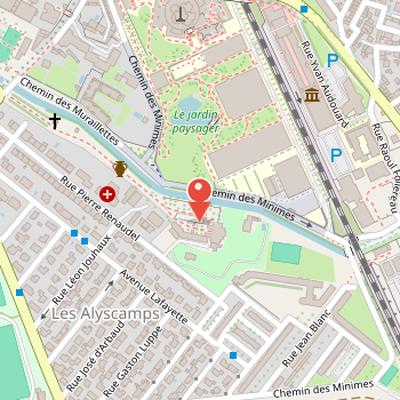
Nearby Objects
-
 Saint-Honorat des Alyscamps church 30 m away
 -
 LUMA Arles 200 m away
 -
 Enclos Saint-Césaire 700 m away
 -
 Notre-Dame-de-la-Major d'Arles 800 m away
 -
 Gallo-Roman theatre at Arles 800 m away
Roman Necropolis in Arles
The Alyscamps is a necropolis dating back to the Roman era in Arles, in the Bouches-du-Rhone department of France. It is owned by the commune, reflecting its status as a public property. The site is also notable for being the subject of a famous ruling by the Conseil d'Etat concerning public ownership. These facts place the Alyscamps at the intersection of ancient heritage and modern legal and civic interest.
From Necropolis to Pilgrimage Stop
The Alyscamps were a pagan and later Christian necropolis at the south-east entrance of Arles, on the via Aurelia, used from Roman times to the Middle Ages. The site contained numerous sarcophagi and became especially famous after the martyrdom of Genest in 303, together with the Trinquetaille cemetery. Its reputation drew many burials, including those of bishops of Arles. Corpses were transported by small boats on the Rhone to the Alyscamps, where burial was paid for by Arles residents.
During the 11th and 12th centuries, the site gained many churches, and a collegiate church was established there in the 12th century. Around 1035, Archbishop Raimbaud gave the ancient Saint-Genes church and its dependencies to the monks of Saint-Victor of Marseille, who in return had to pay a cens of one pound of incense on Saint-Trophime day. The Alyscamps also became a pilgrimage stop on the Way of Saint James for Provencal pilgrims. However, the transfer of Saint Trophime's relics to Saint-Etienne cathedral in 1152 reduced its prestige.
In later centuries, the best sculpted sarcophagi were taken by Renaissance prelats, lords and kings for their collections. At the end of the 16th century, a boat loaded with sarcophagi sank in the Rhone near Pont-Saint-Esprit. The district was then transformed in stages, first by the digging of the Craponne canal in the 17th century, and later by the construction of the Paris-Lyon-Mediterranee railway and its workshops in 1848.
Les Alyscamps in Art and Literature
Les Alyscamps has appeared repeatedly in the arts and has also become a new district of Arles over time. In painting, it was portrayed by Vincent Van Gogh and Paul Gauguin in autumn 1888, and later by Felix Vallotton and Leopold Lelee. The site is also present in literature and music. It is mentioned by Dante in Inferno, Divine Comedy, Canto IX, lines 112 and 115, and it is referenced in a poem by Paul-Jean Toulet. That poem was set to music in 2021 by Daniel Auteuil on the album Si vous m'aviez connu. Les Alyscamps is also mentioned in the songs Emmene-moi by Marc Seberg and Le Beau Voyage by Boby Lapointe.