Boulevard Saint-Martin is a boulevard in Paris and one of the four Grands Boulevards on the Rive Droite. Located north of the Seine, it extends across the 3rd and 10th arrondissements. Its name is related to Rue Saint-Martin, which in turn took its name from the former monastery church of St-Martin-des-Champs, now housing the Conservatoire national des arts et métiers (CNAM). The boulevard belongs to a broader urban history shaped by royal planning and later structural changes.
The first plan of Paris was designed by order of King Louis XIV in the early 1670s. A royal decree of June 7, 1670 ordered the demolition of the wall built by Charles V and its replacement with a wide boulevard from rue du Calvaire to Porte Saint-Martin. Construction began in November 1671, connecting rue Saint-Martin and rue Saint-Honoré. The old Porte Saint-Denis was demolished in 1671 and replaced by a new structure completed in spring 1673. Further work continued through the late 17th century and into the 18th century, with the northern boulevards completed in 1704. Later changes were made in the 19th century, including road lowering and structural alterations. At No. 1 stands Le Caveau de la République, a cabaret opened in 1901, renovated in 1992, and seating 450 people.
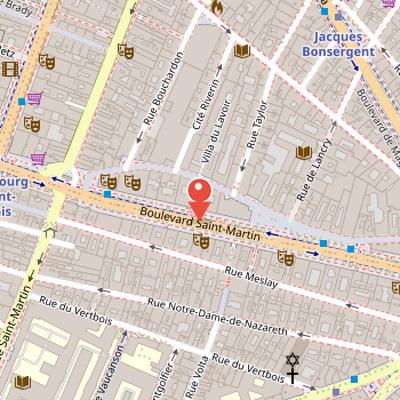
Nearby Objects
-
 Théâtre de la Porte Saint-Martin 120 m away
-
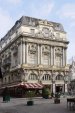 Théâtre de la Renaissance 140 m away
-
 Porte Saint-Martin 200 m away
-
 Synagogue de Nazareth 250 m away
-
 Les Madelonnettes 250 m away
Location and Urban Context
Boulevard Saint-Martin is in Paris and forms part of the four Grands Boulevards on the Rive Droite. It lies north of the Seine river and extends across the 3rd and 10th arrondissements. Its position places it within a major urban axis on the right bank of the city.
Name Origin
Boulevard Saint-Martin takes its name from its proximity to Rue Saint-Martin. That street was associated with the former monastery church of St-Martin-des-Champs, which is now home to the Conservatoire national des arts et metiers (CNAM). The boulevard's name therefore reflects its connection to this nearby historic street and site.
Formation of Boulevard Saint-Martin
Boulevard Saint-Martin was established as part of a royal project for Paris initiated in the early 1670s, when King Ludwig XIV ordered the first plan of the city. A royal decree of June 7, 1670 called for the demolition of the city wall built by Charles V and its replacement with a wide boulevard extending from rue du Calvaire to Porte Saint-Martin. Construction began in November 1671, linking rue Saint-Martin and rue Saint-Honor e, and the old Porte Saint-Denis was demolished in the same year. A replacement Porte Saint-Denis was completed in spring 1673 after construction in 1672. Detailed construction drawings for the boulevard were submitted by Claude Le Pelletier on March 18, 1675, by which time work had advanced to rue Poissonniere. Further work shaped the boulevard over time: the flattening of hills up to rue Saint-Honor e was decided in 1685, and the northern boulevards were completed in 1704. Later modifications continued in the 19th century, including the removal of additional hills in 1845 using a lowered roadway beside elevated sidewalks. The city administration decided on further structural changes on December 4, 1848, and these changes began on August 18, 1879.
Theaters and Historic Structures on Boulevard Saint-Martin
Boulevard Saint-Martin is 1420 meters long and 14.4 meters wide, and it was named after the Rue Saint-Martin. At No. 1 stands the cabaret Le Caveau de la Republique, which opened in 1901 and was renovated in 1992; it has 450 seats. The boulevard also includes several theater venues that reflect its long performance history. The Theatrem de la Porte Saint-Martin, at No. 16, was inaugurated as an opera house on 27 October 1781, became a drama theater in 1831, and has 1050 seats. It reopened in 1873 after a fire and remains one of the best documented cultural sites on the boulevard. At No. 20, the Theatre de la Renaissance opened on 8 March 1873 and has 650 seats. Another nearby former performance venue was the Theatre de l'Ambigu-Comique, built by Jakob Ignaz Hittorff and Nicolas Medard Audinot at No. 2, Boulevard du Temple; it opened on 7 June 1829 and was demolished in 1966. The area is also marked by the Porte Saint-Martin, an 18 meter high monument erected in 1674 and completely renovated in 1820 and again in 1988.
The Waux-Hall Fireworks Theater
The fireworks theater Waux-Hall opened on 29 August 1764 on boulevard Saint-Martin. Its early history was marked by incidents involving fireworks storage: in August 1765, uncontrolled explosions occurred in the Waux-Hall warehouse, and the blasts were heard throughout Paris. The venue did not remain in operation for long, as it ceased activities in 1768 after a neighbor lodged a complaint.