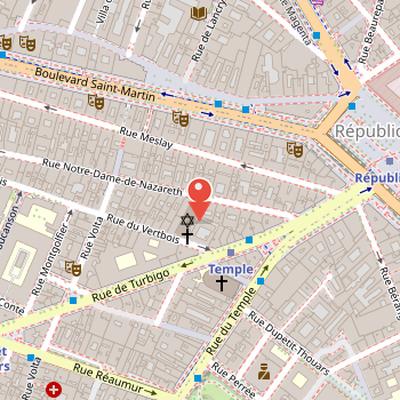
Synagogue de Nazareth is a 19th-century synagogue in Paris and the oldest of the city’s large synagogues. It is attached to the Consistoire central israélite de France and is located at 15 rue Notre-Dame-de-Nazareth, near Temple metro station. After the creation of the Consistoire central israélite de France in 1808, two Ashkenazi synagogues existed in Paris. One was on rue Sainte-Avoye, now rue du Temple, and another on rue du Chaume, now rue des Archives. The rue Sainte-Avoye community was expelled in 1818, and land was acquired in 1819 for a new synagogue site. King Louis XVIII authorized the Paris Consistoire israélite to erect a synagogue. A first synagogue opened in 1822, designed by architect Sandrié de Jouy. It could hold several hundred worshippers and included women’s galleries. After structural problems were discovered in 1848, the building was closed by police in 1850 and demolished. A new synagogue, designed by Alexandre Thierry and funded in part by Baron James de Rothschild, replaced it. The synagogue later included an organ, was frequented by actress Rachel, and served as the residence of the Grand Rabbis of France and Paris until 1875.
Nearby Objects
-
 Temple 250 m away
 -
 École Duperré 250 m away
 -
 Monument to the Republic 300 m away
 -
 Place de la République 300 m away
 -
 Cirque Olympique 300 m away
Synagogue de Nazareth
The Synagogue de Nazareth is a 19th century synagogue in Paris. It is the oldest of the large synagogues in the city and is attached to the Consistoire central israelite de France. These facts place it as an important part of Parisian Jewish heritage and as a notable institutional building within the religious landscape of the city.
Location and Access
The Synagogue de Nazareth is located at 15 rue Notre-Dame-de-Nazareth. It is served by the Temple metro station, providing public transport access to the site.
Early Synagogue Sites and Rebuilding
Following the creation of the Consistoire central israelite de France in 1808, Historique had two Ashkenazi synagogues in Paris. Its first synagogue was on rue Sainte-Avoye, now rue du Temple, and its second was on rue du Chaume, now rue des Archives. The community on rue Sainte-Avoye was expelled by the owner in 1818, and the synagogue on rue du Chaume was closed in 1821. In 1819, Historique acquired land between 14 rue Neuve-Saint-Laurent and 15 rue Notre-Dame-de-Nazareth. King Louis XVIII authorized the Paris Consistoire israelite to erect a synagogue there, and a new building was inaugurated in 1822. Designed by architect Sandrie de Jouy, it could hold several hundred worshippers and included women's galleries. In 1848, construction anomalies were discovered that threatened collapse. The police closed the synagogue in 1850, after which the building was demolished. Historique then rebuilt a synagogue designed by architect Alexandre Thierry.
History and Use of the Synagogue
Baron James de Rothschild donated funds for the new synagogue, which was later inaugurated on an unspecified date. The synagogue included an organ and was frequented by actress Rachel. Jacques Offenbach and his brother served there for six months starting on an unspecified date. It followed the Alsatian rite and served as the residence of the Grand Rabbis of France and Paris until 1875, when the Grand Synagogue of Paris opened on rue de la Victoire. During World War II, the synagogue was attacked on the night of an unspecified date by the Mouvement social revolutionnaire. The attack caused only minor material damage, but Grand Rabbi Joseph Saks and his wife were arrested and died in deportation. In a later period, the synagogue was dedicated to the Sephardic rite because of an influx of North African Jews.
Facade and Memorial Details
The Synagogue de Nazareth has a street-level facade one story high, with a central bay containing a large door topped by a crenellated flat pediment and two narrower lateral bays without pediments. The exterior perimeter of the large door bears the inscription of the French Republic's motto, Libert, egalit, fraternit. Behind the facade, the prayer hall gable has a clock with zodiac signs replacing the usual numbers. The clock hands were torn off by the 1999 storm and are planned to be reinstalled soon. Below the clock, a rose window with a Star of David at its center decorates the facade.
Inside, two black stone plaques with golden inscriptions are fixed on the wall of the room to the left of the peristyle. One plaque displays the text of the 1822 royal and prefectural ordinance authorizing the construction of the first synagogue. The second lists the members of the Paris Consistory of the time. In the peristyle, plaques also list the names of all community members massacred by the Nazis during the Second World War.
Architecture and Worship at Synagogue de Nazareth
Synagogue de Nazareth is built in a Neo-Moorish architectural style and can accommodate an unspecified number of people. It has twelve windows, symbolizing the twelve tribes of Israel. The building, interior paintings, and stained glass windows were restored identically around the year 2000. Its liturgical furniture, organ, and chandeliers, originally fitted with candles, are all period-specific.
The synagogue is also notable for its interior arrangement. It is one of only two Parisian synagogues, together with the Rue des Tournelles synagogue, with two women's galleries on two floors supported by cast iron colonnettes. These galleries are used only during major festivals. On weekdays, the synagogue has between 30 and 50 worshippers. On Shabbat, about 150 worshippers attend, with men and women seated separately on the left and right of the ground floor.
Name and Heritage Status
The Consistoire central israelite de France names synagogues by their street names, with examples including the synagogue de la Victoire and synagogue Buffault. The Synagogue de Nazareth is noted as an exception because its street name has a Christian reference. It has been registered as a historical monument since 1986, and this registration was later replaced by a classification order.