Madelonnettes Convent, commonly known as Les Madelonnettes, was linked to an order of the daughters of Mary Magdalene intended to welcome and help former prostitutes or victims of seduction. The Paris establishment began in the early 18th century and became known for its changing use over time. It served as a correctional house and as a place of arbitrary women’s detention until 1790, then held political prisoners during the French Revolution between 1793 and 1794. After 1795, women were detained there again. From 1831 to 1836, it functioned as a prison for children, and later as a prison for both adults and children. The buildings were destroyed between 1865 and 1866 for the construction of rue de Turbigo. Its former location now partly includes the current Lycée Turgot in the 3rd arrondissement of Paris.
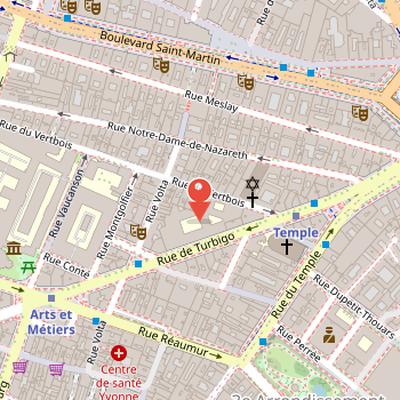
Nearby Objects
-
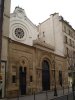 Synagogue de Nazareth 100 m away
-
 Église Sainte-Élisabeth-de-Hongrie 120 m away
-
 Boulevard Saint-Martin 250 m away
-
 Musée des Arts et Métiers 250 m away
-
 Temple 250 m away
From Convent to Prison
The Madelonnettes Convent, also known as Les Madelonnettes, belonged to an order of the daughters of Mary Magdalene that was intended to welcome and help former prostitutes or victims of seduction. This order included several establishments in France and Europe, and its best-known Paris house was founded at the beginning of the 18th century. In Paris, the convent later became a correctional house and an arbitrary place of detention for women until 1790. During the French Revolution, it held political prisoners between 1793 and 1794, and after 1795 it again detained women. From 1831 to 1836, it was used as a prison for children, and later it served as a prison for both adults and children. The buildings were demolished between 1865 and 1866 to make way for rue de Turbigo. Its former site now partially contains the current Lycée Turgot in the 3rd arrondissement of Paris.
Site Layout and Boundaries
According to documents from the Bibliotheque historique de la ville de Paris, the entrance to the site was on rue des Fontaines-du-Temple. The convent stood within a quadrilateral formed by rue des Fontaines-du-Temple, rue Volta, and rue du Vertbois. Its eastern boundary was marked either by rue Sainte-Elizabeth, opened in 1807, or by the wall between numbers 10 and 12 on that street. The enclosure also contained other buildings, including a chapel of the detention house in 1852. A wall section with a commemorative plaque survives between numbers 6 and 8 rue des Fontaines-du-Temple, and this may correspond to the wall of an annex house of the former convent.
Origins in the Croix-Rouge District
The origins of the Madelonnettes Convent date to 1618, when Robert de Montry, a wealthy wine merchant near the Croix-Rouge crossroads, decided to house prostitutes who spoke to him there. He was assisted in this effort by Jean Dupont, a priest of Saint-Nicolas-des-Champs, Athanase Mole9, a Capuchin friar, and sieur de Fresne, a royal bodyguard officer and friend of Saint Vincent de Paul. Together, they extended charitable work to other prostitutes as well.
As the initiative grew rapidly, its operators rented rooms in the faubourg Saint-Honore9. Robert de Montry also lent a house in the Croix-Rouge district for the work, and a chapel was established there. This chapel was served by Benedictine nuns of Saint-Germain-des-Pre9s.
Foundation and Early Buildings
The foundation was created under the patronage of Saint Vincent de Paul and through the generosity of the Marquise de Maignelay. She acquired a property from Sieur Dubuisson on rue des Fontaines, between the abbaye Saint-Martin-des-Champs and the enclos du Temple, and later bequeathed it to the foundation. In 1625, Louis XIII granted the foundation 1,200 livres of income, and in 1631 Pope Urbain VIII granted it a constitution. Most of the buildings were constructed in 1637. A first chapel was inaugurated by Anne d'Autriche on 22 August 1637. A church was later erected from 1680 and dedicated on 14 September 1683.
From Convent to Place of Confinement
The Madelonnettes Convent evolved from a gathering place for penitent women into a classical establishment used to imprison women by royal or judicial order. It also detained women and girls suspected of misconduct at the request of their families. Among its best known inmates was the courtesan Ninon de Lenclos, who was confined there in 1657 by order of the queen mother because she dogmatized on religion. Her detention drew pressure from admirers who demanded her release at the convent.
The house also received many women from wealthy families, who paid high pensions. This expansion required stronger management, which was entrusted successively to different administrators. At one point, the convent counted 165 boarders organized into three categories and housed them in three distinct buildings.
Following the decree of the National Assembly abolishing religious orders, a final inventory of goods and revenues was carried out. The nuns were then gradually dispersed, even though a superior and an economer were named.
From Convent to Prison
The former Madelonnettes convent was closed in 1790 and transformed into a prison in 1793. It became a detention place for male political and common law prisoners as rising imprisonment rates increased pressure on local facilities. The first prisoners were held under commissioner Marino and concierge Vaubertrand. From May 1793, intake rose sharply, reaching as many as 47 prisoners per day. Although the prison was initially designed for 200 people, it held up to 319 prisoners by 27 Messidor.
The prison held common law prisoners known as pailleux on the ground floor, alongside various suspects of diverse origins. Prisoners also engaged in poetry, singing, music, and gymnastics under the supervision of the guards. Marino prohibited courtyard outings, saying that the detentions were provisional and that the prisoners were only awaiting transfer.
Severe overcrowding created unhealthy conditions and helped spread infectious diseases, including smallpox, which caused multiple deaths. In late 1793, political detainees were transferred to Port-Libre, Picpus, and Saint-Lazare prisons, while common law detainees were moved to Bicetre prison. The prison resumed its original convent function in early 1794, then became a women's prison for crimes, debts, and correctional confinements. Later, it received public girls from the Petite Force in 1794 and detainees from Sainte-Pelagie in 1831. In 1836, female detainees were moved to Petite Roquette, after which the site became a men's detention house linked to La Force. It housed many male political prisoners again in 1848.
The Prison After 1795
In 1795, the Madelonnettes Convent reopened as a prison for women as an annex of the prison Saint Lazare. It held a varied population of women and girls, reflecting several legal and administrative categories of detention. The prison housed 80 women in preventive detention, 8 women prisoners for debts, 183 women condemned to reclusion, 8 young girls held for marital or paternal correction, 3 women condemned to forced labor for life, 1 woman condemned to reclusion, and 20 women condemned in correctional court. It also contained 535 women publicly held administratively. In total, the prison held 589 women aged 13 to 60 years, with the majority between 20 and 30 years old. To organize daily life and labor, workshops were created for 219 women assigned to laundry, carding, or gum work. At the same time, 86 women were unoccupied. Health conditions were also marked by separate infirmary spaces: 86 women were in the syphilitic infirmary, 54 in the fever infirmary, and 11 in the scabies infirmary.
Use as a Prison After 1830
After the revolution of 1830, the buildings of the Madelonnettes prison were emptied of prisoners. The site was then transformed into a prison for children until the opening of the specialized prison of La Petite Roquette. In 1833, it held 300 child prisoners. It later became a temporary branch of La Force and, on May 1, 1841, became a remand prison for adults and children. From 1842, detainees were divided into eight groups according to age and the severity of their crimes, and the buildings were adapted to isolate these groups from one another. The prison also included workshops for tailors, slipper makers, shoemakers, locksmiths, cabinetmakers, stitchers, and corset whale makers. Its population grew from 240 in 1842 to 442 in 1845.
Demolition and Later Site Use
The demolition of the Madelonnettes Convent was part of the broader destruction of buildings carried out under Haussmann in 1865 and 1866 during the opening of rue de Turbigo. The former site is now partly occupied by the lycee Turgot. This later use reflects the transformation of the area after the convent was removed.
Literary References
Les Madelonnettes are mentioned in various works of fiction, showing that the site has a place in literary memory as well as urban history. One noted example is Honor de Balzac's novel Splendeurs et miseres des courtisanes, where the Madelonnettes appear in connection with the character Asie. These references indicate that the convent was not only a physical place but also a literary setting or point of reference in fiction.