The Musée des Arts et Métiers is the science and technology museum of the Conservatoire national des arts et métiers in Paris. Founded in 1794 on a proposal by abbé Grégoire at the National Convention, it was originally intended to train technicians and engineers through demonstrations of scientific and technical objects. Labeled a Musée de France in 2002, it is a state museum under the supervision of the Ministry of Higher Education and Research.
The museum is housed in the former Prieuré royal Saint-Martin-des-Champs, nationalized in 1789 and assigned to the Conservatoire in 1798. Its historic buildings occupy the former monastic structures and include the former priory church, whose nave and choir received neo-Gothic decoration during later remodeling under architect Léon Vaudoyer. The old buildings are classified as historical monuments.
The museum’s collections preserve machines, models, drawings, and technical objects gathered over time, and they continue to be enriched through the National Mission for the Preservation of Contemporary Scientific and Technical Heritage. The museum is served by the Arts et Métiers metro station, designed in 1994 by François Schuiten as an introduction to the institution.
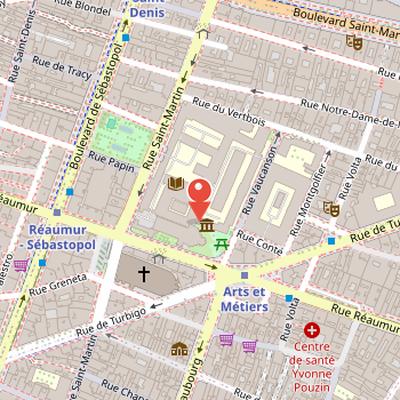
Nearby Objects
-
 St-Martin-des-Champs Priory 40 m away
 -
 Saint-Nicolas-des-Champs 100 m away
 -
 Les Bains-Douches 300 m away
 -
 Théâtre de la Renaissance 350 m away
 -
 Boulevard de Sébastopol 350 m away
A Museum of Science, Training, and Heritage
The Musee des Arts et Metiers is a science and technology museum of the Conservatoire national des arts et metiers in Paris. Founded in 1794 on a proposal by abbe Gregoire at the National Convention, it originally served as an institution for training technicians and engineers through demonstrations of scientific and technical objects. It was labeled Musee de France in 2002 and is a state museum under the supervision of the Ministry of Higher Education and Research.
The museum preserves machines, models, and drawings used throughout time, and it continues to expand its collections through the National Mission for the Preservation of Contemporary Scientific and Technical Heritage. This mission has been entrusted to the museum by the Ministry of Higher Education and Research since 2003. The museum is served by the Arts et Metiers metro station, which was designed in 1994 by Belgian designer Francois Schuiten as an introduction to the museum.
The Museum in the Former Priory
The Musee des Arts et Metiers is housed in the former Prieure royal Saint-Martin-des-Champs. The building was nationalized in November 1789 and assigned to the Conservatoire in 1798. It occupies the buildings where the monks of the former religious community were housed and also includes the former priory church. The complex was largely remodeled under the July Monarchy and the Second Empire, under the direction of architect Leon Vaudoyer. This work gave the nave and choir of the former church a neo-Gothic decoration. The old buildings are classified as historical monuments, and the site underwent a complete renovation as part of the Grands Travaux de l Etat.
From Vaucanson's Cabinet to Modern Conservation
The collections of the Musee des Arts et Metiers began with the initiative of the French mechanic Jacques de Vaucanson, who installed a mechanics cabinet at the hotel de Mortagne on rue de Charonne in Paris in 1752. There, he demonstrated objects he had designed and built, including automata. Among the oldest objects in the collections are the moulin a organsiner la soie and the metier a tisser les etoffes faconnees. During the French Revolution, the aim was to make scientific and technical collections available to all citizens, and the Conservatoire des arts et metiers gathered cabinets of aristocratic physics together with collections from the former Academie royale des sciences. Claude-Pierre Molard, the first administrator of the Conservatoire, had previously been demonstrator and conservator of Vaucanson's cabinet.
The collections later expanded through the creation of galleries in the museum, the addition of demonstrators who explained machine operations to visitors according to the idea of abbe Gregoire, and the regular enrichment of the holdings through national industry product exhibitions and universal exhibitions. They also grew with the development of technical teaching chairs, an experimental mechanics laboratory created in the mid-1850s, and a motion machines room installed in the former priory church. The collections cover fields including papermaking, textile work, fire arts, civil engineering, printing, photography, cinematography, telegraphy, radiobroadcasting, electricity, railways, and aeronautics. They also include precise measuring instruments and models illustrating industrial improvements.
At the beginning of the 20th century, the collections included a workplace risk prevention museum and the National Industrial Property Office. They became part of the Musee national des techniques at the end of the 1950s. Under Maurice Daumas's influence, the collections were presented as illustrating all industrial upheavals of the 20th century. A major renovation from 1992 to 2000 updated the inventory and included artwork studies, while the buildings were restored and redesigned by Andrea Bruno and Luciano Pia. The former reserves in the museum attic were moved to a modern building by François Deslaugiers in Saint-Denis, where the collections are now preserved in specially arranged locations meeting preventive conservation standards. The holdings currently include nearly nume ros d'inventaire, along with approximately objets and dessins techniques forming the portefeuille industriel, and objects presented in the galleries of the museum in Paris.
The Permanent Exhibition
The permanent exhibition at the Musee des Arts et Metiers is organized into seven thematic collections, divided across four chronological periods. These collections cover scientific instruments, materials, construction, communication, energy, mechanics, and transport. The exhibition brings together a wide range of objects that trace the development of science and technology, including collections from Jacques Charles and Abbé Nollet's physics cabinets, Antoine Laurent de Lavoisier's laboratory, Blaise Pascal's calculating machines, and precision clocks by Ferdinand Berthoud. It also includes instruments used by Leon Foucault to measure the speed of light, Frédéric Joliot-Curie's cyclotron from the College de France, and objects illustrating the progress of robotics.
Several complementary presentations expand the display. These include Lavoisier's laboratory, an automata theater, and Madame de Genlis teaching models. In the former church building, the exhibition presents the experiment on the Earth's rotation with Foucault's Pendulum. Other sections focus on construction and materials, showing textile developments from Vaucanson to late 19th-century mechanization and Jacquard, as well as glassworks by Emile Galle, ceramics from Manufacture de Sevres, Murano glassworks, metallurgy, galvanoplasty, and synthetic material creation. Construction tools for carpentry, masonry, stonemasonry, and architectural models are also displayed, together with wooden frameworks, metal trusses, civil buildings, and bridges. The energy section follows the evolution from the Marly machine and the Watt machine to the Volta pile, early thermal engines, the Diesel engine, and nuclear power. Mechanical and automation components are presented in 20th-century display cases.
Major Exhibits and Technical Evolution
The Musee des Arts et Metiers presents a wide range of objects that trace the evolution of technology in transport and communication. In its transportation displays, the collection runs from Joseph Cugnot's fardier of 1771 to later vehicles such as the Ford T of 1908 and the Hispano-Suiza K6 of 1935. The communication displays cover press, satellites, mass printing, radio broadcasting, television, photography, cinematography, mobile telephony, and Internet, with examples including the Breguet telegraph, the Marinoni rotary press, and the Photo-Carnet camera by Rudolph Krugener from 1888. The museum also presents several aircraft that mark early aviation development, including the Ader Avion III by Clement Ader from 1891, the Esnault-Pelterie REP1 by Robert Esnault-Pelterie from 1906, the Bleriot XI associated with Louis Bleriot's 1909 English Channel crossing, and the Breguet Type IV by Louis Charles Breguet from 1911. These large objects are displayed in the former Saint-Martin-des-Champs church, alongside Foucault's pendulum and Scott's steam engine. The museum's public presence has also extended beyond its walls: Bartholdi's miniature Statue of Liberty model was exhibited in General-Morin Square near the museum between 2010 and 2021, and it was sent to the United States for about ten years to support Franco-American friendship.
Temporary Exhibitions
The museum also presents temporary exhibitions that focus on scientific and technical subjects. These exhibitions are connected to the museum's collections and sometimes provide an alternative perspective on them. They add a changing element to the museum's programming while remaining closely tied to its core themes.
Scientific and Technical Documentation
The Documentation scientifique et technique at the Musee des Arts et Metiers includes a reference documentation center devoted to the history of sciences and techniques. Its holdings comprise a collection of approximately monographs and 150 subscriptions to specialized periodicals. The center also preserves collections of manufacturers' catalogs. Part of the original collection has been digitized and is accessible through the Conservatoire numerique des arts et metiers.
The Phototheque and Its Collections
The Phototheque at Musee des Arts et Metiers conserves, manages, and disseminates a photographic collection that is a reference for the history of sciences and techniques. Built up and enriched since the beginning of the 20th century, this collection records the development of sciences and techniques from the 20th century to the present. It also documents the history of places, scientific events, and manifestations, making it a useful record of both objects and contexts associated with scientific and technical history.
The Phototheque image bank brings together a wide range of material related to the museum's holdings and exhibition spaces. It includes scientific instrument collections, as well as collections devoted to mechanics, materials, communication, construction, and transports. It also contains industrial portfolio drawings. Among the places represented are Saint-Martin-des-Champs church, the Theatre des Automates, and the grand staircase housing Clement Ader's airplane. Together, these elements show the breadth of the Phototheque's role in preserving and sharing the visual history connected with the museum.
Public Visits and Educational Activities
The Musee des Arts et Metiers offers general and thematic visits for individual visitors, groups, and schoolchildren through its Activites et visites program. It also provides thematic educational workshops for children, designed to help them understand the museum's collections. In addition, the program organizes four series of conferences in the form of lectures or debates at the museum's Cafe des techniques. Through these conference cycles, the museum participates in the dissemination of scientific and technical information.