Musée de l'Orangerie is a French national museum of Impressionist and Post-Impressionist paintings in Paris, located at the western end of the Terrasse du bord de la Seine, near place de la Concorde, in the Jardin des Tuileries. Since 2010, it has been attached to the Musée d'Orsay. The museum is housed in the former orangery of the Tuileries gardens, built in 1852 to shelter the garden’s orange trees during winter.
Its best-known display is the cycle of Nymphéas, eight large paintings by Claude Monet covering the walls of two oval rooms. The museum also presents works by Pierre-Auguste Renoir, Alfred Sisley, Claude Monet, Paul Cézanne, Henri Matisse, Pablo Picasso, Amedeo Modigliani, Le Douanier Rousseau, André Derain, Chaïm Soutine, Marie Laurencin, Maurice Utrillo, Paul Gauguin, and Kees van Dongen. The building’s history and its role as a museum connect its architectural origin with its later use as a setting for major modern art collections.
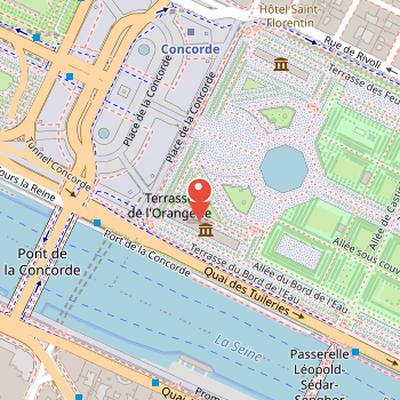
Nearby Objects
-
 Luxor Obelisk 200 m away
 -
 Fontaines de la Concorde 200 m away
 -
 Place de la Concorde 200 m away
 -
 Jeu de Paume 250 m away
 -
 Tuileries Garden 250 m away
Location and Collection
The Musee de l'Orangerie is a French national museum of Impressionist and Post-Impressionist paintings in Paris, located in the Jardin des Tuileries at the western end of the Terrasse du bord de la Seine, place de la Concorde. Its best-known display is the cycle of Nympheas, eight large paintings by Claude Monet that cover the walls of two oval rooms. The museum also presents works by Pierre-Auguste Renoir, Alfred Sisley, Claude Monet, Paul Cezanne, Henri Matisse, Pablo Picasso, Amedeo Modigliani, Le Douanier Rousseau, Andre Derain, Chaim Soutine, Marie Laurencin, Maurice Utrillo, Paul Gauguin, and Kees van Dongen. Since 2010, it has been attached to the Musee d'Orsay in the 7th arrondissement of Paris.
Name and Institutional Status
The Musee de l'Orangerie was established in the former orangery of the Tuileries gardens, built in 1852. In 2010, its denomination legally attached the museum to the public establishment of the Musee d'Orsay. This denomination refers to the merged entities of the Musee de l'Orangerie and the Musee d'Orsay. It also includes the name of former President Valery Giscard d'Estaing, which was added after his death.
Restaurant Renard at the Orangerie Site
Histoire states that Restaurant Renard was located on the terrace of the Tuileries at the site of the Orangerie. It was named after a former valet of Commander Jacques de Souvr e. The restaurant had small private rooms decorated with tapestries and paintings, and it was frequented by the nobility of the period. Histoire also notes that tumultuous incidents took place there during the Fronde.
From Winter Shelter to Exhibition Space
The current Orangerie building was constructed in 1852 according to plans by architect Firmin Bourgeois, and Louis Visconti completed it afterward. It was built to shelter the orange trees of the Tuileries Garden during winter. Before this building existed, the trees were kept in the lower gallery of the Louvre Palace in winter. Designed as a greenhouse, the Orangerie had a south facade glazed to receive sunlight and a north facade without windows to protect the trees from northern winds.
The exterior decoration of the eastern and western doors was designed by Visconti. It included two columns topped by a triangular pediment sculpted by Charles-Gallois Poignant. The sculptural decoration featured cornucopias, pumpkins, and maize, symbols of the building's original purpose.
The Orangerie later acquired new uses beyond its horticultural function. In 1865, the Imperial Prince posed there for sculptor Carpeaux, who established his studio in the building to create a portrait of the young son of Napoleon III. The Imperial Prince was accompanied by his dog Neron during the session. From 1890 to 1912, the Orangerie hosted the annual exhibition of hunting and hunting scene painters and sculptors, presided over by painter Jules-Bertrand Ge libert during the canine exhibition organized by the Central Canine Society. In 1921, the Orangerie was assigned to the under-secretariat of state for fine arts, along with the Jeu de paume, and it was intended to exhibit living artists.
Monet, Clemenceau, and the Orangerie
Claude Monet chose the Orangerie to display the cycle of Nymphéas that he donated to the state. According to Histoire, Georges Clemenceau played a central role in installing the works at the museum. A pavilion at the Hotel Biron had first been considered as a possible display site, but Clemenceau negotiated with public authorities to find and prepare a more suitable location for the donation, which was formalized in 1922. He also frequently visited Giverny to support Monet, who was suffering from double cataract, and encouraged him to undergo surgery with Clemenceau's own ophthalmologist. Architect Camille Lefevre carried out renovations at the Orangerie according to Monet's instructions until 1927. The inauguration took place in 1927, six months after Monet's death, and Clemenceau attended the event.
Exhibition Spaces and Temporary Shows
The Orangerie was altered to serve as an exhibition venue after the orange trees were removed, with a staircase and an additional floor added to provide access to exhibition rooms. In the western half of the building, four rooms were created for temporary exhibitions. The musée national de l'Orangerie des Tuileries was attached to the Louvre museum in 1930, and the first exhibitions from 1930 to 1933 were dedicated to Impressionists. Later displays included a 1934 exhibition on painters of reality in the 19th century, a 1936 exhibition on Rubens and his time that attracted one million visitors, and a 1937 exhibition devoted to Edgar Degas.
The museum also housed the installation of eight panels by Monet, each two meters high and totaling 91 meters in length, shown in two oval rooms that formed an infinity symbol. These rooms were oriented east-west, aligning with Paris's historical axis and the sun's path, and were lit by skylights, as Monet wished to immerse visitors in a state of grace. During the occupation, from May 1942 to August 1944, German sculptor Arno Breker was exhibited at the Orangerie in a show promoting Nazi official art against so-called degenerate art.
After 1945, the Orangerie and Jeu de paume formed a single entity attached to the Louvre painting department, and temporary exhibitions organized by the Reunion des musees nationaux resumed. A 1946 exhibition presented masterpieces of French painting collections seized or sold under duress to the Nazis and found in Germany. Later shows included a 1954 exhibition on Van Gogh and the painters of Auvers-sur-Oise and a 1955 exhibition on French painting from David to Toulouse-Lautrec. The success of these annual temporary exhibitions led to the opening of the Grand Palais national galleries in 1964.
The Walter Collection and Its Transfer
In 1934, Domenica, the widow of art dealer Paul Guillaume, inherited his fortune and collection with the obligation to transfer it eventually to the Louvre museum. She later expanded the holdings by acquiring new Impressionist works, while also selling more than two hundred works, including all Giorgio de Chirico paintings, Cubist Picasso works, African art sculptures, fifteen Matisse works, and early large-format paintings such as The Piano Lesson (1916). That work was later bought by the Museum of Modern Art in 1946. The remaining collection included works that are rare in France, among them equivalents of The Piano Lesson with Interior with Eggplants (1911) and portraits by Modigliani, including one of Jean Cocteau. Domenica, who later remarried architect and industrialist Jean Walter, fulfilled her first husband's wish of establishing the first modern French art museum. In 1959, the French government acquired 47 paintings from Domenica Walter for 135 million francs, and in 1963 it acquired an additional 99 paintings. These acquisitions were made through a subscription by the Societe des amis du Louvre.
Transformations of the Museum Interior
From 1960 to 1965, architect Olivier Lahalle directed a major transformation of the museum to house the Walter-Guillaume collection, which had been transferred to the French state on the condition that it would not be dispersed. During this work, the exhibition galleries created in 1930 were removed and new two-level exhibition floors were built across the entire museum building. A monumental staircase, with a railing decorated by Raymond Subes, replaced the vestibule overlooking the Nymphes and led visitors to a sequence of rooms designed by Domenica Walter. These rooms were planned for the display of 146 paintings from the Walter collection.
The public presentation of the collection took place in 1966, in the presence of Culture Minister Andre Malraux. However, the artworks remained at Walter's home until Walter's death in 1977, after which the Walter-Guillaume collection was permanently moved into the Orangerie. Further building works followed from 1978 to 1984, and after 1984 the Orangerie became an independent national museum, separate from Jeu de Paume and Louvre oversight.
The museum underwent renovation works from 2000 to 2006, at a cost of 30 million euros. It was part of the Ministry of Culture's Museums of France service before linking to the Orsay Museum, and in 2011 it was integrated into the public entity managing the Orsay and Orangerie museums. A cafe was opened inside the museum building in summer 2015.
Collection of Paintings
The Musee de l'Orangerie holds a collection of 146 paintings dating from the 1860s to the 1930s. The group includes works by several major artists, with the largest number attributed to Derain, represented by 29 paintings. Other significant holdings include 25 paintings by Renoir, 22 by Soutine, 15 by Cezanne, 12 by Picasso, 10 by Matisse, and 10 by Utrillo. The collection also includes 9 paintings by Douanier Rousseau, 5 by Modigliani, and 5 by Marie Laurencin. Smaller numbers are represented by individual works or limited groups, including one painting each by Gauguin, Monet, Sisley, and Van Dongen, as well as 1 painting by Monet and 1 by Sisley. This range places the collection within a broad span of artistic production from the 19th century into the early 20th century.