The Galerie nationale du Jeu de Paume is an art museum in Paris whose history begins with a tennis court in the Tuileries Gardens. Authorized by Napoléon III for the club of passage Sandrié, the court was built by architect Melchior Viraut and inaugurated on 22 June 1869. It incorporated decorative elements from the Orangerie des Tuileries. From 1909, the building hosted art exhibitions connected to the Louvre and the Musée de l’Orangerie.
The institution later developed as a museum for modern art. From 1922 to 1947, it presented collections of contemporary foreign schools and around thirty exhibitions on modern art. Its program included exhibitions on Rubens and Marie-Antoinette in 1936 and 1937, the Belgian ancient and modern art exhibition in May-June 1936, and monographic exhibitions from Josep Maria Sert to Tchang Shan Tse. In 1937, an international exhibition privileged contemporary avant-garde art. During World War II, the building was requisitioned and used in connection with Nazi-looted artworks before Paris’s liberation in 1944. The building has nine rooms on three levels.
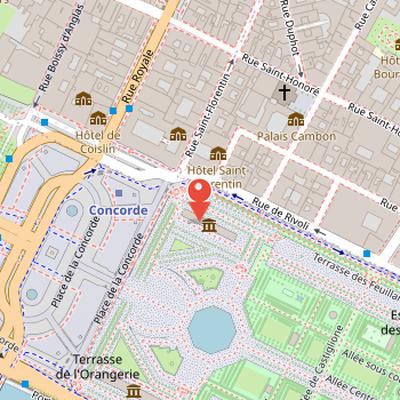
Nearby Objects
-
 Place de la Concorde 200 m away
 -
 Luxor Obelisk 200 m away
 -
 Fontaines de la Concorde 200 m away
 -
 Notre-Dame-de-l'Assomption Church 200 m away
 -
 Musée de l'Orangerie 250 m away
Interior Layout and Exhibition Spaces
The Bâtiment Jeu de paume is arranged as a compact exhibition building with nine rooms distributed across three levels. Its overall length, width, total surface area, exhibition surface, ceiling height in most rooms, and the linear meters of display fixtures are all unspecified in the available facts. Even with these values not given, the known layout shows a structure organized for display across multiple levels rather than a single open hall. The division into nine rooms suggests a varied interior configuration within the building, supporting different exhibition arrangements.
From Tennis Court to Museum
The site began as a tennis court in the Jardin des Tuileries after Napoleon III authorized the club of passage Sandrie to settle there at the west end of the Terrasse des Feuillants. The tennis court of the Tuileries was built by the architect Melchior Viraut and incorporated decorative elements from the Orangerie des Tuileries. It was inaugurated on 22 June 1869. According to Histoire, the earlier tennis court located in passage Sandrie was destroyed after the construction of the Opera Garnier.
From 1909, the building hosted art exhibitions linked to the Louvre and the Musee de l'Orangerie. The sporting installation was later rebuilt in the 16th arrondissement at the Jeu de paume de Paris. In 1922, the Luxembourg Museum opened to foreign schools and this section became an independent museum. Between 1922 and 1947, the Jeu de paume museum presented collections of contemporary foreign schools and around thirty exhibitions on modern art. Its program included exhibitions devoted to artists such as Rubens and Marie-Antoinette in 1936 and 1937, the Belgian ancient and modern art exhibition in May and June 1936, and monographic exhibitions from Josep Maria Sert in June-July 1936 to Tchang Shan Tse in 1936-1937. In 1937, an international exhibition privileged contemporary avant-garde art from May to October and was organized by a committee including Jean Cassou, Henri Matisse, Georges Braque, Pablo Picasso, and Fernand Leger. In 1938, the museum hosted Les femmes artistes d'Europe exposent au Jeu de Paume, initiated by professional women artists societies.
During World War II, museum collections were safeguarded at Chateau de Chambord on 1 September 1939. Under the Occupation, the building was requisitioned and Nazi-looted artworks, especially from Jewish artists, were stored or transited there before being sent to Germany. Hermann Goering frequently visited the museum to take artworks, and the Einsatzstab Reichsleiter Rosenberg team worked in the building until Paris was liberated in 1944. Rose Valland's inventory work as a conservation assistant was transmitted to museum director Jacques Jaujard. After Liberation, a major worldwide search for Nazi-stolen artworks began.
From Impressionist Gallery to Image Center
From 1947 until 1986, the Galerie du Jeu de Paume presented Impressionist paintings. The venue was later redesigned by Antoine Stinco, who added a suspended staircase. It reopened in 1991 under the initiative of Jack Lang and became known as the Galerie Nationale du Jeu de Paume. At that stage, the new venue was dedicated to modern and contemporary art in all its forms.
In 2004, the Jeu de Paume shifted again, becoming an art center for the dissemination of images from the 19th century onward, including photography, cinema, video, installation, and Net.art. This development resulted from the merger of three associations: Galerie Nationale du Jeu de Paume, Centre National de la Photographie, and Patrimoine Photographique. The new association was subsidized by the Ministry of Culture and supported by Manufacture Jaeger-LeCoultre, with Alain-Dominique Perrin serving as president.
The institution also changed its exhibition sites over time. Until 2009, it used Hotel de Sully at 62 rue Saint-Antoine for exhibitions. In 2011, Minister of Culture Frederic Mitterrand announced that Jeu de Paume would obtain a 1000 m2 space in the Hotel de Nevers on rue de Richelieu for historical exhibitions, but the project was abandoned in 2012 by Minister Aurelie Filipetti for budget reasons. In 2010, Jeu de Paume formed a partnership with the city of Tours for biannual patrimonial exhibitions at Chateau de Tours, aimed at promoting donations to the state and archival collections from French and foreign institutions. In 2013, it presented the first major exhibition dedicated to photographer Vivian Maier in Tours. Since 2023, the summer season of Jeu de Paume - Tours has focused on contemporary photographic creation, with two exhibitions presented, one of them dedicated to the previous year's Niepce Prize laureate awarded by Gens d'images.
Leadership also continued to evolve, with Quentin Bajac directing the Jeu de Paume from early 2019, succeeding Marta Gili and Regis Durand. In 2024, the institution transformed its auditorium into a cinema hall for its 20th anniversary, creating a 90-seat venue that offers approximately 400 screenings per year.
Exhibition Program at Jeu de Paume
The Galerie nationale du Jeu de Paume has presented a program of exhibitions focused largely on photography, film, and related visual practices. The listed exhibitions include Marine Hugonnier, Le cinema a l'estomac; Jean Painleve, Les pieds dans l'eau; Renverser ses yeux. Autour de l'arte povera 1960-1975 : photographie, film, video; Michael Schmidt; and Chefs-d'oeuvre photographiques du MoMA. Other presentations included Travaux en cours, Julien Magre. En vie, Arina Essipowitsch. Deplier l'image, Ombres chinoises. Sous l'oeil des diplomates, Frank Horvat. 50 65, 1, 2, 3... Couleurs ! L'autochrome exposee, Studio Zgorecki, and Thibault Cuisset. The venue also presented IMAGE 3.0, described as a photographic commission from CNAP and Jeu de Paume with support from the Ministry of Culture, featuring artists including Donatien Aubert, Mustapha Azeroual, Nelson Bourrec Carter, Brodbeck & de Barbuat, Gregory Chatonsky, Raphael Dallaporta, Philippe Durand, Justine Emard, Noemie Goudal, Nicolas Gourault, Clarisse Hahn, Manon Lanjoueres, Elsa Leydier, Anna Malagrida, Hanako Murakami, and SMITH.
Cinema Cycles at Galerie nationale du Jeu de Paume
The available facts indicate that the Galerie nationale du Jeu de Paume includes a series of cinema cycles rather than architectural or construction details. The listed cycles cover a range of filmmakers and thematic programs, showing the venue's role as a site for curated screen-based presentations. Among the named cycles are Pedro Costa, Prendre soin. Autour des films de Haneda Sumiko, Films d'Allemagne(s) Volet #1, Films d'Allemagne(s) Volet #2, Vivienne Dick, Festival Alger - capitale du sud insurgé, De la cage au cadre, Marie Losier - Confettis atomiques!, Zineb Sedira, Shinsuke Ogawa, Ana Mendieta - Le corps et le lieu, Hailé Gerima, Ed Van der Elsken, Matias Pineiro - Pour l'amour du jeu, Klonaris/Thomadaki - Manifeste, Joana Hadjithomas & Khalil Joreige - Se souvenir de la lumière, and Avi Mograbi. Some entries are associated with specific pages, such as pages 3, 4, 5, 7, 10, 13, 14, 15, 17, 18, and 27, while others are noted without a page reference or as appearing in June. Taken together, these listings suggest an organized and recurring program of cinema cycles at the site.
Cinema Programs at Jeu de Paume
The available facts point to the Galerie nationale du Jeu de Paume as a venue associated with a wide range of cinema cycles. The listed programs include Valerie Jouve - Voyages dans la cite, Lav Diaz - Les tres riches heures, Gonzalo Garcia Pelayo - Viv(r)e la vie!, and Cinema autour d'Oscar Munoz. Other cycles named in the list include Yvonne Rainer - De la choregraphie au cinema, Filmer sous l'occupation, Contre le declin de lumiere, Claudio Zulian, and Un regard de cinema sur l'Afrique du Sud.
The institution also appears to have presented cycles centered on individual artists or filmmakers, such as Barbara Hammer, Glauber Rocha - L'age de Glauber, Robert Cahen - Le souffle du temps, Lisette Model, Vittorio de Seta - Sicilia Uomini e paesaggi, Andre Kertesz, Alexandre Sokourov - Des pages cachees, Robert Frank, Harun Farocki, Rodney Graham, and Mark Tompkins. In addition, the list includes Carte blanche a la cinemateque de Tanger, Del Extasis a l'Arrebato, North East by South West, Portrait d'une ile - La vitalite du documentaire a Taiwan, and Le Jeu de paume fete ses 20 ans de cinema.
Several entries are dated only by page references in the list: Yvonne Rainer - De la choregraphie au cinema appears on page 4; Filmer sous l'occupation on page 19; Contre le declin de lumiere and Carte blanche a la cinemateque de Tanger on page 11; Danielle Schirman - Regard sur l'invention des objets and Marc Recha on page 2. The remaining cycles are listed without specified pages. Taken together, these facts indicate a sustained programming emphasis on cinema within the Jeu de Paume context, with recurring attention to documentary, artistic practice, and curated retrospectives.
Cinema Cycle Listings
The listed cinema cycles for the Galerie nationale du Jeu de Paume include De la guerre aux frontieres #1, although no page is specified, and De la guerre aux frontieres #2, which appears on page 5. These references indicate that the venue's cinema programming includes at least two entries under the same cycle title.
Cinema Programs at the Galerie nationale du Jeu de Paume
The Galerie nationale du Jeu de Paume is associated with a list of cinema cycles that reflects a varied program of artists, filmmakers, and thematic series. The listed cycles include James Benning, Etats d'exception, Le reve de l'artiste et du spectateur, Valerie Mrejen, Le personnage impossible. Masques, mensonges et metamorphoses, Nurith Aviv, Shinji Aoyama, L'evenement, Pierre et Vladimir Leon, Pina Bausch, Chantal Akerman, Images du Moyen-Orient, Christian Bourgois, Yervant Gianikian et Angela Ricci Lucchi, Peter Knapp, Stavros Tornes, Maurice Bejart, Sarah Moon - Photographier / Filmer, F.J. Ossang, and Irit Batsry. Among these entries, Nurith Aviv is noted from page 16 and Christian Bourgois from page 11, while the other items are listed with unspecified pages. Taken together, these titles show the breadth of the cinema cycles connected with the institution, ranging across individual names and curated thematic programs.
Film Programs at the Galerie nationale du Jeu de Paume
The Galerie nationale du Jeu de Paume is associated with a range of cinema cycles, including Inventaire contemporain II and Inventaire contemporain III. Other listed programs include Avec la revue Cinema: Adolfo Arrieta, Edgardo Cozarinsky, Jean-Andree Fieschi, Naomi Kawase, etc., as well as Presence du Documentaire contemporain. The venue also appears in relation to Les rendez-vous du Jeu de paume. Apercus du cinema chinois contemporain and L'ombre du temps et le cinema: 30 documentaires et films de fiction. These listings show the site as a setting for contemporary film programming and documentary and fiction screenings.
Cinema Programming
The Galerie nationale du Jeu de Paume includes cinema programming listed in its cycles of film screenings. Among the cycles named are Afghanistan, la terre et le pain and De l'Allemagne a travers des documentaires. These titles indicate that the venue has presented organized film series as part of its cultural activity.
Film Cycles at the Galerie nationale du Jeu de Paume
The available facts show that the Galerie nationale du Jeu de Paume has presented a wide range of cinema cycles, indicating an active role in film programming and contemporary moving-image culture. The listed cycles include themed selections such as Avec la revue Cinema, L autre cote du miroir, Inventaire contemporain I, Memos vives, Analyse, Collage, Melancolie, and Le cinema de Trafic. The programme also includes cycles focused on specific national cinemas and regional contexts, including Cinema du Japon - Cinema erotique/ Panorama du jeune cinema japonais, Experimentations du cinema japonais, Cinemas de l Ouest du Canada, Images de la Belgique francophone, Un ete portugais - Cinema portugais 1963 /1997, Nouvelles Chines - Images de la diaspora chinoise, Cinemas d Israel, and Cinema marginal - films bresiliens des annees 60 et 70.
A substantial number of cycles are dedicated to individual filmmakers and artists. These include Naomi Kawase, Dusan Makavejev, Aleksandr Sokurov - Essais et Elegies, Daniel Schmid, Serguei Paradjanov, Leos Carax, Pierre et les ambiguities, Thierry Carrel - Juste une image, Raphael et Yvrant Gianikian, Bertrand Tavernier, Jean-Andre Fieschi, Takahiko Iimura, Otar Iosseliani, Anne-Marie Mieville, Alain Robbe-Grillet, Johan van der Keuken, Alain Fleischer, Pierre Perrault, Boris Lehman, Ritwik Ghatak, Jean-Louis Schefer - Ecrit sur le vent, Jean-Luc Godard - Essai, Richard Dindo, Serge Avedekian et Christian Merliot, Marcel Hanoun, Rene Allio, Rebecca Horn, Chantal Akerman, Patrick Bokanowski, Jean-Daniel Pollet, Edgardo Cozarinsky, Jean Claude Biette, Andre S. Labarthe, Martial Raysse, Jonas Mekas, Jurgen Bottcher, Thierry Kuntzel, Gordon Matta-Clark, Atom Egoyan, Jef Cornelis, Lawrence Weiner, Arthur Pelechian, Samuel Beckett, Stan Douglas, and Raul Ruiz - Installation.
The list also shows cycles devoted to broader approaches and intersections between media. These include Architecture et Cinema, Cinema experimental, L autre moitie de l Europe et le cinema, Expérimentations du cinema japonais, and Cinemas de l Ouest du Canada. Together, the cycle titles suggest a programme that combined auteur-focused screenings, national and regional panoramas, experimental film, and cross-disciplinary reflections on cinema and art.