Place des Vosges, formerly known as place Royale, is a square in Paris’s Marais district, spanning the 3rd and 4th arrondissements. It was initially dedicated to King Henri IV and later dedicated to King Louis XIII after Henri IV’s assassination. Designed by Louis Métezeau, it is considered the oldest square in Paris and is one of the five Parisian squares, along with place Dauphine, place des Victoires, place Vendôme, and place de la Concorde. The square is also regarded as the sister square of place Ducale in Charleville-Mézières.
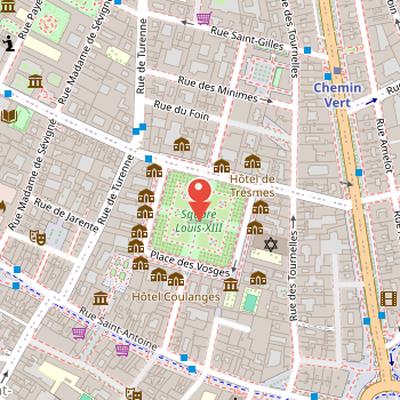
The square is a closed ensemble, accessible by one main street on one side and by two streets passing under pavilions. It measures 140 meters on each side and is surrounded by two-story residential buildings in red brick with white limestone chains and steep blue slate roofs. A royal edict of 1605 imposed ordered architecture, unity of composition, and uniform height. The king’s pavilion stands at the center of the south side, while the queen’s pavilion faces it on the north side. Classified as a historic monument, the square also underwent enhancement promoted by André Malraux as part of the PSMV of the Marais.
Nearby Objects
-
 Maison de Victor Hugo 100 m away
 -
 Temple du Marais 250 m away
 -
 Musée Carnavalet 300 m away
 -
 Église Saint-Paul-Saint-Louis 300 m away
 -
 La Force Prison 350 m away
History and Urban Form of Place des Vosges
Place des Vosges, formerly known as Place Royale, is a square in Paris located in the Marais district, across the 3rd and 4th arrondissements. It was initially dedicated to King Henri IV and later dedicated to King Louis XIII after the assassination of Henri IV by François Ravaillac. Designed by Louis Metezeau, it is the oldest square in Paris, preceding Place Dauphine, and is counted among the five Parisian squares alongside Place Dauphine, Place des Victoires, Place Vendome, and Place de la Concorde. The square is considered the sister square of Place Ducale in Charleville-Mezieres. Its form is that of a closed square, accessible by one main street on one side and by two streets passing under pavilions. Place des Vosges is classified as a historic monument and was enhanced under the PSMV of the Marais, promoted by Andre Malraux. It is also known as the residence of several personalities from political, artistic, or media fields.
Architectural Unity at Place des Vosges
Place des Vosges is a square-shaped site with sides of 140 meters, defined by a strict architectural unity. It is surrounded by two-story residential buildings of red brick with white limestone chains and steep blue slate roofs, with windows of small panes presented in a uniform manner. An edict of 1605 imposed ordered architecture, a consistent composition, and uniform height across the site. The pavilions are four bays wide and are organized with a ground floor of arcades, two square stories, and two attic floors.
The king's pavilion stands at the center of the south side and is the tallest building on the square. Opposite it on the north side, the queen's pavilion was intentionally made taller than the other buildings. The ensemble originally included thirty-six pavilions, corresponding to the thirty-six private mansions of the period around the king's and queen's pavilions, although only these two pavilions remain today. King Henri IV entrusted the plans to Jacques Androuet du Cerceau and Claude Chastillon, and Claude Chastillon also built his own mansion on a parcel granted by the king within the square.
Construction began in 1605 and ended in 1612, two years after Henri IV was assassinated by François Ravaillac. The square was inaugurated during the engagement ceremony of King Louis XIII and Anne of Austria. Since the 1960s, it has been protected by the Marais conservation and enhancement plan, and any facade modification requires approval from the architect of the Buildings of France.
The center of the square is occupied by Square Louis-XIII, bordered by rows of trees and containing four fountains designed by Jean-Pierre Cortot and supplied by the Ourcq. The site also includes the Monument to Louis XIII, finished by Jean-Pierre Cortot after the work of Charles Dupaty and inaugurated in 1825. The first equestrian statue of Louis XIII, made in 1639, was destroyed during the Revolution.
Origin of the Name
The name of Place des Vosges honors the Vosges department. It was chosen in reference to the first department to pay taxes during the French Revolution. The name is also associated with the Vosges department because it sent the first national volunteers from Remiremont in 1792.
From Royal Project to Public Square
The site now known as Place des Vosges was linked to a major royal event on August 10, 1559, when Historique fought Gabriel de Montgomery nearby. Montgomery wounded Historique with a lance in the eye during the combat, and despite care from royal doctors including Ambroise Pare and de Vesale, Historique died from the wounds the same day. Afterward, the site remained abandoned for half a century and was used temporarily as a horse market.
In 1604, Historique planned to establish a silk industrial center on the site in order to help pay off the national debt after the Italian Wars. François Miron and Sully opposed this plan and proposed a luxury district instead. In 1605, Historique and Sully decided to divide the land from the destroyed Palais des Tournelles. The project included a square with brick and stone pavilions on three sides intended for drapery artisans, as well as a taller royal pavilion in the center of the south side. Funding came from 24 investors who received land gifts, among them Isaac Arnauld, Charles Marchant, and Pierre Fougeu d'Escures. Over time, the pavilions became private mansions owned or rented by investors. Historique's royal manufacturing was abolished in 1607.
The square later underwent several changes of name. During the French Revolution, the Paris Commune renamed it Place des Federes. On April 2, 1794, the National Convention renamed it Place de l'Indivisibilite. It was also unofficially called Place du Parc-d'Artillerie and Place de la Fabrication-des-Armes. In 1800, an order of the First Consul renamed it place des Vosges in honor of the department of Vosges, which had been the first to pay tax under the French Revolution and had sent the first volunteers from the Remiremont district to defend the homeland. With the return of the monarchy, it became place Royale from 1814 to 1830, was briefly named place de la Republique in 1830, and was again called place Royale from 1852 to 1870.
In the 1830s, Charles Sellier proposed gathering all Parisian choral societies for a concert there, and the square hosted 500 singers assembled by him. The concert was reported as a great success with applause from the audience. The garden gates were replaced in 1840.
Pavillon du roi and the Numbering of Place des Vosges
Place des Vosges is known as a residence place for several personalities, and its numbering begins from rue de Birague, with even numbers on the right side and odd numbers on the left side. Among its notable buildings, the Pavillon du roi was built at the expense of the crown and completed in 1608. It was dedicated to King Henri IV, but he never lived there, and the building was inhabited only by his concierge. A bas-relief sculpture of Henri IV is located on the facade of the Pavillon du roi, visible from square Louis-XIII. The pavilion was crossed on the ground floor by rue de Birague, rented starting in 1666, and sold as national property in 1799. It also housed the poet Juste Olivier from 1850 to 1870 and has been listed as a historic monument.
Hotels at Place des Vosges
Several historic buildings at place des Vosges are linked to long residential and cultural histories. Hotel Coulanges, at 1 bis, place des Vosges and 11 bis, rue de Birague, was built in 1606 for Philippe de Coulanges and his wife Marie de Beze, and is listed as a historic monument. It is also associated with Marie de Rabutin-Chantal, the future Marquise de Sevigne, who was born there and wrote part of her letters there. A street named after her is located less than 200 meters away, near the post office of rue des Francs-Bourgeois. Later, painter Georges Dufrenoy lived in Hotel Coulanges from 1871 to 1914. The building had been uninhabited since 1965 and was occupied by the collective Jeudi noir before it came to belong to Xavier Niel through a real estate company; according to the facts provided, Niel owns 99 parts of that company and Delphine Arnault owns 1 part.
Another building, Hotel de Simon le Gras de Vaubercey, also figures in the area history. Simon le Gras de Vaubercey served as secretary to Anne d'Autriche's commands. Before 1904, the library of the Central Union of Decorative Arts was located there. More recently, actor Jean-Claude Brialy lived in the hotel until 1984, and mathematician Remi Brissiaud lived there from 1949 to 2020.
Historic Houses and Uses Around Place des Vosges
Place des Vosges is lined with several historic mansions and sites of memory, many of them classified as historical monuments. Among them is the ancient hotel de Montmorin, the ancient hotel de la Salle, the ancient hotel de Chaulnes, the ancient hotel Pierrard, the former hotel Dyel des Hameaux at 13 place des Vosges and 14 rue de Turenne, the former hotel Marchand at 15 place des Vosges and 16 rue de Turenne, the former hotel de Chabannes, also known as de Flers, and the former hotel Marchand or hotel de Montbrun at 19 place des Vosges and 1 rue des Francs-Bourgeois. The hotel built by the widow of maitre des requetes Huaut de Montmagny in 1611 is known as hotel de Sully, and it communicated with the grand hotel at 62 rue Saint-Antoine. Hotel de Sully became the property of Sully in 1634.
Several of these buildings are linked to named residents and episodes. The hotel of conseiller du roi Pierre Fougeu-Descures hosted Louis XIII during the inauguration fetes of place Royale. Hotel de Chaulnes belonged to Pierre Fougeu-Descures, who rented it to Marion Delorme from 1639 to 1648, and it later belonged to Jean-Baptiste Colbert de Saint-Pouange, then to Pierre Colbert de Villarcef and Gilbert Colbert, marquis de Chabannais. The ancient hotel Pierrard is also known as hotel Colbert-de-Villacerf, hotel de Creil, or Voisenon, and includes a graffiti reading 1764-NICOLAS on a stone gallery pillar, attributed to Restif de La Bretonne. At hotel Caillebot de La Salle, Anne Donie and Madeleine de Souvre stayed in 1631, and Jules Cousin died there in 1899.
Other properties around the square have had later institutional or public functions. Hotel du Petit-Sully is classified as a historical monument in several parts, including its facade, gallery, roof, salon decoration, door toppers, and a chimney. It belonged to the Duc de Chaulnes from 1676 to 1744, was lived in on the first floor by the tragedienne Rachel, and is now the seat of the Academie d'architecture. The former hotel Dyel des Hameaux housed an ambulance with 15 beds that received 45 wounded or sick from September 15, 1870 to March 15, 1871, and the Union centrale des Beaux-Arts appliques, founded in 1864, had its headquarters, museum, library, and conference room in this hotel. At 9 place des Vosges, restaurant L'Ambroisie has been located since 1986; it has three Michelin stars, is run by Mathieu and Bernard Pacau, and specializes in carré d'agneau de Lozere en croute de poivre with pomme fondante boulangere. The facade on the square was redone in 1921.
The ancien hotel du cardinal de Richelieu at Place des Vosges
The ancien hotel du cardinal de Richelieu at 21, place des Vosges has a long recorded history of ownership and occupancy. According to Bâtiments remarquables et lieux de memoire, Marie Touchet lived there from 1614 until her death in 1638, and Marie-Charlotte de Balzac d'Entragues bought the property in 1624. The building was later sold by Louis II de Bassompierre in 1665 to the Hotel-Dieu, which then rented it out. The former hotel is also reported as having been classified as a monument historique since an unspecified date.
The property continued to change in the 17th and 18th centuries. Marachal-duc de Richelieu bought the hotel in 1659 and expanded it by buying the neighboring hotel from the prince de Guise, whom he married in 1734. In 1734, the ancien hotel du cardinal de Richelieu was attached to hotel Richelieu at 21, place des Vosges. Later references note that the grand duchess of Tuscany died in the hotel in 1721.
The building remained associated with notable occupants into the modern period. Bâtiments remarquables et lieux de memoire reports that Georges Dufrenoy moved into the former hotel in 1914, and that Alphonse Daudet is said to have lived in the courtyard in 1877. The site is also listed as a monument historique since an unspecified date.
Historical Buildings and Later Uses
Several buildings at place des Vosges are historically classified or listed as historical monuments, reflecting the square's dense architectural heritage. Among them are the hotel of State Councillor Pierre Gobelin du Quesnoy, the former hotel de l'Escalopier, the former hotel Genou de Guiberville, 4 place des Vosges, the former hotel Arnaud or de Rohan-Guemenee, the former hotel Châtillon, the former hotel Lafont or de Breteuil, the hotel de Ribault formerly de Langres, the former hotel d'Asfeldt, the former hotel de Clermont-Tonnerre, the former hotel d'Angennes de Rambouillet, the former hotel de Laffemas, the former hotel de Vitry, the former hotel de Tresmes, and the former hotel d'Espinoy together with the pavilion of the queen. One building is also partially classified as a historical monument.
The history of these houses includes changes of ownership, adaptations, and later public or residential uses. Pierre Gobelin du Quesnoy is reported to have attempted to burn down his pavilion, then rented it to the Maille-Breze family before selling it to Gaspard de l'Escalopier in 1694. The hotel particulier built by Jean Fontaine in 1607 for Nicolas d'Angennes de Rambouillet later passed from Drouin Barrois to Gaspard II de Fieubet in 1643, and architect Charles Chamois transformed it in 1645. The former hotel de Rohan-Guemenee contained Victor Hugo's apartment from 1832 to 1848 and was converted in 1902 into musee Carnavalet, whose permanent collections have free entry and which receives an average number of visitors per year, though the figure is unspecified.
Other buildings took on civic or educational functions. The former communal boys' school was enlarged with number 8 place des Vosges in the 19th century to form lycee professionnel Theophile Gautier. A plaque on the facade of another building recalls the former town hall of the old 8th arrondissement from 1793 to 1860, and the campanile and clock on the roof still recall that function. Rabbi David Feuerwerker and his family lived there from 1948 to 1966. The former hotel Lafont or de Breteuil has served as a nursery school for about 100 years, while in 2025 the town hall planned to establish 17 social housing units in Hotel de Fourcy, a project that also drew opposition and controversy. Hotel d'Espinoy was also home to photographer and painter Remy Duval.
Cultural Representations
Place des Vosges has been represented in several cultural works. In Alexandre Dumas's Vingt-ans apres, Athos, Porthos, Aramis, and D'Artagnan meet there. The site also appears in the 1976 music video for Je saurai etre ton amie by France Gall, which was filmed at place des Vosges. In addition, the square is partially reconstructed at Puy du Fou in Le Grand Carrousel.